


Corning's US Shares Plunge 15% in Pre-Market Trading! Q2 Revenue and Profit Both Beat Expectations, but Q3 Revenue Guidance Lacks "Surprise" | Earnings Insight
Corning's Q2 revenue rose 17% and profit increased 30%, with optical communications revenue up 32% year-over-year. However, Q3 core sales guidance of $4.9–5.0 billion has an upper bound that merely meets expectations, implying a sharp drop in sequential growth from 9% to 3–6%
The AI bull market has reached a critical juncture—a lackluster earnings report is enough to trigger a violent market reaction.
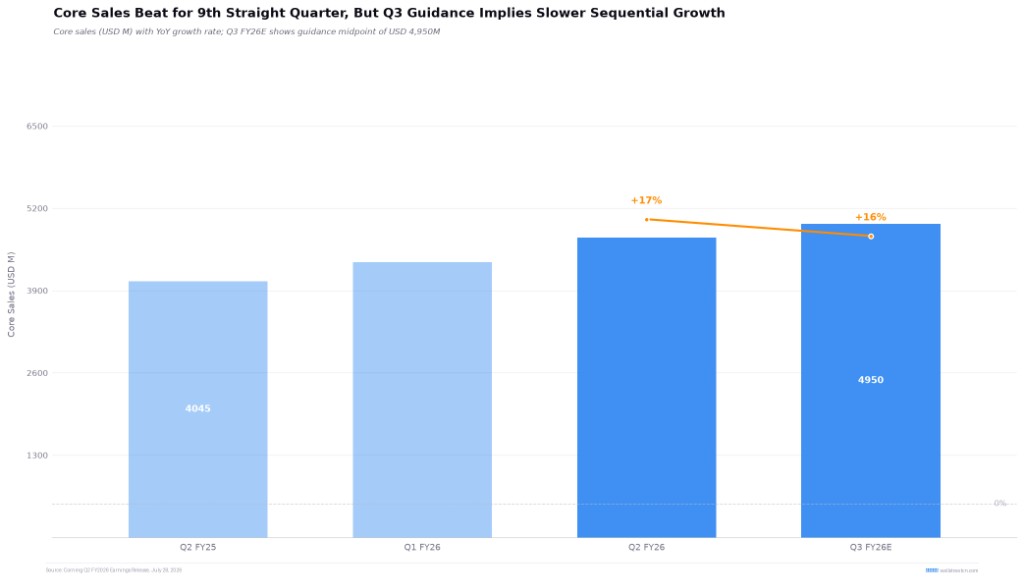
On Tuesday, Corning’s shares plummeted more than 15% in pre-market trading after the release of its Q2 earnings. This was not due to poor data, but because the Q3 guidance fell far short of expectations. Core sales guidance was set at $4.9–5.0 billion, with the upper end merely meeting expectations and the midpoint of $4.95 billion slightly below consensus.
Against the backdrop of finalized multi-billion dollar agreements with Amazon and long-term partnerships with NVIDIA, the market was expecting not just "meeting expectations," but a significant upward revision. The Q3 revenue guidance not only failed to provide an upward revision, but the implied sequential growth rate dropped sharply from 9% in Q2 to 3–6%—a signal of a turning point from acceleration to deceleration, which explains the intense pre-market sell-off better than the absolute revenue figures themselves.
This was not an isolated adjustment. Prior to the earnings release, the stock had already corrected about 40% from its late-June high of approximately $255–271 to around $145. Combined with the 15% pre-market drop, the cumulative drawdown over two months approached 50%. This is not merely an adjustment; it is a repricing.
Q2 Data Fully Beats, But Is Already in the Past
Objectively speaking, there were no major flaws in the Q2 data itself. Core sales were $4.74 billion, up 17% year-over-year, beating expectations by about 2.3%. Core EPS was $0.78, up 30% year-over-year, beating expectations by 2.7–4%. Core operating margin was 20.9%, expanding by 190 basis points year-over-year. Core ROIC was 14.9%, improving by 180 basis points year-over-year.
However, upon closer inspection, the quality of this beat is debatable.
The new "hedging exposure adjustment" methodology adopted in Q2 boosted core sales by approximately $233 million compared to GAAP figures—this single item covered the entire beat amount. This does not mean the company was dressing up the data (the change in methodology is reasonable in itself), but rather that the incremental information behind the "beat" is thinner than the numbers suggest.
Morgan Stanley had accurately predicted before the earnings release that optical communications capacity was nearly sold out, limiting the upside surprise for Q2 to around $50 million. The final beat of $130 million slightly exceeded this estimate, but was far from enough to overturn concerns about "peaking growth." The signal from the market is clear: in an environment of elevated valuations, backward-looking beats are far less important than forward-looking guidance.
High Growth in Optical Communications Hits a Ceiling
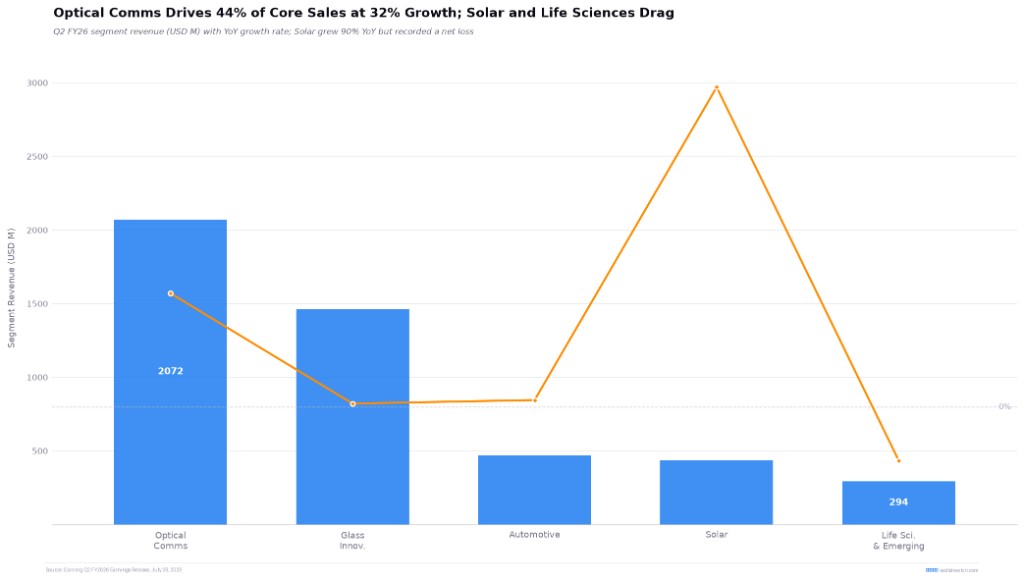
Optical communications revenue for the quarter was $2.07 billion, accounting for 44% of core sales, and grew 32% year-over-year. Segment net profit was $438 million, with a margin of 21.1%, and profit growth (+77%) was more than double the revenue growth. Enterprise network growth was 65%, with generative AI-related products growing even faster. Looking at these numbers alone, there are no flaws.
But the issue lies not in Q2, but in what can be delivered in Q3. The implied sequential growth rate in the Q3 guidance dropped sharply from 9% to 3–6%, indicating that management is already preparing for a slowdown in growth. Morgan Stanley’s judgment that "capacity is nearly sold out" was indirectly validated by this guidance—if capacity cannot be rapidly released, it will be difficult to sustain a 32% revenue growth rate in subsequent quarters.
A sharper issue is valuation. JPMorgan had already provided a incisive reason for downgrading the rating in May: investors are effectively paying for 2028 earnings, with the fiber optics business trading at a P/E ratio close to 40x. On such a valuation base, the value of the Amazon and NVIDIA partnerships needs to be realized quarter by quarter—and the first realization signal given by the Q3 guidance is clearly insufficient.
Margins Diluted, Cash Flow Reliant on Advances
Core gross margin improved by 120 basis points year-over-year to 39.6%, but the aforementioned hedging exposure adjustment contributed approximately $207 million at the gross profit level, impacting the gross margin by about 4.6 percentage points. Restructuring and impairment charges of $39 million and acquisition-related costs of $24 million also created noise across various profit levels. The direction of profit expansion is correct, but the magnitude needs to be discounted.
Free cash flow data withstands even less scrutiny. Adjusted free cash flow was $1.42 billion, more than triple that of the same period last year. However, "customer deposits and government incentives" contributed $880 million—compared to only $59 million in the same period last year. NVIDIA’s $500 million warrant and customer prepayments tied to capacity are essentially "exchanging future capacity for today's cash." Stripping out these one-time inflows, the operational improvement is much more moderate.
Solar Losses and Life Sciences Contraction
Outside of optical communications, signals from the other four segments are even less optimistic. Solar revenue surged 90% year-over-year to $438 million, but recorded a net loss of $7 million—compared to a profit of $2 million in the same period last year and a profit of $7 million in Q1. Production stoppages due to extended maintenance and equipment upgrades at wafer factories temporarily turned a high-growth business into a loss-making one.
Management promised improvement in Q3, but promises are not equivalent to delivery. Life Sciences and Emerging Growth fared worse: revenue fell 15% year-over-year to $294 million, swinging from a profit of $6 million to a loss of $21 million. These two businesses were positioned in the Springboard plan as the next growth batons after optical communications—currently, both batons are dropping. Glass Innovations (+1%) and Automotive (+2%) are also in a state of near stagnation.
06 Springboard: $20 Billion Within Reach, $40 Billion Out of Sight
Q2 also updated the Springboard plan targets: annualized $20 billion by the end of 2026, $30 billion by the end of 2028, and $40 billion by the end of 2030. Based on the Q3 guidance annualized to approximately $19.6–20 billion, the 2026 year-end target is almost within reach. From Q4 2026 to Q4 2030, the implied compound annual growth rate (CAGR) is about 19%.
The trouble is: with the short-term target already nearly met, the market naturally looks further ahead to 2028 and 2030. The climb from $30 billion to $40 billion requires Solar to turn from losses to large-scale profitability, and Automotive to accelerate from 2% to double-digit growth—currently, there is neither data support nor a clear timeline for this. A 19% CAGR is an extremely aggressive assumption in any industry. The pre-market decline is, to some extent, a repricing of this assumption.
Conclusion
Corning scored high on its Q2 results, but the market set a higher passing grade given the stock price above $200 and the 40x P/E ratio for fiber optics. The pre-market drop of over 15% conveyed an unambiguous message: when valuations have already priced in the most optimistic assumptions, "meeting expectations" is failing, and the Q3 guidance barely touched the expectation line even at its upper bound.
What deserves attention next is not whether Q3 will beat again—it likely will—but three questions. Can the slope of capacity expansion in optical communications substantially accelerate in Q3–Q4? Can Solar deliver on management's repeated promises to return to profitability in Q3? After the valuation repricing, where does the market's new anchor lie? For a stock falling from near $270 to approach $120, any judgment that "fundamentals are fine" must face the question: if there is no problem, why has it fallen by nearly half?
