


Samsung's Earnings Beat Expectations Significantly; Korean Stocks Rebound Strongly by Over 5%, Samsung Rises More Than 5%, Japanese Stocks Gain Over 2%
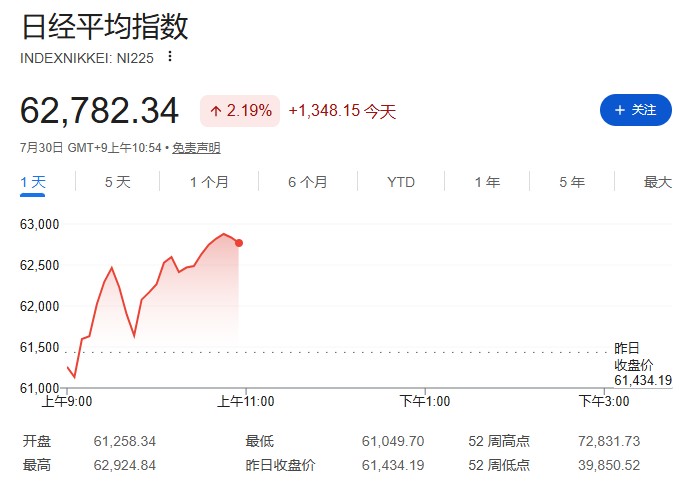
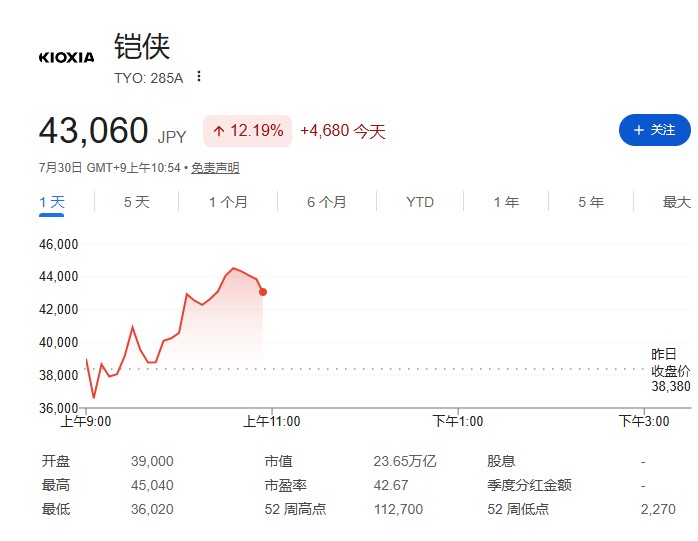
Samsung Electronics' net profit surged year-on-year in the second quarter, with results significantly beating expectations. Coupled with the South Korean government's announcement of market-stabilizing measures, including restrictions on retail participation in leveraged ETFs, the KOSPI's intraday gains widened to 5% on Thursday. Samsung's stock price rose 5.5%, while SK Hynix gained 2%. The KOSPI has cumulatively fallen about 40% from its June peak. The Nikkei 225 Index rose more than 2% during the day, with Kioxia surging over 12%
Samsung Electronics' profits surged in the second quarter. Combined with the South Korean government's intervention to stabilize the market, the Korean stock market staged a strong rebound after two days of sharp declines.
On Thursday, July 30, the South Korean KOSPI's intraday gains widened to 5%. In the previous two trading sessions, the index had cumulatively dropped 16%, triggering circuit breakers across the entire market for two consecutive days. The MSCI Asia Pacific Index also rose by 1%.
Today, Samsung Electronics announced that its operating profit for the second quarter increased more than 18-fold year-on-year, with semiconductor operating profit reaching 89 trillion South Korean won, a 250-fold increase year-on-year. Boosted by the news, Samsung's stock price rose 5.5% during intraday trading.
SK Hynix, another semiconductor giant, had cumulatively fallen nearly 25% in the previous two trading sessions. It followed the rebound on Thursday, gaining 2%.
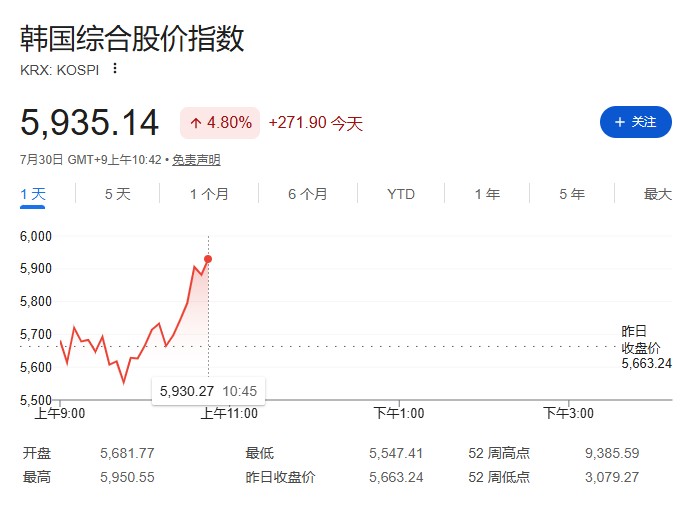
Regarding Japanese stocks, the Nikkei 225 Index rose more than 2% during the day, with Kioxia surging over 12%.
South Korea Takes Emergency Action to Restrict Leveraged ETFs
After the close on Wednesday, the South Korean Ministry of Finance, the Bank of Korea, and financial regulators jointly held an emergency meeting, promising to take additional measures to stabilize the stock market and tighten channels for retail investors to participate in leveraged ETFs.
According to the South Korean Ministry of Finance, the new measures include linking the cap on retail holdings of leveraged ETFs to their total investment portfolios, while simultaneously increasing related transaction costs.
The sharp declines over the previous two days caused billions of dollars in losses for investors. The triggering of market-wide circuit breakers for two consecutive days was a first in the history of the South Korean market.
The KOSPI has cumulatively fallen about 40% from its June peak. The core logic behind this decline lies in market skepticism regarding the sustainability of AI-driven trades. Investors began to reassess whether AI-driven semiconductor demand could be maintained in the long term. As a core global supplier of memory chips, South Korea bore the brunt of this sentiment.
However, some market participants believe this volatility is a normal cost. Josh Gilbert, Chief Analyst for Asia Pacific and the Middle East at eToro, stated, "This volatility is the cost of entry, not proof that the AI story is over."
