Politburo Meeting: Several Signals of Intensified Efforts and Improved Efficiency
The July Politburo meeting set an objective and pragmatic tone, emphasizing high attention to economic difficulties and challenges. Macro policies were upgraded to "more proactive fiscal policy and moderately loose monetary policy," strengthening counter-cyclical adjustments and planning for incremental policies. Industrial deployment is extending from single-point breakthroughs to a future industry matrix, with the "Six Networks" entering a comprehensive construction phase, aiming to promote steady and long-term high-quality development
In response to the continued divergence in the economy and the marginal slowdown in growth since the second quarter, the July Politburo meeting adopted an objective and pragmatic tone, placing "high attention to the difficulties and challenges in economic operations" in a prominent position.
Against this backdrop, the coordinated defensive and hedging attributes of macro policies have significantly strengthened: the regulatory requirements have not only been clearly upgraded to "strengthen counter-cyclical adjustments," but also forward-lookingly proposed to "timely plan and introduce practical and effective incremental policies." This clearly signals that macro regulation in the second half of the year will comprehensively unfold around "intensifying efforts and improving efficiency" to break through bottlenecks, making "promoting steady and long-term high-quality development" an important proposition of the new era.
New momentum coexists with challenges, leading to a more objective and pragmatic assessment of the economic situation. Compared to the April meeting's tone of "a strong start, better than expected," this July meeting shifted its assessment of the first-half economy to a structural affirmation of "new momentum and optimized structure," and explicitly stated that "high attention must be paid to the difficulties and challenges in economic operations." Therefore, the urgency of "stabilizing growth" in the second half of the year has increased, building consensus for the accelerated release of existing policies and the timely reservation of incremental policies.
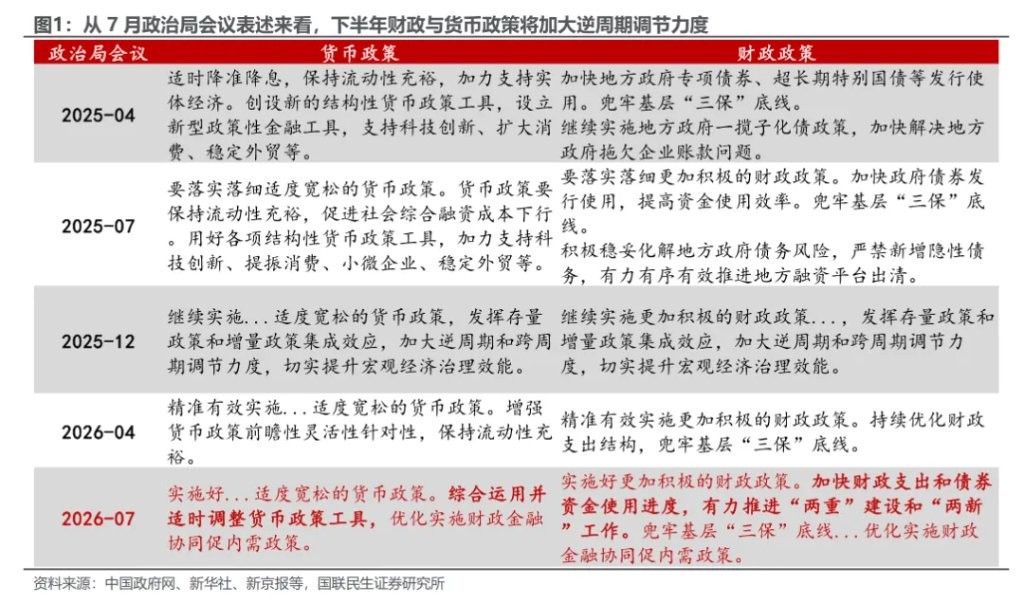
Macro Regulation: Counter-cyclical adjustment efforts are expected to increase, with the second half of the year welcoming a key period for policy release. The tone of macro regulation has been elevated from "precise and effective implementation" in April to "implementing more proactive fiscal policy and moderately loose monetary policy," and explicitly proposed to "timely plan and introduce practical and effective incremental policies," suggesting that policies in the second half of the year may provide more substantive incremental support.
On the fiscal side, emphasis is placed on "accelerating the progress of fiscal expenditure and the use of bond funds." In addition to the "Two Major" and "Two New" initiatives, the "Six Networks" are also a key area for fiscal resource allocation in the second half of the year; on the monetary side, emphasis is placed on "comprehensive use and timely adjustment," indicating that there is still room for both aggregate and structural tools. Furthermore, the statement from the April meeting to "maintain the basic stability of the RMB exchange rate at a reasonable and balanced level" was not mentioned in this meeting, which may imply that the autonomy of monetary policy is further strengthening in the trade-off between the external environment and internal growth stabilization.
Industrial Deployment: Extending from single-point breakthroughs to a future industry matrix, the "Six Networks," represented by computing power centers, are expected to enter a comprehensive construction phase. Compared to April, there are significant new expressions in industrial deployment in this meeting: First, regarding the deployment of the "Six Networks," the focus shifted from "strengthening planning" in April to "solidly advancing" in July, reflecting a shift in focus from blueprint to implementation; Second, this meeting added "actively promoting breakthroughs in frontier technologies and the development of future industries," expanding the vision from a single AI focus in April's "comprehensive implementation of the 'AI+' action" to a broader range of future industries; Third, it explicitly proposed to "formulate and implement regulations for the construction of a unified national market," creating a fair and orderly market competition environment through legal means.
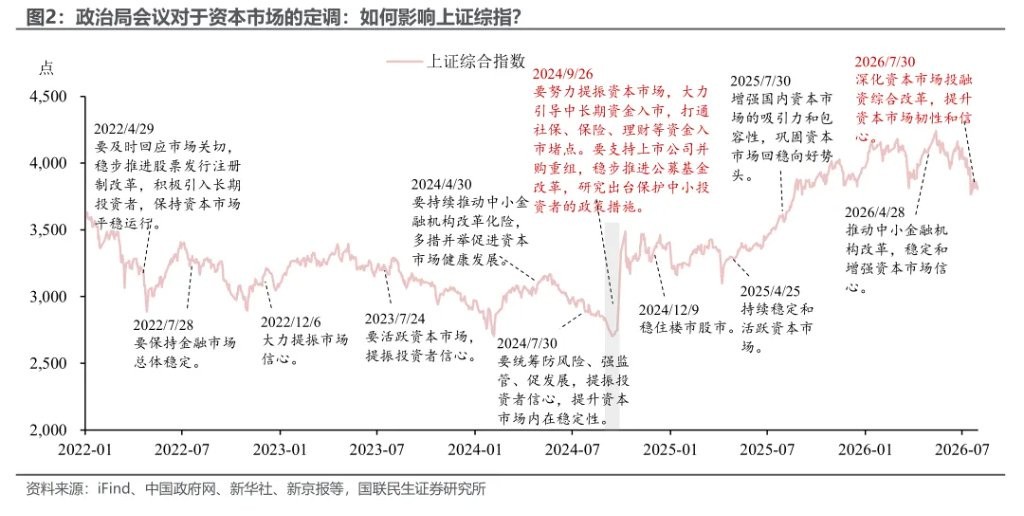
Capital Markets: The tone has advanced from "stabilizing confidence" to "enhancing resilience," focusing on building institutional moats under external shocks. The April meeting's statement on capital markets was to "stabilize and enhance confidence in the capital market"; in July, this was upgraded to "deepening the comprehensive reform of investment and financing in the capital market, enhancing the resilience and confidence of the capital market." Against the background of increased external volatility, capital market-related policies remain focused on "stability," aiming to resist external risks through institutional construction.
Reviewing the "September 26" meeting of 2024, the tone on capital markets at that time was more direct and powerful. In contrast, the expression in this meeting is relatively euphemistic and restrained, reflecting a balanced consideration between long-term institutional construction and short-term confidence maintenance at the current stage.