


The Federal Reserve Becomes a Market "Follower"
CMS points out that the Federal Reserve under Waller's leadership is rewriting market pricing logic, no longer providing a clear policy path but instead relying on market interest rates to adjust financial conditions. The July FOMC meeting kept interest rates unchanged, but internal divisions over inflation widened. The report argues that the market is already tightening policy on behalf of the Fed, with future rate hikes depending on the spread of inflation, and suggests paying attention to the interplay between growth and recession factors as well as crude oil asset allocation
The Federal Reserve in the Waller era is rewriting market pricing logic.
In their commentary on the July FOMC meeting released on July 30, Zhang Jingjing and Wang Luobin from the macro team at CMS noted that the truly noteworthy aspect of this monetary policy meeting was not the decision to hold rates steady, but rather Fed Chair Waller’s first systematic exposition of a new policy reaction function. Compared to the Powell era, the Federal Reserve is no longer willing to provide the market with a clear policy path; market interest rates are gradually replacing the federal funds rate as the primary vehicle for tightening or easing financial conditions.
The July FOMC meeting maintained interest rates unchanged, with almost no adjustments to the statement wording, continuing to emphasize robust expansion in economic activity and strong productivity and capital investment. However, officials Hammack, Kashkari, and Logan supported a 25 basis point rate hike, marking a rare three-vote dissent in recent years and reflecting widening divergences within the committee regarding inflation risks.
CMS believes that understanding the policy framework of the Waller era is a key prerequisite for current market pricing. He emphasized that the significant rise in nominal and real yields on US Treasuries during the past two meetings means that "the market has already completed part of the tightening on behalf of the Federal Reserve," and the impact of monetary policy on financial conditions is increasingly being realized through market interest rates rather than policy rates.
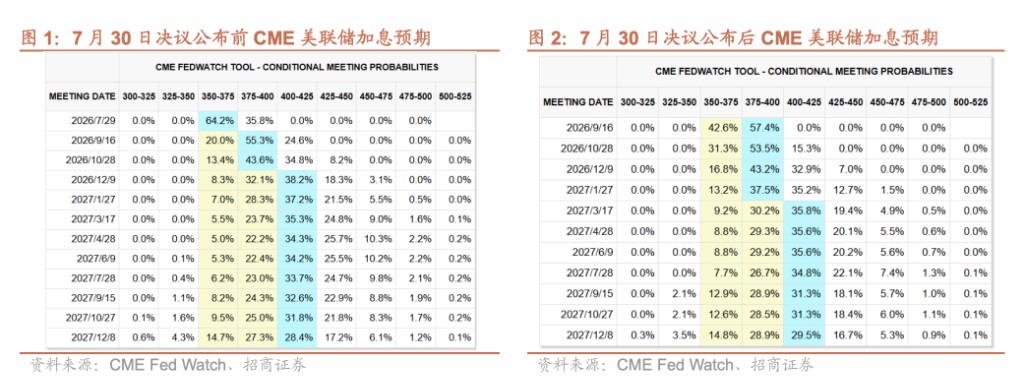
The Market Is "Hiking Rates" on Behalf of the Fed
The report argues that the reaction function in the Waller era stands in sharp contrast to that of the Powell era.
On one hand, the Federal Reserve no longer maintains a high tolerance for inflation caused by supply shocks, but instead focuses more on whether inflation is spreading from local sectors to the broader economy; on the other hand, compared to the previous greater emphasis on employment and financial market volatility, Waller places more emphasis on the market's own role in adjusting financial conditions, with the Fed deliberately downplaying its role as the market's "put option."
Under this framework, there are mainly two trigger paths for future rate hikes: first, new inflation metrics are officially launched and show a resurgence in inflation strength; second, existing high inflation is confirmed to have spread to a wider range of goods and services. Until then, keeping interest rates unchanged remains the baseline scenario.
CMS also warns that the US economy is entering a stage where "growth factors" and "recession factors" are playing out simultaneously. Since the fourth quarter of last year, the US personal savings rate has fallen below 4%, and the support of AI investment for economic growth may marginally weaken in the coming months.
Regarding asset allocation, the report remains bullish on crude oil-related assets and believes that if the AI industry chain releases positive signals, the Nasdaq still has room for a phased rebound; however, the growth rate of global capital expenditure may peak in the third quarter, warranting heightened vigilance in the fourth quarter. For US Treasuries, as the Federal Reserve cancels forward guidance and its reaction function changes, the overall central tendency of the yield curve is expected to continue rising. If expectations for future rate hikes further intensify, a renewed inversion of the curve deserves medium-term attention.
Risk Warning and Disclaimer
Investment involves risks; please proceed with caution. This article does not constitute personal investment advice, nor does it take into account the specific investment objectives, financial status, or needs of individual users. Users should consider whether any opinions, views, or conclusions in this article align with their specific circumstances. Investment decisions made based on this content are the sole responsibility of the investor.
