


Open Source vs. Closed Source: Endgame Scenarios for the AI War and Market Implications
Morgan Stanley constructs a three-scenario framework for the AI endgame: closed-source oligopoly, open-closed hybrid coexistence, and open-source dominance. Under these three paths, cloud service providers, security software firms, and semiconductor companies each have distinct focal points, while core targets like NVIDIA and PANW remain relevant across all scenarios, earning them the title of "all-weather winners." Significant uncertainty remains regarding the direction of the AI landscape, but structural beneficiaries are gradually emerging. Analysts assert that open-weight models are catalysts accelerating AI adoption rather than threats—the real question is not whether AI demand will shrink, but at which layer value will accumulate
The debate between open-source and closed-source models has evolved from academic discussion into a core issue influencing billions of dollars in investment decisions. In its latest research report, Morgan Stanley systematically outlines three endgame scenarios for this competition and maps out beneficiary stocks for investors across semiconductors, cloud computing, security software, and energy infrastructure.
The release of Kimi K3, along with open-weight position papers subsequently published by NVIDIA and Anthropic, has intensified this debate. Investors are concerned that the surge of smaller, more efficient open-source models will suppress demand for computing power and AI infrastructure. Morgan Stanley holds a different view—the firm believes that open-weight models foster competition and accelerate AI adoption through the "Jevons paradox," thereby driving larger-scale enterprise AI adoption rather than weakening demand.
Survey data corroborates this trend. According to a McKinsey survey of 700 tech leaders across 41 countries, 63% of enterprises have incorporated open-source models into their AI technology stacks, typically using them in parallel with closed-source models. Additional data shows that between February and July 2026, the share of tokens routed weekly by US companies to Chinese open-source models via OpenRouter exceeded 30%, although this figure may reflect startup behavior more than that of large enterprises. Nevertheless, Morgan Stanley judges that the landscape of enterprise AI spending will continue to evolve with improvements in model efficiency and the development of open-source models, requiring investors to adopt a clear analytical framework to navigate this transformation.
Open Source vs. Closed Source: A Misunderstood Debate
Morgan Stanley believes there is a fundamental misunderstanding in the market regarding open-weight models.
The core difference between open-source and closed-source models lies not in parameter scale or performance levels, but in how users access and pay for them: open-weight models are free to acquire, can be trained and fine-tuned, and offer flexible deployment (locally, on the cloud, or via API); closed-source models charge users through licenses and token-based billing, with weights remaining consistent for all users.
Strictly speaking, open-weight models (such as Meta's Llama, Google's Gemma, Qwen, DeepSeek, and Kimi) only disclose training parameters but may retain training data or restrict licensing; open-source models (such as AI2's OLMo) fully open the entire technology stack, including code, training guides, and data details. Currently, the highest-performing frontier models are all closed-source, for a simple reason—training costs are high, and model developers cannot afford to provide them for free before releasing the next generation of models.
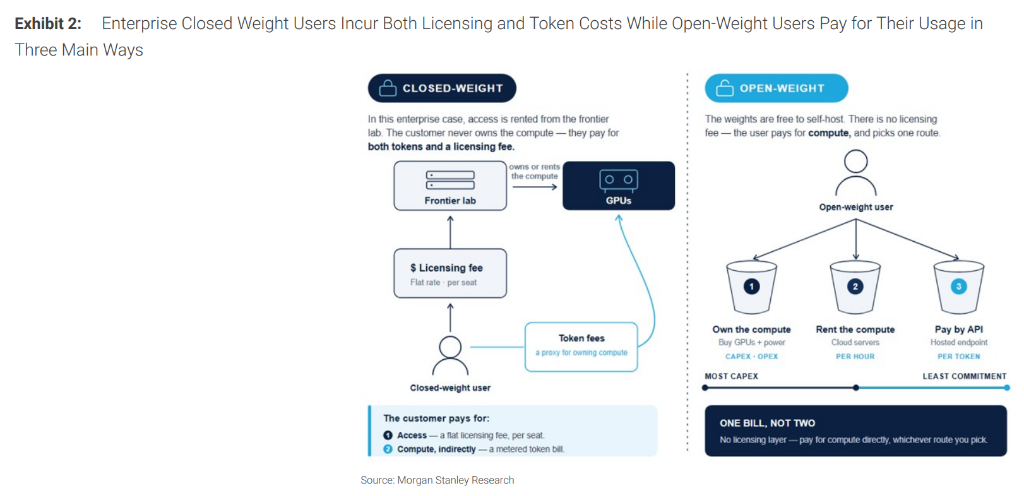
It is worth noting that open-weight does not truly mean "free."
A study by MIT estimated that switching from closed-source to open-source models could reduce average prices by 70%, saving enterprises approximately $25 billion annually.
However, Morgan Stanley points out that this study was completed in December 2025 and did not fully account for deployment costs—research from Carnegie Mellon University shows that the payback period for open-source models varies significantly by scale: small-scale deployments (fewer than 30 billion parameters) can have a payback period as short as 3 months, while large-scale deployments (200 billion to 1 trillion parameters) can take up to 6 years.
Current Enterprise Adoption: Hybrid Strategies Dominate, Closed Source Remains Mainstream
More than 60% of enterprises have incorporated open-weight models into their technology stacks, but current usage scenarios are highly concentrated in specific areas. Enterprises mainly apply them to code generation, document parsing, and other high-frequency, small-scale specialized tasks, where the core advantages are no token fees, customizability, and control over hosting locations.
Kshetrajna Raghavan, Head of Machine Learning at Shopify, provided a representative statement: "When you need to run billions of multimodal inferences daily, the per-token pricing of closed-source models is simply unsustainable." The McKinsey survey also showed that 40% of corporate executives favor open-weight models, primarily due to data sovereignty and localized compliance requirements.
However, the disadvantages of open-weight models cannot be ignored.
First, the cost of continuous fine-tuning is substantial, often proving challenging for enterprises with weaker technical capabilities; second, security risks are prominent—in tests conducted by the Financial Times and AI safety agency Alice in April 2026, safety guardrails in Meta and Google open-source models were removed within minutes using the Heretic tool; third, enterprises using closed-source models receive IP indemnification protection, whereas open-weight models do not offer such clauses; fourth, geopolitical risks are rising—if the US imposes bans on Chinese open-source models, it will force enterprises to switch to domestic US alternatives, creating business continuity risks.
Furthermore, Morgan Stanley believes that as the number of open-weight models increases, orchestration and observability tools will become increasingly critical—regardless of whether enterprises choose open or closed source, the software layer managing authentication, routing, inference optimization, and governance will be a necessary investment.
Three Endgame Scenarios and Core Beneficiary Stocks
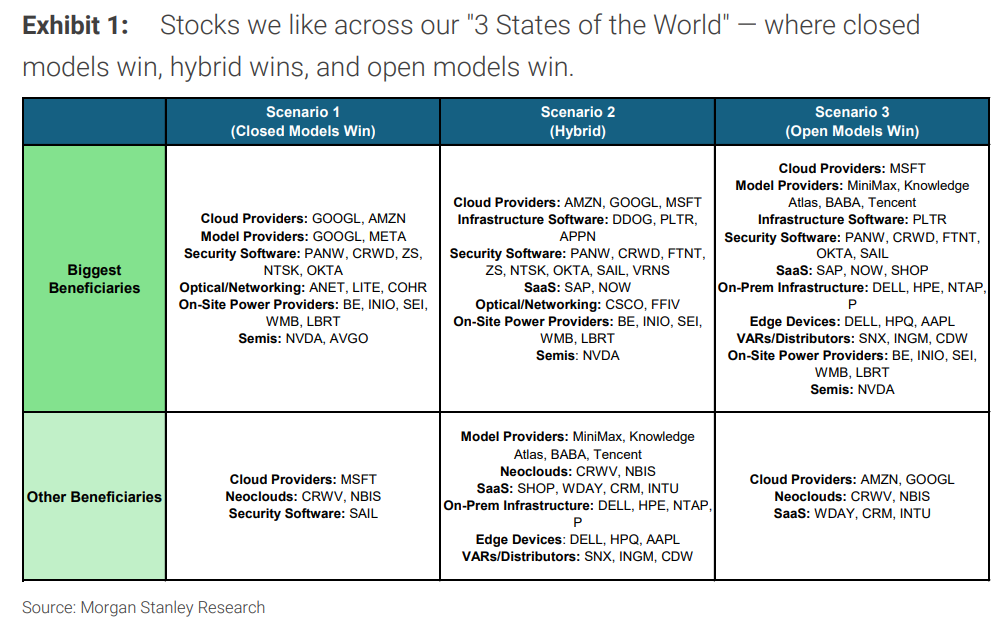
Morgan Stanley has constructed a three-scenario framework covering the full spectrum from closed-source dominance to open-source victory, identifying corresponding investment beneficiaries for each scenario.
Scenario 1: Closed-Source Models Prevail
Frontier model performance is difficult to replicate, and a few well-capitalized laboratories emerge victorious. Computing workloads continue to concentrate in hyperscale clouds, and training demand remains highly compute-intensive. Token prices decline, but the decrease is less than in the open-source scenario due to market oligopoly structures.
In this scenario, Google's strategic position depends on whether Gemini returns to the frontier—if Gemini 4 achieves a breakthrough, Google's return on investment (ROI) for operating model APIs on its own infrastructure would be approximately 45%; if it fails to lead the frontier, it would operate more as an infrastructure provider, corresponding to an ROI of about 30%.
Core beneficiary companies: Cloud service providers (Google, Amazon), model providers (Google, Meta), security software (PANW, CRWD, ZS, NTSK, OKTA), optical networking (ANET, LITE, COHR), on-site power suppliers (BE, INIO, SEI, WMB, LBRT), semiconductors (NVDA, AVGO).
Scenario 2: Hybrid Landscape
No single architecture prevails. Closed-source frontier models dominate complex reasoning and intelligent agent tasks, while open-weight models handle high-frequency, cost-sensitive, or vertical-specific tasks. Workloads are distributed across public clouds, private clouds, on-premises deployments, and edge devices. Closed-source models retain pricing power, but excess returns are suppressed by open-source competition. The value of model orchestration, routing, evaluation, and governance software increases significantly, and demand for security software expands due to dispersed workloads.
Core beneficiary companies: Cloud service providers (Amazon, Google, Microsoft), infrastructure software (DDOG, PLTR, APPN), security software (PANW, CRWD, FTNT, ZS, NTSK, OKTA, SAIL, VRNS), SaaS (SAP, NOW), optical networking (CSCO, FFIV), on-site power suppliers (BE, INIO, SEI, WMB, LBRT), semiconductors (NVDA).
Scenario 3: Open-Weight Models Prevail
Open-weight model performance converges to frontier levels, foundational model intelligence becomes widely 普及, model API prices drop significantly, driving a wave of enterprise adoption and validating the Jevons paradox. AI infrastructure moves towards decentralization, with significant growth in demand for private data centers, sovereign clouds, on-premises deployments, and edge devices. The focus of innovation shifts from pre-training to fine-tuning, inference optimization, intelligent agents, and specific application deployments. Security software emerges as one of the biggest winners due to local and distributed workloads.
Core beneficiary companies: Cloud service providers (Microsoft), model providers (MiniMax, Knowledge Atlas, Alibaba, Tencent), infrastructure software (PLTR), security software (PANW, CRWD, FTNT, OKTA, SAIL), SaaS (SAP, NOW, SHOP), on-premises infrastructure (DELL, HPE, NTAP, P), edge devices (DELL, HPQ, Apple), distributors (SNX, INGM, CDW), on-site power suppliers (BE, INIO, SEI, WMB, LBRT), semiconductors (NVDA).
Certainty Across Scenarios: Power and NVIDIA
In all three scenarios, two types of assets remain in a beneficiary position regardless of the outcome.
NVIDIA ranks as a core beneficiary in all three scenarios—the underlying logic of GPU demand remains unchanged whether computing demand is concentrated in hyperscale data centers or dispersed to the edge. On-site power suppliers (BE, INIO, SEI, WMB, LBRT) also span all three scenarios, as the growth in electricity demand driven by AI expansion has structural support regardless of whether workloads are concentrated or dispersed.
In contrast, the fate of some companies is highly correlated with the scenario trajectory. AVGO enjoys the greatest beneficiary status exclusively in the closed-source scenario; on-premises infrastructure vendors like DELL and HPE, and edge device makers like Apple, can only fully realize their value in the open-source scenario; the prospects of large cloud service providers depend on where workloads flow—if the open-source scenario materializes, Microsoft possesses unique advantages due to its hybrid cloud and on-premises deployment capabilities, while Amazon and Google would be relegated to "other beneficiaries" in this scenario.
Morgan Stanley's core judgment is that open-weight models are catalysts accelerating AI adoption rather than threats—the real question is not whether AI demand will shrink, but at which layer value will accumulate.
