


SpaceX’s Big AI Bet: Is the $100bn Prize Real?
Big picture, this is $SpaceX.US's first earnings print, and the headline numbers were solid — revenue beat with upside momentum, and losses narrowed faster, putting OP near breakeven. The concern is the rapid acceleration in capex.
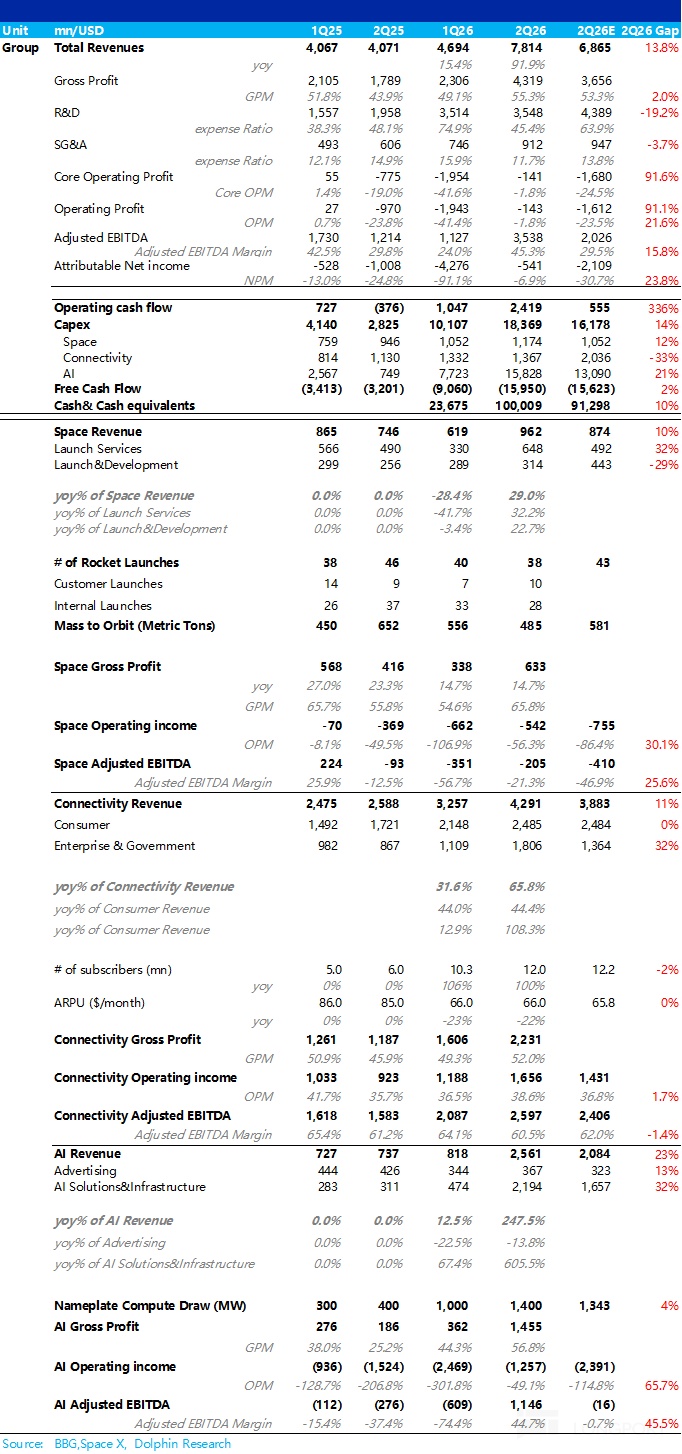
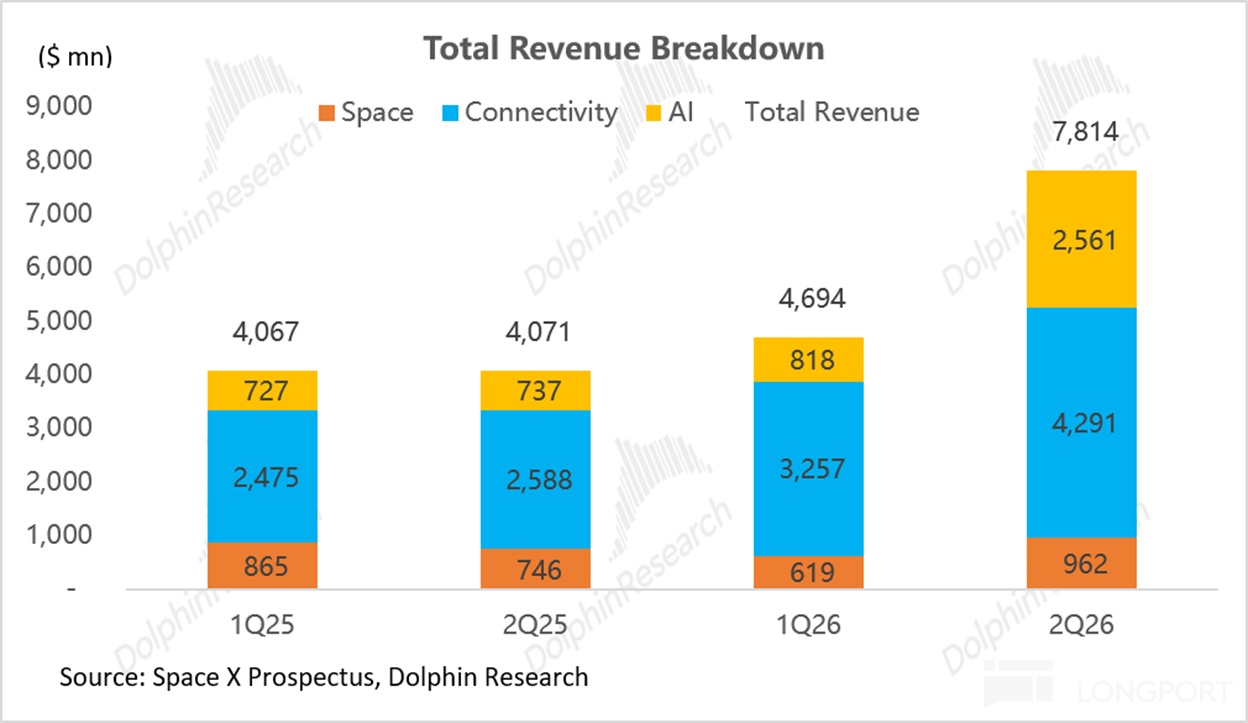
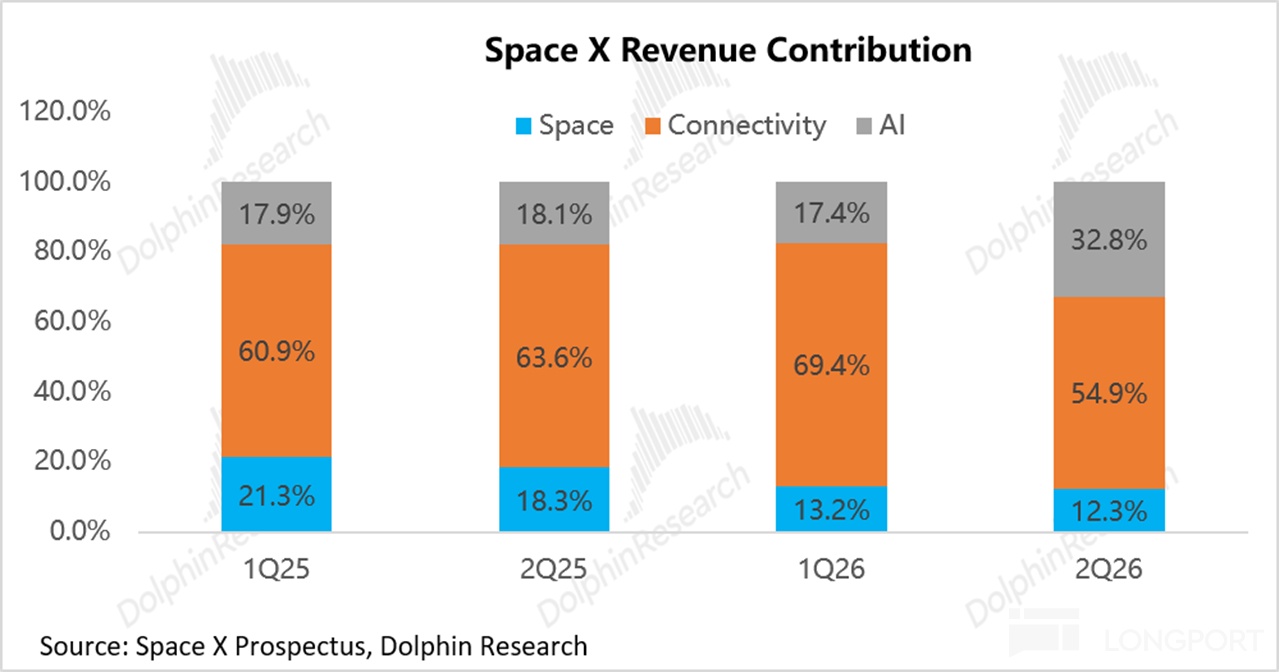
① Top line beat, AI drove the surge YoY: Q2 revenue was $7.8bn vs. street ~$6.9bn, up 92% YoY and sharply faster vs. Q1 (~+15%). The main driver was AI (notably compute leasing beginning to contribute incremental AI revenue, AI segment +247% YoY) and strong To B/G growth in Starlink.
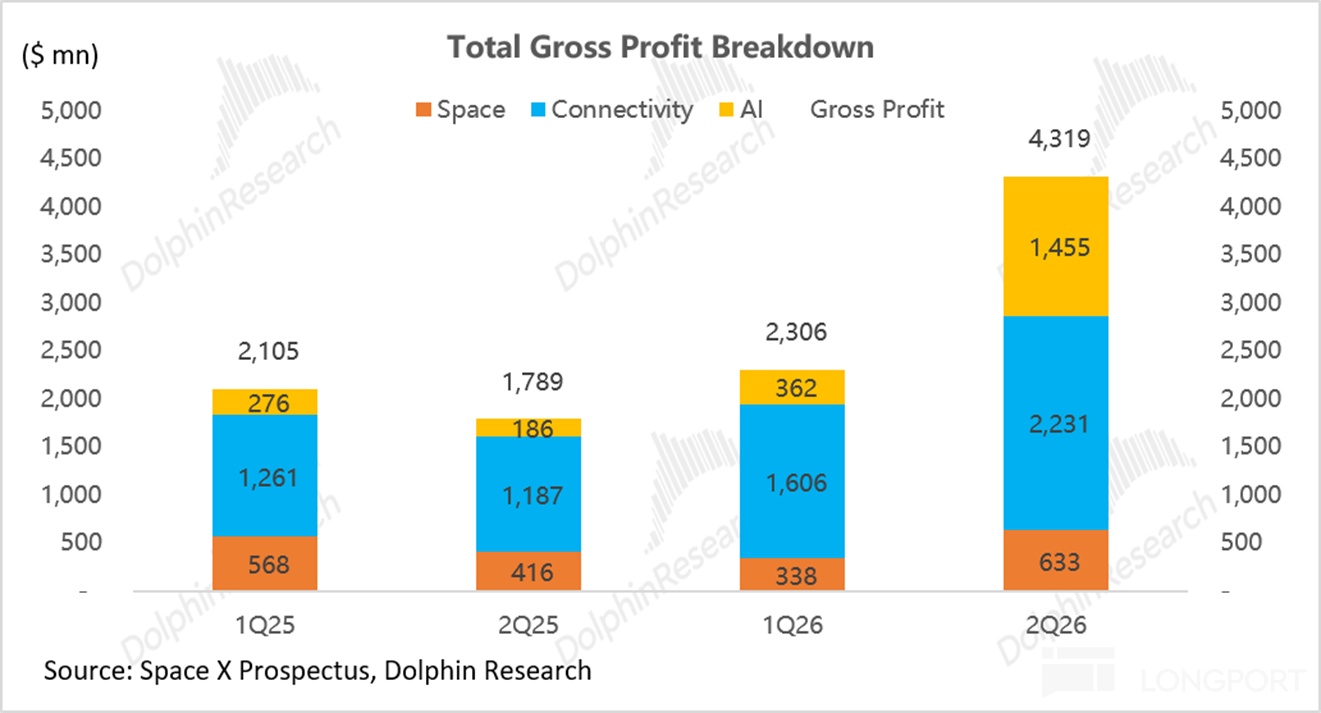
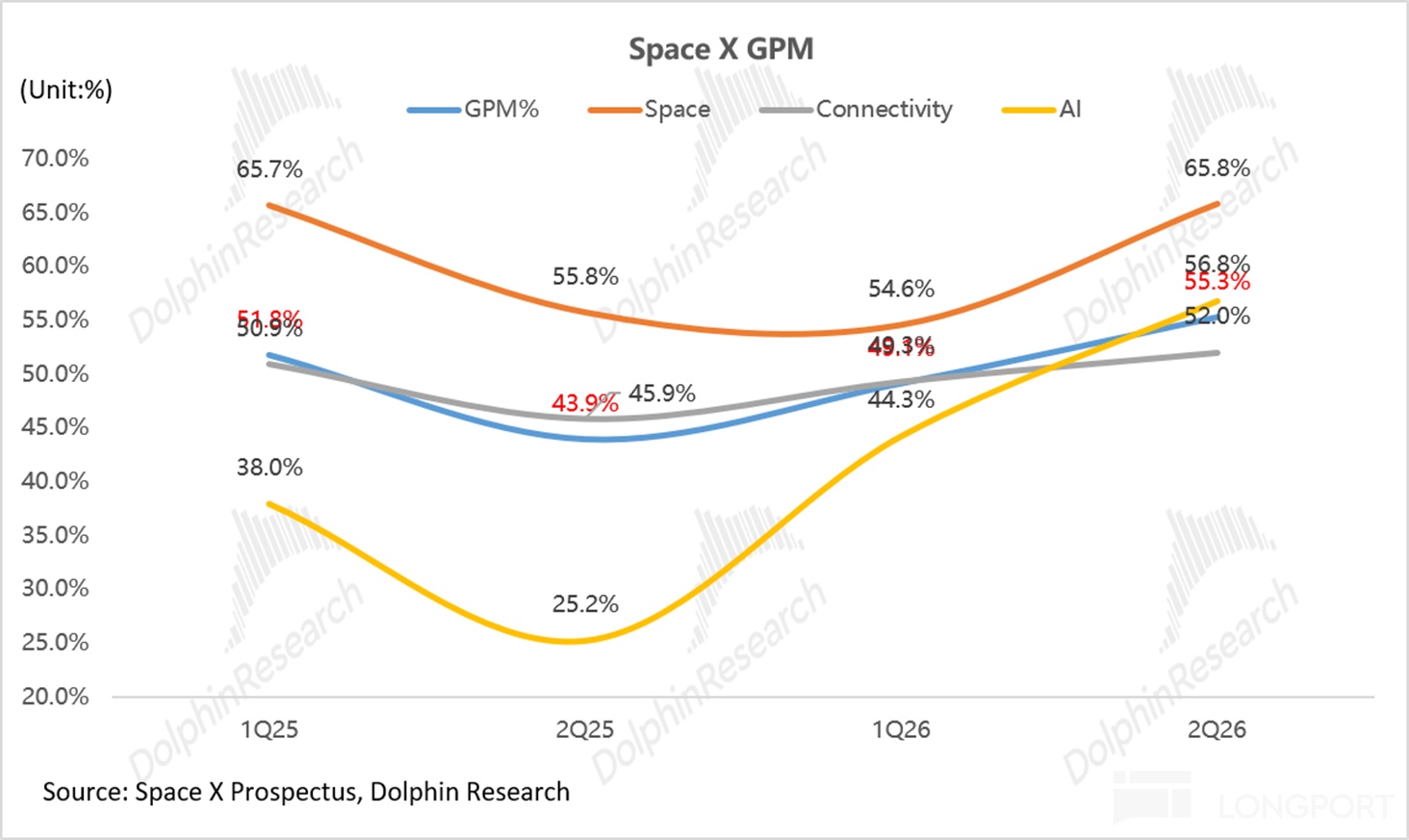
② GPM rose QoQ: Q2 GP was $4.3bn vs. street ~$3.7bn, with GPM up ~600bps QoQ to 55.3%. The step-up was largely due to AI mix and margin — as compute leasing revenue started to be recognized, premium pricing translated into high GPM, lifting AI GPM by 32ppt YoY to 56.8% (vs. 25.2% in Q2 last year).
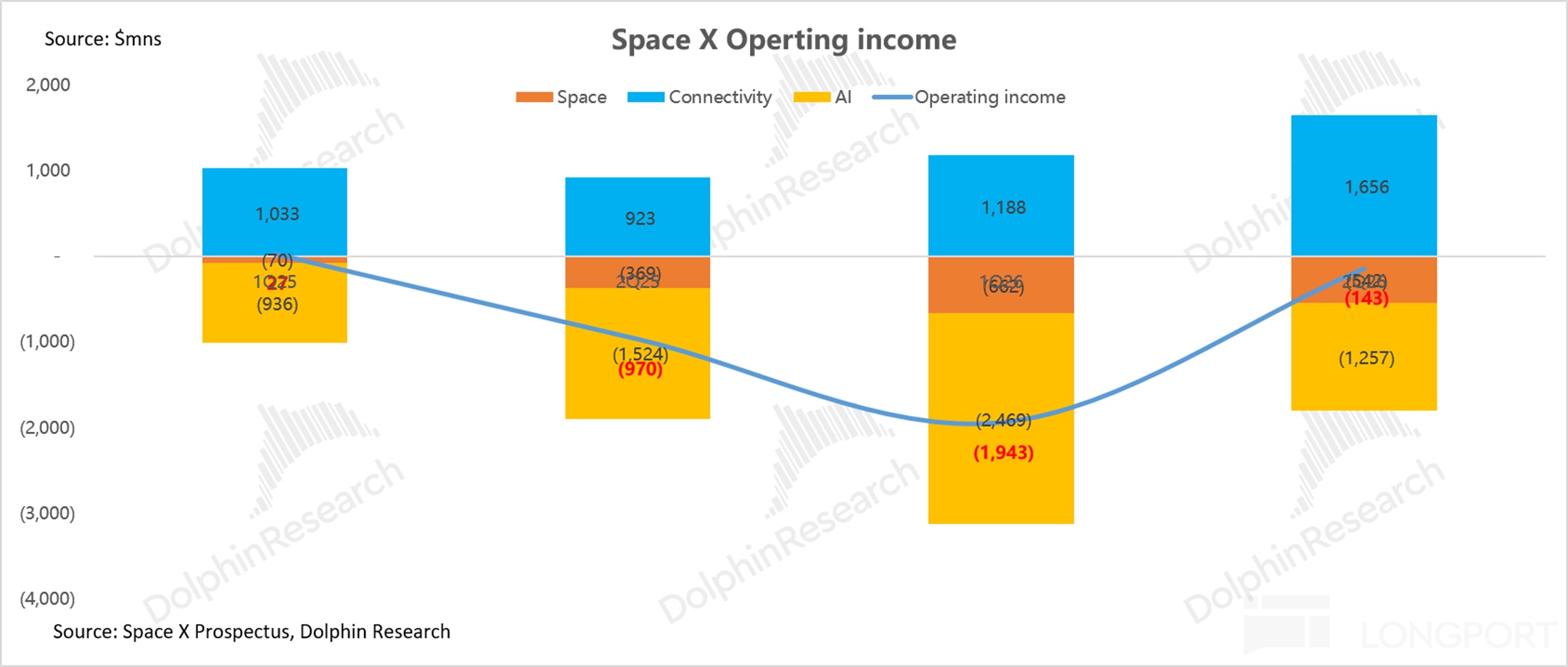
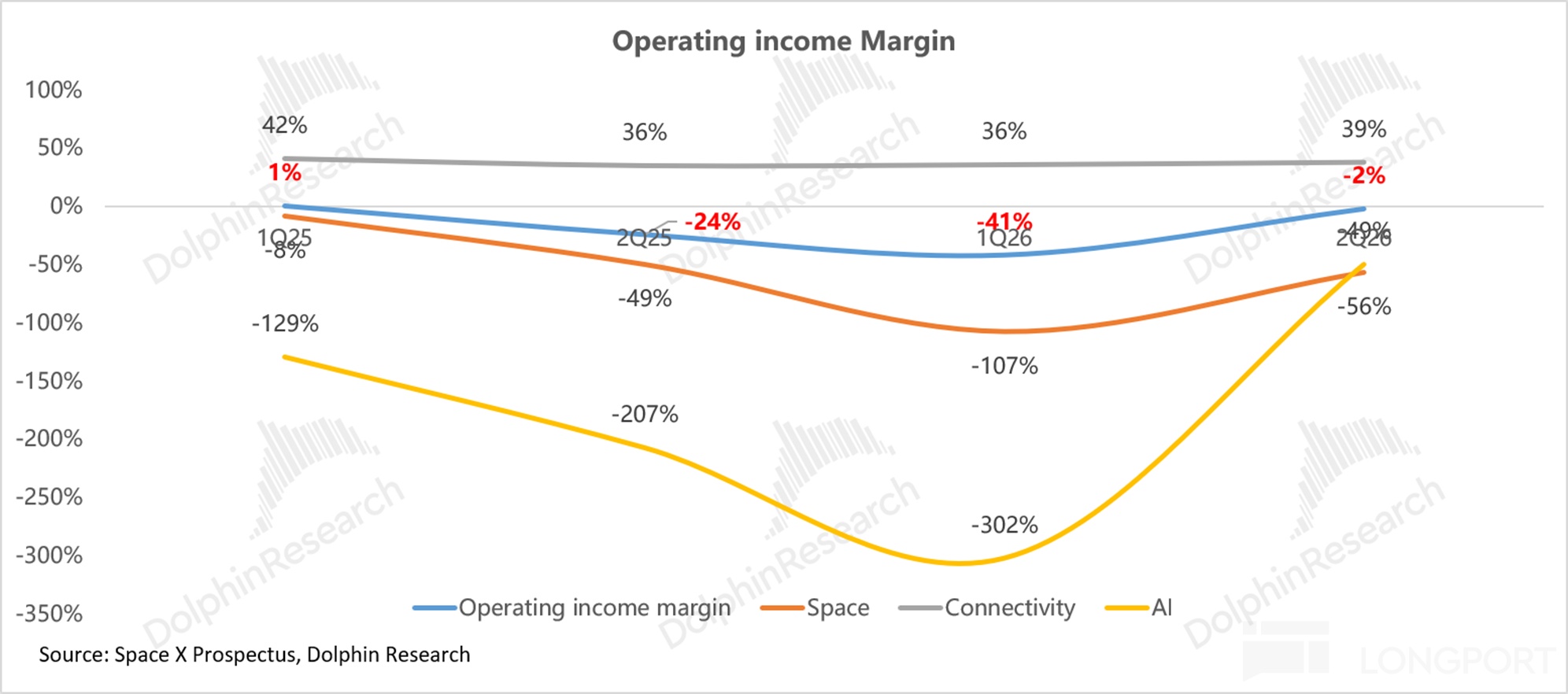
③ Operating leverage drove sharp OP improvement: Q2 OP was -$0.14bn, far better than street -$1.68bn. OPM improved 40ppt QoQ to -1.8% (vs. -41.4% in Q1), driven by AI compute leasing boosting both revenue and GPM, plus operating leverage, placing OP at the cusp of breakeven.
④ Segment detail:
a. Launch: more external launches, ASP and margins rose against the tide
Revenue: Q2 launch revenue was $0.96bn vs. street $0.87bn, +29% YoY. Launch services revenue rose 32% YoY to $0.65bn, while launch & R&D services recognized $0.31bn, +23% YoY.
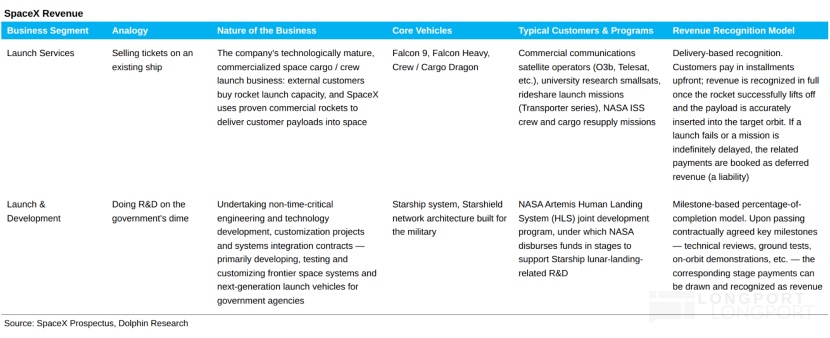
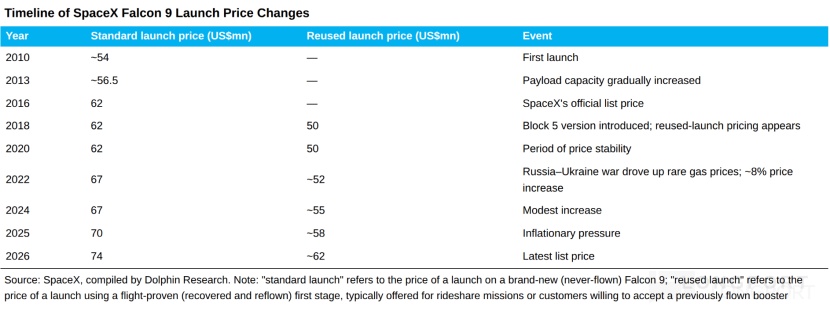
Launch services: SpaceX’s commercial launch is priced by mission/weight. External Falcon 9 commercial launches reached 10 in the quarter, up from 7 in Q1 and 9 a year ago, driven by more missions from large customers. Launch ASP is estimated to have risen from ~$54mn/launch a year ago to ~$65mn/launch (derived), with pricing strength mainly from a richer customer mix.
This reflects SpaceX monetizing its dominant position while the market lacks low-cost, mature substitutes. Falcon delivers ~2,500 tons to orbit per year vs. ~300 tons for the rest of the world combined, implying 80%–90% share of global annual to-orbit mass.
Launch & R&D services: This includes NASA (HLS crewed lunar lander) and U.S. defense programs recognized by milestone/POC, pacing to agency budgets and SpaceX’s progress at key technical gates (e.g., PDR pass, engine hot-fire, specific orbital tests). Crewed lunar milestones depend on Starship achieving high-reliability satellite launches first, with crew-level safety targeted by end-2027. Artemis III is slated for 2027 to dock with Orion; a subsequent uncrewed direct lunar cargo mission would follow; 2028 targets the crewed landing, which would trigger meaningful revenue recognition for launch & R&D services.
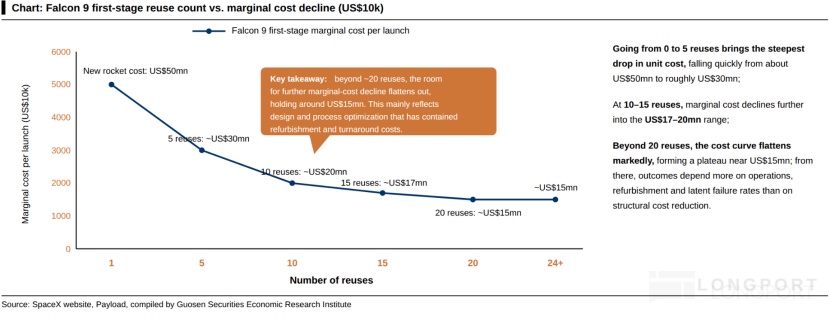
Profitability: Launch GPM rose ~11ppt QoQ to ~66%. Despite Starship test-flight costs (incl. hardware losses) expensed in launch COGS and pressuring margins, launch GPM still improved, driven by higher ASPs and structural cost declines from reuse (mainly Falcon 9), where more reuses reduce marginal costs.
With Starship R&D accelerating, launch services R&D opex rose 55% YoY to $1.1bn, pulling OPM down 7ppt YoY to -56%, yet still better than street -86.4%.
b. Starlink: beat driven by To B/G; subs growth broadly in line
Revenue: Q2 Starlink revenue was $4.29bn, +66% YoY and slightly above street $3.88bn. To B/G revenue doubled to $1.8bn, while Consumer continued steady growth, +44% YoY to $2.5bn.
To B/G: SpaceX signed and activated multiple in-flight Wi-Fi deals with airlines, and Starshield secured a multi-year U.S. Gov. contract of over $6bn. To C: subs reached 12mn, about doubling YoY, with ~1.7mn net adds QoQ, broadly in line. ARPU held stable QoQ at $66/month, though still -22.4% YoY.
In mobile, SpaceX obtained 65 MHz of U.S. spectrum (former EchoStar 2GHz) plus several global MSS licenses. Though early, SpaceX has effectively declared direct competition against U.S. MNOs — planning to launch V2 mobile satellites using the EchoStar 65 MHz next year and build a terrestrial network to take share from AT&T, Verizon, and T-Mobile.
As of end-Q2 2026, on-orbit comms and direct-to-cell satellites totaled 10,200 (vs. 9,600 in Q1), including 9,600 comms sats providing 800 Tb/s downlink and 600 mobile sats.
Margins: Starlink margins remained stable, with Q2 GPM at 52%, up 270bps QoQ, lifting OPM by 210bps QoQ. As a SaaS-like model with high upfront fixed costs (launch + satellite builds) and very low marginal cost later, rising subs continue to drive margin expansion.
c. AI: revenue beat, margins improved sharply
Revenue: Q2 AI revenue was $2.56bn vs. street $2.08bn, led by a 6x YoY jump to $2.2bn from AI solutions and infrastructure (incl. cloud service agreements with Anthropic, etc., contributing ~$1.6bn incremental AI infra revenue in the quarter). Grok model revenue was estimated at ~$0.6bn in Q2 vs. ~$0.47bn in Q1 (+26% QoQ).
Ad revenue from X was $367mn in Q2 vs. $343mn in Q1 (+7% QoQ). This followed a full rebuild of X’s AI ad stack in Q1 2026 to reverse tech disadvantages, focusing on fully automated buying, AI probabilistic attribution, Grok-driven real-time brand safety, and native fusion of ad and recommendation algorithms.
Post-rebuild, ads have stabilized and improved, but are still -14% YoY. Whether the overhaul can truly win back lost budgets requires more time to confirm.
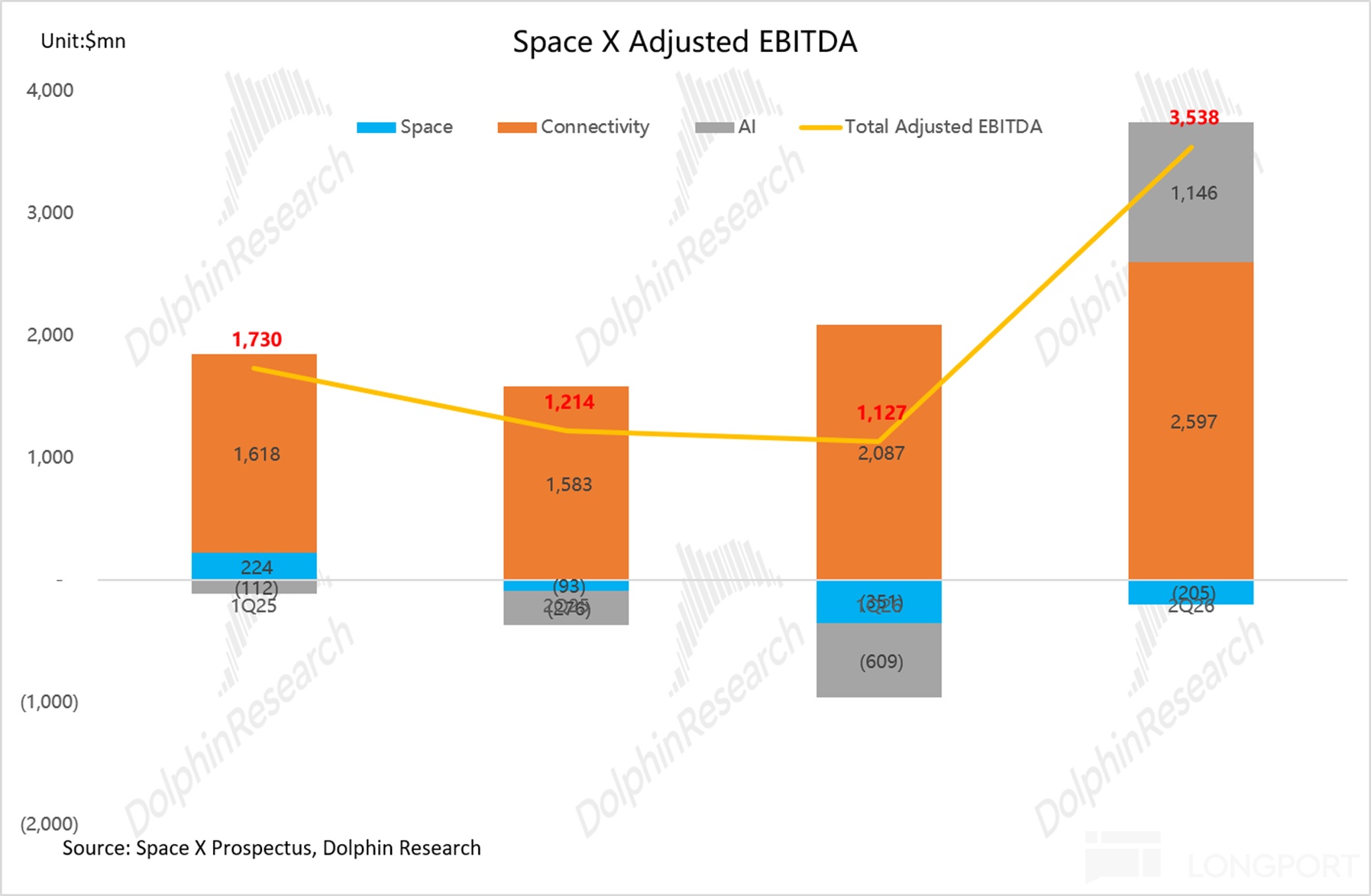
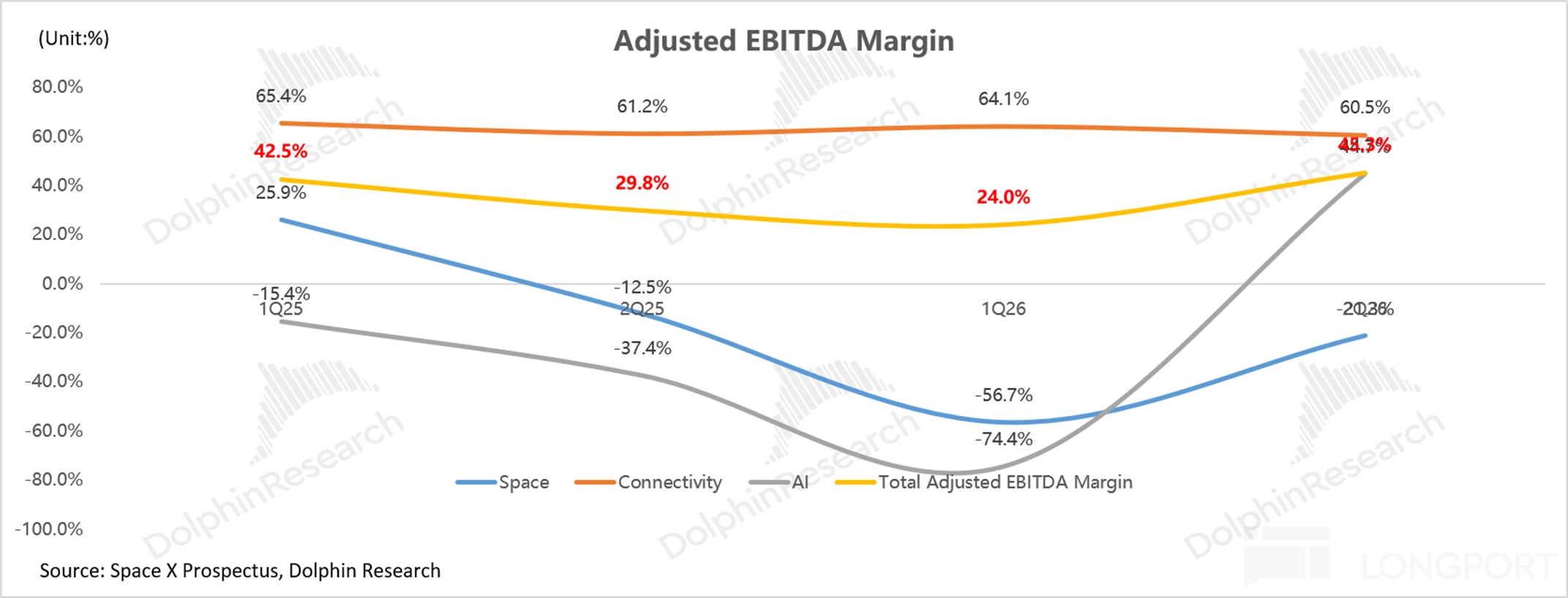
Margins: AI margins improved materially. GPM was ~57%, +1,250bps QoQ (vs. 44.3% in Q1); OPM was ~-49% vs. street -115%; Adj. EBITDA margin ~45%, with Q2 delivering the first positive AI Adj. EBITDA of $1.146bn. The uplift reflects premium pricing on compute leasing amid severe capacity shortages (est. $30–50bn per GW vs. peers at $10–15bn per GW).
The sharp AI margin gains (GPM ~57%, +1,250bps QoQ; OPM ~-49% vs. street -115%; Adj. EBITDA margin 45% with YoY/QoQ swing to profit) were mainly driven by premium compute pricing under capacity scarcity (est. $30–50bn per GW vs. peers at $10–15bn per GW). However, AI leasing agreements include 90-day termination-at-will clauses, implying inherently low visibility despite strong current revenue.

Dolphin Research view:
On the print alone, SpaceX did well — both revenue and profit beat, OP losses narrowed sharply, and the biz is near breakeven. But shares are down almost 50% from the peak and ~20% below IPO price, with post-market weakness, driven by several factors:
a. Aggressive capex, while new AI orders are not yet enough to fully match the capex surge
This season, we saw a pattern: when cloud vendors guide capex well above expectations but revenue/orders do not keep pace, the market questions ROI, especially with deeply negative FCF (cf. Meta). SpaceX straddles launch + Starlink + AI, but AI is now the No.2 revenue driver near term (Q2 ~$2.56bn vs. Starlink $4.29bn), with ~86% of capex going to AI (Q2 single-quarter ~$15.8bn). Management expects AI to surpass Starlink in 2026 as the largest revenue stream.
Compute capacity is ramping fast: nameplate reached 1.4 GW in Q2 2026 vs. 1 GW in Q1 and 400 MW a year ago, with 2 GW expected by year-end. By end-2027, online compute could be several times that — management said the scale is closer to 10 GW than 5 GW.
On capex, Q2 2026 was $18.4bn, and management expects similar spend in the next two quarters, implying 2026E total capex of ~$65.2bn vs. prior street ~$45.5bn. For next year, street is at ~$89.7bn, but if the 10 GW plan by end-2027 is fully funded (assume ~$30–35bn per GW, referencing Q1 2026’s 400 MW at ~$15.8bn or ~$39.5bn/GW), total 2027 capex could reach $240–280bn — far above current expectations.
While compute leasing enjoys premium pricing in today’s tight market and flexible 90-day termination clauses, with management suggesting ~1-year payback, investors still need to see orders commensurate with the spend. This print announced ~$6.7bn of new cloud service agreements, which helps, but the incremental scale looks small vs. previously disclosed mega-deals — Anthropic ($45bn/3 years) and Google (~$30.36bn/33 months). The market worries capex may be running ahead of verifiable order-backed returns, especially given the terminable nature of these leases.

b. OP cash flow turned positive, but FCF remains deeply negative under capex surge
Q2 operating cash flow turned positive to ~$2.4bn, but capex was still ~$18.4bn (mainly AI infra), driving FCF to -$16.0bn, deteriorating by nearly $7bn QoQ. The company raised ~$75bn at IPO, then issued $25bn in bonds, with cash and equivalents at ~$100bn. But with such heavy capex and low order visibility, another large raise could be needed late this year or in 2027.
The market is concerned funding needs may be a bottomless pit — whether AI orders and revenue can truly match the intensity of capital deployment.
c. Massive lock-up expiries create direct technical overhang
Beyond capex ROI, immediate pressure comes from the first 930mn-share unlock starting Aug 6 (market value ~$100bn). Large pre-IPO investor and employee stakes will begin to float, creating direct supply pressure.
Thereafter, ~300mn shares unlock every 15–20 days until the Q3 print when another ~1.3bn shares are released. By Jan 2027, roughly 4bn shares will have been unlocked over eight tranches.
Near term, the announced capex ramp plus the impending large unlocks weigh directly on the stock, and most investors remain bearish tactically.
SpaceX’s setup rhymes with Tesla — near-term price action is event-driven more than earnings-driven, because long-dated businesses (esp. space data centers) dominate current valuation but contribute little profit today.
The further out the horizon, the lower the confidence in key assumptions: can Starship truly drive launch costs below $200/kg — likely but not yet certain; what is Starlink’s global penetration ceiling; and is space compute necessary and commercially viable at scale — even more contentious. Consensus is hard to form.
In effect, the market prices probabilities: investors adjust their subjective odds of the long-term vision as events unfold, and the aggregation sets price. Each catalyst either shortens time-to-exercise or raises exercise probability, lifting option value (the stock). When catalysts are absent and sentiment cools, implied vol gets marked down and the stock retraces.
Post the major unlocks, the market will wait for the next catalysts to reopen the upside. Key milestones include: fully reusable Starship (Flight 14/15 targeted for orbital flight and upper-stage catch in Sep–Oct), first batch deployment of V3 satellites, Grok 5.0 before year-end (6T-parameter model), and continued signing of compute leasing deals (as compute doubles to 2 GW by year-end).
Specifically:
a. Launch: Starship cost-down is the prerequisite for mass V3 constellation and space data centers.
On progress, Starship completed IFT-13 in Jul, deployed the first V3 test sats, validated Raptor in-space re-ignition, and gathered critical data on TPS integrity. The booster hard-landed due to partial engine re-ignition failure, but as the second attempt to land a V3 booster, it remains within controllable iteration.
Flight 14 is expected to insert V3 Starlink sats into operational orbit, with a non-zero chance of the first-ever chopstick catch of the upper stage. Management also indicated that even if Flight 14 falls short, simultaneous catch of both stages by year-end is a firm objective.
Management said Starship TPS issues have been addressed, and once validated, no other material technical blockers remain for rapid full reuse. On timing, Flight 14 is likely late Aug to early Sep (Q3-end), and Flight 15 could come as early as late Sep to Oct (Q4 2026).
If full recovery succeeds — both booster and ship recovered and readied for rapid reuse — investor odds on SpaceX’s long-term success should rise, evidencing a path to $200/kg and prompting a valuation re-rate. The most likely window is Q4 2026 (Flight 15 more probable).
b. Starlink: DTC uncertainties remain high; near term, focus on scale V3 deployment
Mobile broadband: SpaceX believes meaningful service uplift from V3 requires a critical mass of at least ~1,000 V3 satellites, around Q2 2027.
V3 deployment plan: Flight 12 (first Starship V3 test) successfully validated sub-orbital deployment of 20 simulated V3 satellites and next-gen deployment flow. First orbital batch is expected in 2H 2026, but mass, high-frequency deployment awaits Starship’s demonstration of full reuse (likely post Flight 15) for economic viability.
V3 key specs: Starship can carry ~60 V3 broadband satellites per launch. Each V3 has up to 1 Tbps downlink capacity, 10x+ that of the current V2 Mini at 96 Gbps.
Scale V3 networking is the prerequisite for a structural supply step-up, enabling Starlink to evolve from a rural/remote broadband provider into a global, hundred-million-user connectivity platform (incl. direct-to-cell, enterprise private lines, and new scenarios).
DTC direct-to-cell: Beyond subs and ARPU, investors focus on the U.S. terrestrial strategy — build, MVNO, or M&A. Next-gen V2 Mobile satellites are planned to launch in batches via Starship starting 2027, with 10–16x capacity vs. V1 Mobile, beams rising from 256 to 1,024+, supporting 5G-class performance and service by end-2027.
Positioning-wise, SpaceX aspires to be the fourth competitor in U.S. mobile. Because satellites face strong competition in dense urban cores (limited spectrum reuse makes urban speeds slower than suburban), terrestrial sites are needed for coverage and capacity.
To address concerns about massive terrestrial capex (potentially hundreds of billions over time, incl. spectrum), SpaceX proposes using small cells and femto cells to provide mobile-band connectivity — effectively adding mobile base station functions to Starlink rooftop terminals at homes and enterprises. The goal is to deliver bandwidth superior to incumbent MNOs.
However, without a nationwide MVNO agreement — the Big 3 have signaled no interest in wholesale to SpaceX — and with terrestrial rollout still uncertain, scaling DTC remains challenging. Thus, near-term focus stays on V3 mass deployment.
c. AI: aggressive ARR goals still require new compute leasing wins
How to value AI — the core question for the next year. Versus launch/connectivity, AI is more capex-heavy, and the profitability and odds of success for space AI compute centers are highly uncertain. Management suggested SpaceX aims for $100bn ARR by year-end and brought forward the $1tn revenue target to 2030, with AI as the main contributor in our view.
On the $100bn ARR split (monthly run-rate $8.3bn, a year early), management has not provided specifics. Under an optimistic assumption without major new compute wins, we estimate AI could contribute around $50bn ARR, with Starlink + launch at ~$26–30bn ARR by year-end, implying more compute orders are needed to hit that aggressive target.
① Compute leasing: Orders in hand are about $88.4bn (incl. Q3 adds, per disclosed contracts), implying ARR of ~$30bn (monthly ~$2.5bn).

② Cursor — a powerful AI monetization catalyst:
In Apr 2026, SpaceX agreed with AI coding platform Cursor on an option to acquire for $60bn (or pay a $10bn collaboration fee if not exercised), and exercised in Jun via stock, targeting Q3 2026 close. Cursor’s performance smashed expectations: SaaS ARR doubled from $2bn in Feb 2026 to $4bn in Jun (vs. $0.5bn in Jun 2025 and ~$1bn by end-2025), a ~19% monthly CAGR. If we extrapolate 19% monthly growth through year-end, ARR could reach ~$11.4bn (monthly ~$0.95bn).
③ Grok: Elon Musk indicated Grok 4.6 (~2T params per market chatter) would launch on Aug 7, with 4.7 a few weeks later; Grok 5 is targeted for Q3-end/Q4 with ~6T-parameter MoE to compete with OpenAI, Anthropic, etc. New versions will likely train on Cursor’s proprietary code data, as did Grok 4.5.
Grok revenue was estimated at ~$0.6bn in Q2 vs. ~$0.47bn in Q1 (+26% QoQ), which is modest. Assuming 10% monthly growth to year-end, ARR could reach ~$5–6.4bn.
④ Ads: Expected to contribute ~ $2bn ARR.
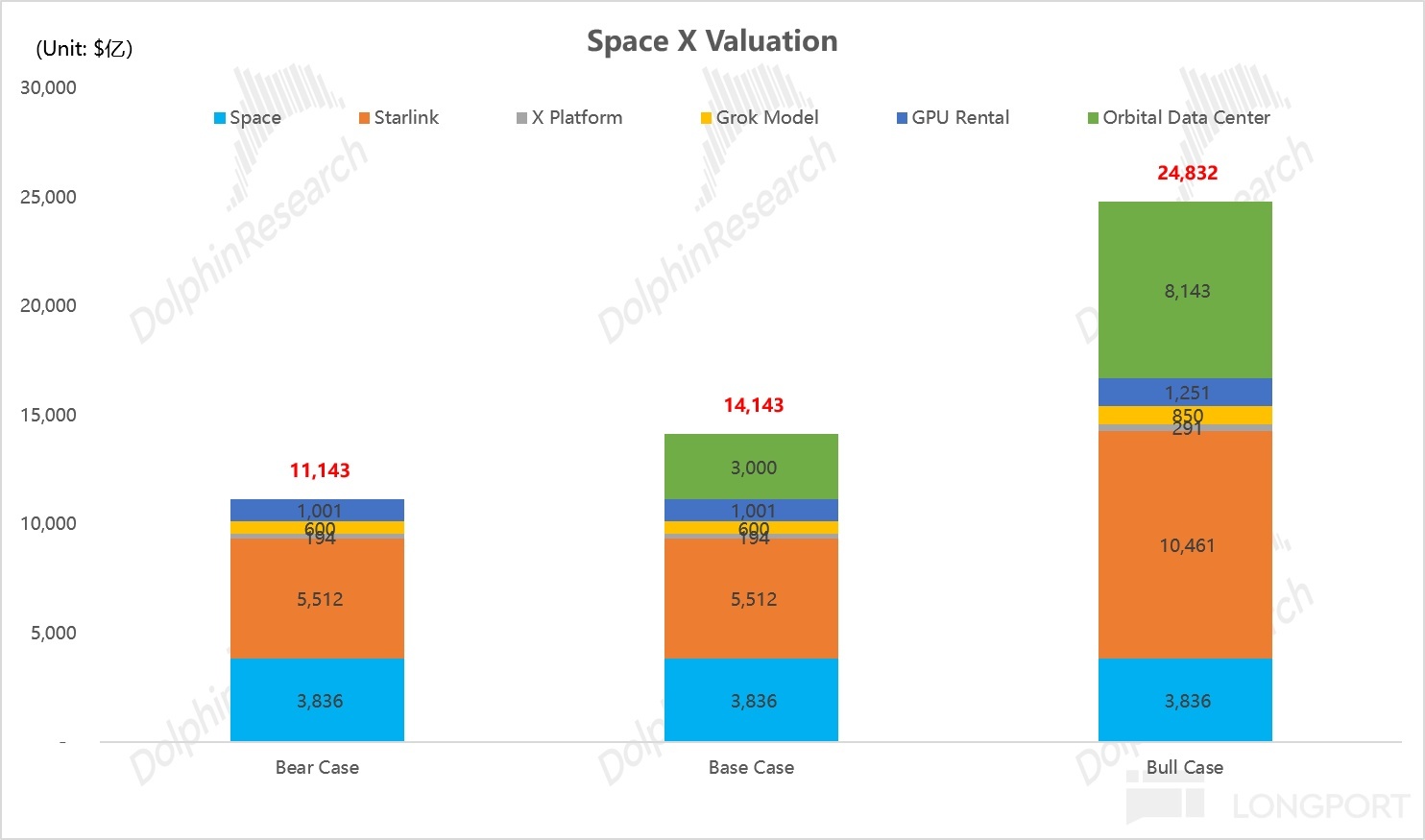
Hence, near term we see continued pressure from capex ROI skepticism and the unlock overhang, making further downside likely. Post the first unlock tranche, if shares pull back toward our $1.1–1.4tn value range in ' SpaceX: Space Compute — Vision or Real Future? ' (a conservative sum-of-parts excluding space data center optionality, valuing only launch + Starlink + current monetizable AI), we would consider buying in tranches on weakness.
At that point, successful Starship tests (full reuse most important), mass launch and deployment of V3 satellites, Grok 5 or Cursor ARR upside, and any new compute leasing deals could flip to positive catalysts for SPCX shares.
<End here>
Historical pieces by Dolphin Research:
Deep dives:
<From Daydream to Fortune: Is SpaceX Really That Sci-Fi?>
<SpaceX: Sky Net, Becoming Unbeatable?>
<SpaceX: Endless AI Burn — Is 'Space Compute Hegemony' the Endgame?>
<SpaceX: Space Compute — Vision or Real Future?>
<SpaceX Challengers: Can Bezos and China’s Teams Catch Up?>
<Musk’s Next Trump Card: Can SpaceX Reshape the Economics of Space?>
Risk disclosure and statement:Dolphin Research disclaimer and general disclosure
