


Morgan Stanley: Q3 is a Golden Window for Increasing Hong Kong Stock Allocations
Morgan Stanley recommends increasing allocations to Hong Kong stocks and raising the Hang Seng Index target to 28,400 points. The core logic lies in improved earnings expectations (easing price wars in the internet sector) and improved liquidity (significant underweighting by foreign capital and short covering). The firm is most bullish on the internet sector and believes IPO lock-up expiration pressure is limited, suggesting investors seize event-driven opportunities brought by the August adjustment to the Stock Connect
Hong Kong stocks are entering a window for increased allocation.
In its latest China equity strategy report, Morgan Stanley believes that as corporate earnings expectations improve, room for overseas capital inflows opens up, and the global market environment becomes more favorable, the logic for a Q3 rebound in Hong Kong stocks is further strengthening. The bank advises investors to increase their allocations to Hong Kong stocks currently and raises the base-case target for the Hang Seng Index to 28,400 points.
Morgan Stanley points out that Hong Kong stocks are currently benefiting from two main themes: fundamental improvement and improved liquidity conditions.
On one hand, Q2 earnings previews show that the pressure to downgrade corporate earnings has significantly eased, with earnings expectations stabilizing in key sectors such as internet and e-commerce. On the other hand, global market volatility has prompted continuous covering of financing short positions previously established against the Hong Kong market, while overseas active funds remain significantly underweight Chinese assets, providing a financial foundation for further gains in Hong Kong stocks.
Earnings Downgrades Slow, Internet Sector Becomes Core Support
Morgan Stanley believes that the core logic behind this round of Hong Kong stock recovery stems from improved earnings expectations.
Judging from Q2 earnings previews, the net proportion of positive earnings warnings among MSCI China constituents has risen to a relatively high level in recent years, indicating that corporate earnings are gradually bottoming out.
Among these, the improvement in the internet and e-commerce sectors is the most significant. The report notes that since regulators strengthened constraints on price competition in mid-April 2026, price wars in the e-commerce industry have noticeably eased, and the pressure to downgrade earnings for internet platform companies has significantly diminished.
At the same time, the AI industry is also providing new catalysts. As China continues to launch new generations of large models and continuously embeds AI capabilities into existing product ecosystems, market concerns about excessive capital expenditure expansion and earnings pressure on domestic large cloud vendors have eased.
Consensus expectation data shows that the EPS for the MSCI China Consumer Discretionary sector is expected to grow by 29% in 2026, the Information Technology sector by 42%, and the Materials sector by as much as 117%, all reflecting strengthening momentum in earnings recovery.
Foreign Capital Remains Underweight, Ample Room for Inflows
Morgan Stanley believes that overseas capital remains the largest potential source of incremental funds for Hong Kong stocks.
As of now, the allocation to Chinese stocks by global and emerging market active funds remains significantly below benchmark weights. Since 2026, the inflow of overseas mutual funds into the Chinese market has been only about half of the full-year 2025 level, with funds mainly coming from passive funds; active capital has not yet shown significant signs of returning.
In terms of holdings, global active funds are currently overweight Tencent by approximately 0.9 percentage points, while Alibaba remains underweight by 2.6 percentage points. In the semiconductor sector, domestic equipment and chip companies such as Montage Technology and AMEC have received higher active allocations, indicating that institutional funds continue to layout along the theme of domestic substitution.
Exchange rate factors also provide support. Morgan Stanley's China Economics team expects the USD/CNY exchange rate to appreciate to 6.72 by the end of Q3 2026 and 6.75 by year-end (indicating relative strength in the RMB). Exchange rate stability helps enhance the willingness of overseas capital to allocate to Chinese assets.
Limited IPO Lock-up Expiration Pressure, Hong Kong Financing Activity Continues to Rise
Regarding market concerns about IPO share lock-up expirations, Morgan Stanley believes they will not pose a systemic risk.
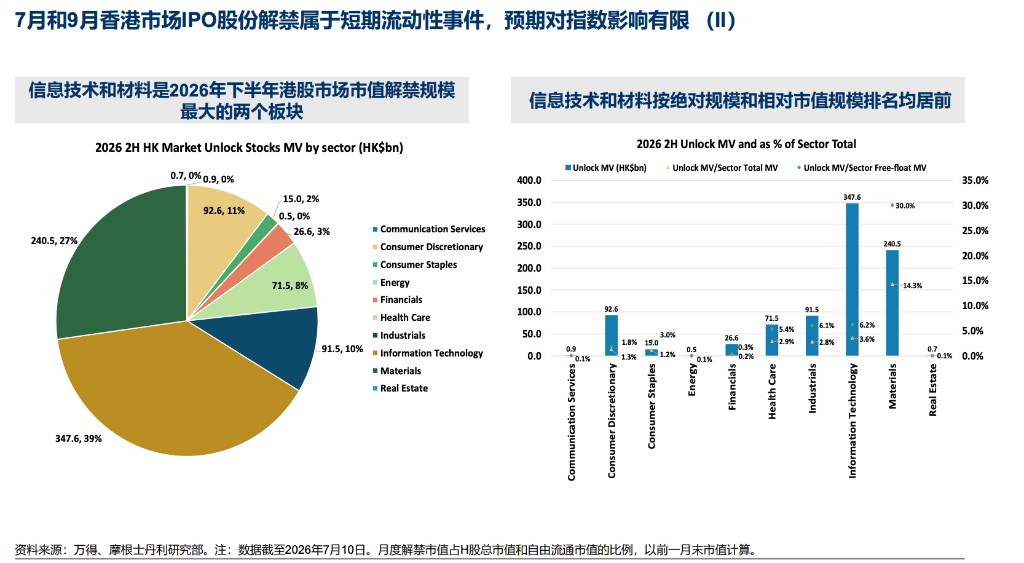
The report points out that July and September 2026 correspond to the second-largest and largest lock-up expiration months, respectively, over the past five years, with the information technology and materials sectors accounting for about 66% of the expiration scale in the second half of the year.
However, historical experience suggests that months with large-scale lock-up expirations do not necessarily correspond to weak market performance. Furthermore, the cumulative IPO lock-up expiration pressure since May has been continuously absorbed, so the impact on the index is expected to be limited, leaning more towards a short-term liquidity event.
Meanwhile, the primary market in Hong Kong, China, continues to warm up. Hong Kong's IPO fundraising reached $37 billion in 2025 and has further risen to $41.5 billion so far in 2026, continuing to rank as one of the most active IPO markets globally.
Allocation Advice: Overweight Internet, Seize Southbound Capital Event-Driven Opportunities
In terms of industry allocation, Morgan Stanley advises investors to increase their allocations to the internet sector, listing it as one of the most favored overweight directions in the current Hong Kong stock market to seize market recovery opportunities.
In addition, the bank plans to launch an event-driven strategy related to the inclusion and exclusion of stocks in the Stock Connect in early August, with a layout period of about one month. Morgan Stanley expects that the scope of new additions to the Stock Connect in September 2026 may cover multiple industries including information technology, industrials, and healthcare, with related sectors likely to attract capital attention.
Morgan Stanley stated that its China/Hong Kong, China focus list has achieved a cumulative return of 113.5% since its inception, outperforming the MSCI China Index by 70.6 percentage points. Looking ahead, the bank advises investors to reassess their Hong Kong stock allocations in late summer to seize structural opportunities amidst changes in the global market environment.
