


AMD's Sharp Drop Fails to Halt AI Leaders' Rally: NVIDIA Hits Two-Month High with Five-Day Winning Streak, Micron Rejoins 'Trillion-Dollar Club'
Following its earnings report, AMD fell nearly 8% during Wednesday's session, dragging the semiconductor index to end its four-day winning streak. Meanwhile, NVIDIA rose nearly 5%, with its market cap approaching $5.8 trillion, partly driven by Elon Musk's statement that SpaceX will lock in NVIDIA chips for future use. Micron surged over 4% during the session, emerging as a key beneficiary of the sustained release of AI memory demand
AMD's sharp drop following its earnings report did not stop capital from continuing to chase AI leaders.
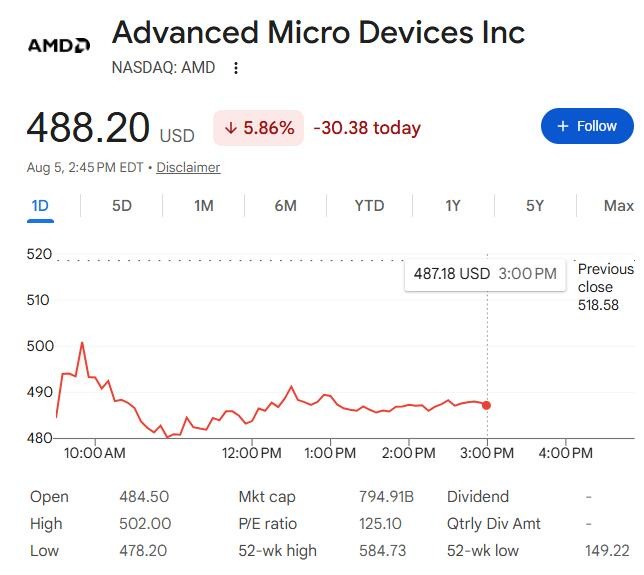
On Wednesday, U.S. chip stocks showed a clear divergence. After AMD's post-market performance guidance failed to meet high market expectations on Tuesday, its stock opened about 6.6% lower, dropping as much as 7.8% in early trading. This dragged the Philadelphia Semiconductor Index (SOX), which tracks 30 blue-chip chip stocks, to end its four-day winning streak, falling more than 1.6% when it refreshed its daily low in the morning.
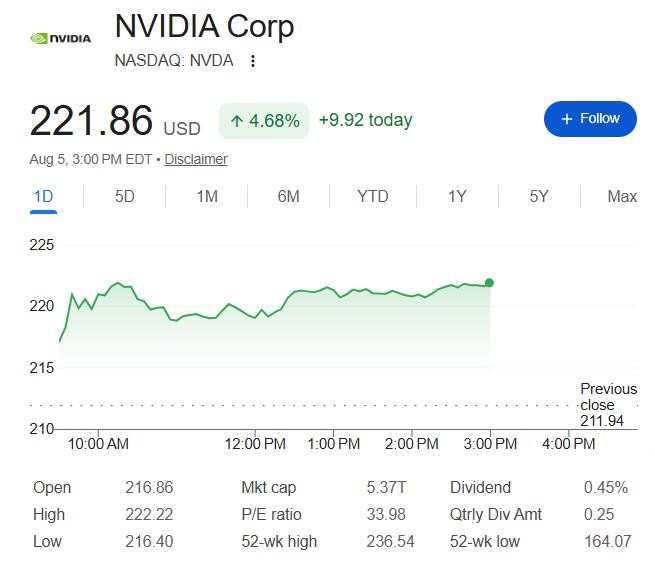
Meanwhile, AMD's fierce rival, the "number one" AI chipmaker NVIDIA, and memory chip giant Micron Tech continued to rise. NVIDIA climbed as high as $222.22 during the session, marking its highest intraday level since June 3, with a maximum daily gain of 4.85%. Its market cap approached $5.8 trillion, extending its winning streak to five consecutive trading days.
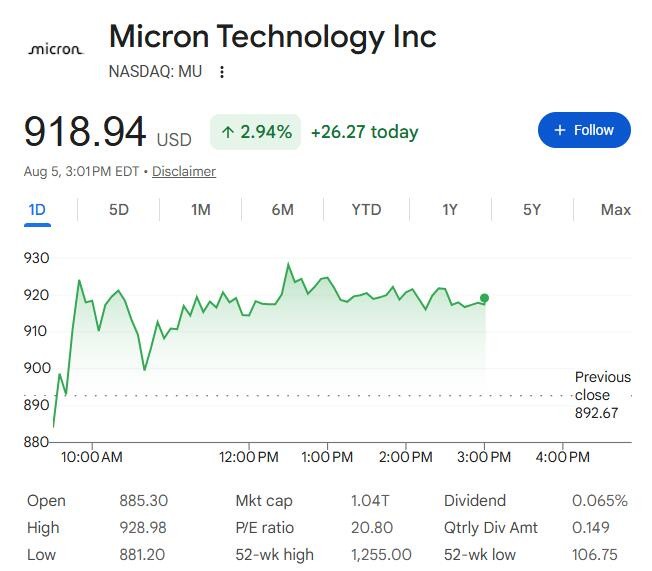
Micron rose for the third consecutive day, gaining nearly 4.1% when it hit a new daily high during Wednesday's session, pushing its market cap back above the $1 trillion mark.
Market participants believe that Wednesday's trading activity reflected not a cooling of AI trades, but further differentiation within the AI rally. After profit-taking triggered by AMD's performance guidance, capital did not flee the AI sector in large volumes; instead, it continued to flow toward leading companies with clearer competitive advantages and stronger earnings certainty. NVIDIA and Micron became representatives of this round of capital "huddling."
For NVIDIA, this round of rising prices resembles a short-term rebound driven jointly by sentiment, capital flows, and industrial catalysts. For Micron, however, its market cap returning to the $1 trillion threshold signifies that capital markets are further raising the valuation level assigned to memory chips in the AI era.
AMD Drags Sector into Correction, NVIDIA Defies Trend with Five-Day Winning Streak
Unlike the broad-based rally seen previously across industry stocks, semiconductor stocks exhibited a clear structural trend on Wednesday.
AMD's second-quarter earnings showed its performance continued to benefit from growing AI demand. However, the midpoint of its third-quarter revenue guidance, at $13 billion, failed to further exceed the market's more optimistic revenue expectations. After experiencing a significant rally previously, investors chose to take profits, causing AMD's stock to remain under pressure after hours and into the next day, becoming the main factor dragging the Philadelphia Semiconductor Index into correction.
In terms of timing, NVIDIA's current rebound coincides with a noticeable repair in market risk appetite.
Recently, tech giants such as Microsoft, Amazon, and Meta have continuously strengthened expectations for AI investment. The market expects global AI infrastructure spending to exceed $750 billion this year, potentially reaching the trillion-dollar level next year. Meanwhile, AI demand signals released during the U.S. earnings season were generally stronger than expected, driving capital to flow back into the semiconductor sector.
However, capital did not leave the AI main theme; instead, it concentrated further on industry leaders.
As of Wednesday, NVIDIA had risen for five consecutive trading days, touching a high of $222.22 during the session, its highest intraday level since June 3. Market analysis suggests this rebound was primarily driven by multiple factors: on one hand, large tech companies like Microsoft, Meta, and Amazon have continuously strengthened expectations for AI capital expenditure, keeping the market optimistic about the AI infrastructure investment cycle; on the other hand, recent improvements in U.S. inflation data have also boosted overall risk appetite for growth stocks.
At the same time, positive news surrounding NVIDIA's AI ecosystem continues to provide catalysts. Market expectations for the deployment of new-generation AI servers, the construction of hyperscale data centers, and the continuous expansion of AI inference demand have kept NVIDIA as the preferred choice for capital allocating to AI computing power assets.
During SpaceX's post-market earnings call on Tuesday, CEO Elon Musk stated that SpaceX would fully adopt NVIDIA chips in the future, describing its Vera Rubin architecture as one of the best AI computing platforms currently available. This news further reinforced the market's perception of NVIDIA's dominance in AI infrastructure, becoming an important catalyst driving the stock price higher on Wednesday.
From a technical perspective, rising for five consecutive days and hitting a two-month high means NVIDIA has largely recovered most of the adjustment losses since early June, also showing that capital is retesting previous high-level areas. However, compared to the all-time high (ATH) set in May this year, the current stock price still has some distance to cover. This round of rising prices reflects more of a short-term trend repair rather than a breakthrough to a new ATH.
For short-term traders, the significance of hitting a two-month high lies in NVIDIA returning to a range close to historical highs. Market focus is gradually shifting from "whether AI investment is overheating" to "whether AI demand can continue to exceed expectations."
Leader Effect Strengthens, NVIDIA's $5.8 Trillion Market Cap Continues to Reshape Market Landscape
As the stock price continues to climb, NVIDIA's total market cap approached $5.8 trillion on Wednesday, further consolidating its position as the world's most valuable technology company.
For the market, NVIDIA's importance extends far beyond the company itself. As a core beneficiary of the AI computing power supply chain, NVIDIA has become a significant weight in global tech stocks and even U.S. stock indices. Its stock price volatility has an increasingly prominent impact on the Nasdaq Composite and S&P 500 indices.
More noteworthy is that NVIDIA's counter-trend rise occurred against the backdrop of a broader correction in the semiconductor index. This means the market's trading logic is gradually shifting from the previous widespread chasing of AI concept stocks to a repricing of leading enterprises' competitive advantages and earnings realization capabilities.
Compared to the overall valuation expansion of the industry, capital now prefers to concentrate allocations on AI leaders with scale advantages, technological leadership, and demand certainty. This is also an important reason why NVIDIA could continue to attract capital inflows while the sector faced pressure.
Micron's Market Cap Returns to $1 Trillion, AI Memory Leader Sees New Round of Valuation Reassessment
If NVIDIA represents AI computing power, then Micron has become an important beneficiary of the sustained release of AI memory demand.
On Wednesday, Micron rose for the third consecutive day, gaining nearly 4.1% at one point during the session, with its market cap breaking through $1 trillion again. This marks the company's return to the "trillion-dollar club" after previously breaking through this integer threshold.
Behind this market cap milestone reflects the capital market's continuous reassessment of the value of the AI memory supply chain.
On Wednesday, Micron rose for the third consecutive day, with its market cap breaking through the $1 trillion mark again. This is the second time it has stood above this symbolic threshold after initially breaking through it.
Compared to its past image as a traditional memory manufacturer reliant on PC and smartphone cycles, Micron is increasingly viewed by the market as a core supplier of AI infrastructure.
As AI training and inference drive rapid growth in memory bandwidth demand, High Bandwidth Memory (HBM) has become one of the most critical core components of AI servers. The market generally expects that HBM will maintain a tight supply-and-demand pattern in the coming years. As one of the major global suppliers of HBM, Micron is seen as an important beneficiary of the AI infrastructure investment cycle.
Compared to when its market cap was around $800 billion, the higher valuation the market now assigns to Micron is not just due to the improvement in the memory industry's prosperity. More importantly, investors are beginning to view it as an important component of AI infrastructure, rather than just a traditional memory chip manufacturer.
Wednesday's market performance also showed that capital is not only continuing to bet on GPU leader NVIDIA but is simultaneously raising the valuation level for AI memory leaders.
The sharp drop in AMD's stock price after its earnings report formed a stark contrast with the counter-trend rises of NVIDIA and Micron, reflecting that the current AI rally is entering a new stage. The market has not abandoned the AI main theme but is conducting stricter screening based on earnings realization, competitive barriers, and growth certainty. For investors, AI trading continues, but capital is increasingly concentrating on a few core leaders with leading advantages, rather than a broad-based rally across the entire sector.
