


Top 20 U.S. Stock Trading Volumes on August 6: Musk Claims SpaceX Will Only Use NVIDIA Chips for Future AI Infrastructure
On August 6th, the top three stocks by trading volume in the US market were NVIDIA, Micron, and AMD. NVIDIA rose by 3.43%, reaching a two-month high, as Musk announced that SpaceX's future AI infrastructure will exclusively use NVIDIA chips. Analysts believe its strength stems from solid AI demand, capital inflows, and a favorable macro environment. Micron slightly increased by 0.06%, while the "big short" Paulson continued to hold its short position. AMD plummeted by 7.04%
On Wednesday, NVIDIA, the top stock in U.S. trading volume, rose 3.43%, with a trading volume of $34.256 billion. By the close of trading on Wednesday, NVIDIA's stock price had increased for five consecutive trading days, reaching a two-month high. After a brief pullback in the sector, this computing powerhouse made a strong comeback, significantly boosting sentiment in the global AI hardware supply chain.
Elon Musk stated on Wednesday that SpaceX will only use NVIDIA processors in building artificial intelligence computing infrastructure in the future. During the SpaceX earnings call, he mentioned that NVIDIA has "the best AI computers" and added, "We only choose NVIDIA."
Analysts say that the core drivers behind NVIDIA's recent sustained strength mainly come from four aspects: first, the medium to long-term demand for AI computing power remains solid, with global cloud providers and tech companies continuously increasing investments in AI infrastructure, leading to full GPU orders, and the demand for high-end graphics cards driven by the scaling of artificial intelligence has not weakened; second, funds are flowing back to safe havens, as the panic in the chip sector triggered by AMD's earnings has been fully released, with capital re-entering the computing leader with the strongest earnings certainty; third, the iterative improvement of industry technology is raising valuation expectations, as the continuous rollout of new generation GPUs, optical interconnects, and AI acceleration solutions prompts institutions to continuously raise long-term revenue outlooks; fourth, the overall environment for U.S. stocks is favorable, with indices hitting new highs and liquidity being loose, providing a conducive environment for tech growth stocks. Overall, NVIDIA's strong performance is the result of the resonance of multiple factors, including fundamentals, capital flows, industry trends, and macroeconomic conditions, with short-term fluctuations not altering the long-term upward logic.
Micron, ranked second, rose 0.06%, with a trading volume of $30.416 billion. Notable investor and major short seller Bill Ackman stated on Wednesday that he continues to hold short positions in the iShares Semiconductor ETF (SOXX), Micron, NVIDIA, Caterpillar, Palantir, Tesla, and Applied Materials. This investor expressed confidence in the long-term prospects of these positions.
AMD, ranked third, fell 7.04%, with a trading volume of $23.619 billion. Although the company's latest financial data was generally positive, it did not fully match the capital market's strong expectations for explosive growth in the artificial intelligence industry. Data shows that AMD expects third-quarter revenue of approximately $13 billion, exceeding the previous expectation of $12.52 billion from industry analysts, with its core data center business revenue doubling to $6.72 billion, surpassing market expectations. Several financial research institutions have pointed out that due to the earnings reports of other companies in the industry and the recent significant rise in AMD's stock price, the capital market has already overdrawn bullish sentiment and set extremely high evaluation standards, resulting in its objectively good performance failing to effectively boost the stock price.
In terms of market competition, SpaceX CEO Elon Musk's decision to fully adopt NVIDIA's chips for building computing infrastructure has further increased downward pressure on AMD's stock price.
SpaceX, ranked fourth, fell 13.61%, with a trading volume of $22.538 billion. This rocket company released its first quarterly report since going public in June The company stated that capital expenditures in the second quarter soared sixfold to $18.4 billion, exceeding analysts' expectations, with most of the spending directed towards artificial intelligence.
SanDisk, ranked 5th, fell 5.40% with a transaction volume of $19.891 billion. SanDisk announced its Q4 fiscal report for FY2026 after the market closed on Wednesday: revenue was $8.96 billion, a year-on-year increase of 372%, compared to market expectations of $8.394 billion and $1.901 billion in the same period last year. The company expects Q1 revenue for FY2027 to be between $10.3 billion and $10.8 billion, with market expectations at $10.8 billion.
Google Class A shares (GOOGL), ranked 6th, fell 4.03% with a transaction volume of $16.992 billion. The company announced on Wednesday that its AI division will undergo restructuring, and Chief Scientist Jeff Dean will leave the company after 27 years.
According to a memo released by Google CEO Sundar Pichai on the Google blog, Demis Hassabis, CEO of Google DeepMind, will transition to the role of chairman of the division while also serving as Chief Scientist of the parent company Alphabet.
Dean is a pioneer in the field of artificial intelligence and has contributed to some of Google's most significant technological breakthroughs. He will co-found his own company with Google Senior Researcher Sanjay Ghemawat. A representative stated that the departure is amicable, and Google will invest in his startup.
Palantir, ranked 11th, fell 2.60% with a transaction volume of $9.815 billion. Palantir recently reported second-quarter sales that far exceeded Wall Street expectations and raised its revenue and profit forecasts for the year. The CEO stated that the company's performance is "extraordinary," with strong growth momentum expected to last at least 18 months, countering market concerns that AI startups will replace its business.
The financial report showed that the company's second-quarter revenue reached $1.935 billion, a year-on-year increase of 93%; net profit reached $1.062 billion, a year-on-year increase of 55%; diluted earnings per share (EPS) were $0.41, higher than the market expectation of $0.35.
Eli Lilly, ranked 15th, rose 4.86% with a transaction volume of $7.474 billion. In its latest financial report, Eli Lilly raised its sales guidance for 2026, as the company's weight loss drug business performed far better than expected in the second quarter, alleviating investor concerns about the "weight loss drug craze cooling down."
Eli Lilly stated on Wednesday that it expects total sales for 2026 to be between $85 billion and $87 billion, higher than previous expectations. Additionally, the company's adjusted earnings and revenue for the second quarter also exceeded Wall Street expectations.
The diabetes drug Mounjaro performed above all expectations in the quarter, with sales of this injectable drug soaring 91% year-on-year as it expands into more global markets. The weight loss drug Zepbound also exceeded Wall Street expectations, and the newly launched oral weight loss drug Foundayo had a strong start Shopify, ranked 17th, rose by 16.98%, with a transaction volume of $5.941 billion. The company's previously announced third-quarter revenue outlook exceeded market expectations. Shopify stated that it expects its revenue to achieve "growth rates in the low 30% range." This growth rate will be higher than Wall Street's previous expectation of 27% and means that the company's revenue growth has exceeded 30% for the sixth consecutive quarter. Analyst Anurag Rana noted in a report that, as this quarter began, rising costs associated with artificial intelligence were initially expected to compress profit margins. Shopify mentioned in its earnings call in May that more than half of its code is generated through artificial intelligence.
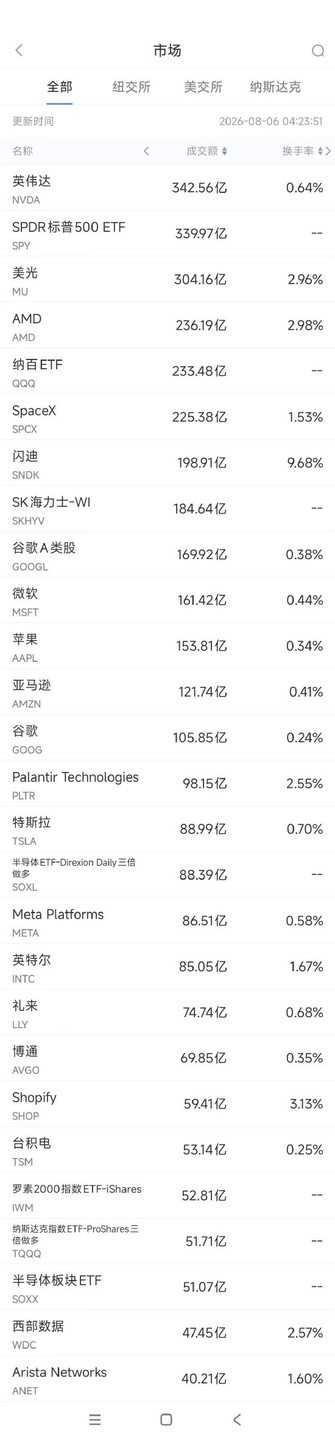
(Screenshot from Sina Finance APP Market - US Stocks - Stock Market Sector Swipe for more data) Download the Sina Finance APP
