


TMT Funds Suffer Historic Losses! JPMorgan: AI Trading May Increasingly Rely on Retail Capital
A JPMorgan report indicates that TMT hedge funds suffered historic losses in July, with single-month losses reaching 10.2%, driven by forced deleveraging in semiconductor and memory stocks. The losses would be even more severe if the Situational Awareness fund were included. Multi-strategy funds also lost 2.3%. The report points out that this setback will structurally compress the capacity to hold technology positions through mechanisms such as declining assets under management and tighter risk controls, triggering reflections on concentration risk and liquidity management
A wave of forced deleveraging concentrated in semiconductor and memory stocks caused TMT hedge funds to suffer their worst single-month loss on record in July. The subsequent impact of this shock may be far more profound than the numbers themselves suggest.
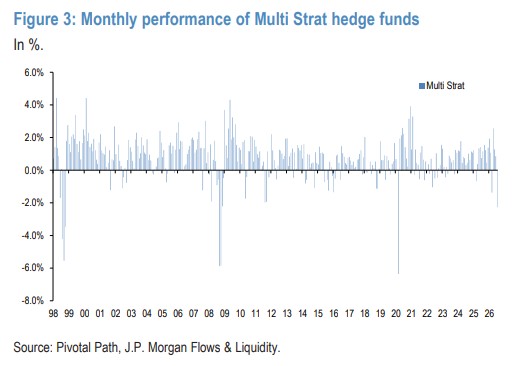
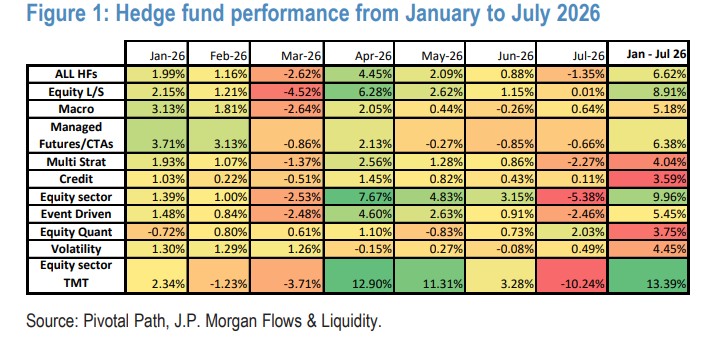
According to Zhuifeng Trading Desk, JPMorgan's "Flows & Liquidity" report released on August 5, citing preliminary data from Pivotal Path, stated that TMT equity hedge funds lost 10.2% for the month, while multi-strategy funds lost 2.3%.
At the core of these losses was the forced liquidation of positions concentrated in semiconductor and memory stocks.
Historic Losses: Forced Liquidation Behind the Numbers
The 10.2% figure does not tell the whole story.
JPMorgan's report noted that the aforementioned loss figures exclude the Situational Awareness fund—whose assets under management reportedly plummeted from $45 billion to $10 billion. Including this fund, the actual losses for TMT funds in July would be even more startling.
Citing historical data from Pivotal Path, the report stated that if final data is confirmed by more funds, July will become the largest single-month loss ever for TMT equity hedge funds.
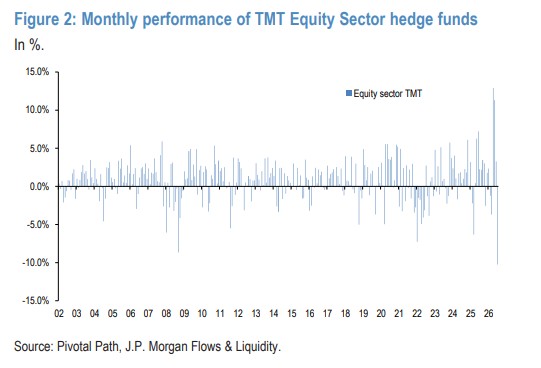
Multi-strategy funds were not spared either. JPMorgan pointed out that their 2.3% single-month loss ranks fourth in history. To find larger single-month losses, one must look back to the March 2020 pandemic crisis, the 2008 Lehman crisis, or the bursting of the internet bubble in 2000.
In the report, JPMorgan directly raised a series of questions regarding risk management: "Is concentration risk underestimated? Are volatility/correlation risks in option positions mishandled? Have stop-loss/risk budget disciplines failed or been overridden? Have financing/margin/liquidity dynamics been insufficiently stress-tested?"
Structural Impact: Hedge Fund Position-Holding Capacity May Be Long-Term Constrained
The impact of a single loss event does not end there.
JPMorgan's analysis suggests that the July setback will structurally compress the ability of TMT industry funds and multi-strategy funds to hold technology positions through multiple mechanisms:
First, a decline in AUM directly leads to a mechanical contraction of risk budgets;
Second, funds may proactively tighten their risk management frameworks and raise concentration limits;
Third, prime brokers may reduce the balance sheet space allocated to such strategies.
The superposition of these three pressures means that the capacity of these two types of funds to absorb technology stock positions will systematically decline in the future.
New Concerns for AI Trading: Will Retail Investors Become the Last Buyers?
This structural change leads to the most noteworthy judgment in JPMorgan's report.
The report explicitly states: "If the above judgment holds true, and the capacity of hedge funds to hold technology positions structurally declines, then technology trading will increasingly rely on retail investors over the longer term, making it more susceptible to volatility shocks from leveraged ETFs, retail option buying, and retail margin accounts."
The logical chain is clear: Institutional capital retreats → Marginal pricing power for technology stocks (especially AI-related targets) shifts to retail investors → Market volatility structurally rises.
Retail capital is characterized by emotion-driven behavior, concentrated leverage, and weak stop-loss discipline. Once it becomes the main supporting force for AI trading, the rise and fall of the technology sector will depend more on the fluctuations of retail sentiment than on changes in fundamentals.
The above exciting content comes from Zhuifeng Trading Desk.
For more detailed interpretations, including real-time analysis and frontline research, please join [Zhuifeng Trading Desk ▪ Annual Membership]

Risk Warning and Disclaimer
The market carries risks; investment requires caution. This article does not constitute personal investment advice, nor does it take into account the specific investment objectives, financial status, or needs of individual users. Users should consider whether any opinions, views, or conclusions in this article align with their specific circumstances. Investment decisions made based on this content are at the user's own risk.