


Zuckerberg Takes on DeepSeek
Meta Platforms has launched its coding agent, Muse Code, and the Muse Spark 1.2 model. Its pricing strategy is significantly lower than that of DeepSeek-V4-Flash, offering a 5% discount to users who allow data sharing. On the same day, DeepSeek announced it would raise API prices. This move has drawn attention to the global price war among large language models, with Meta vying for user data at extremely low prices, while domestic models such as Z.AI's GLM also face pressure to adjust prices
Zhidx.com reported on August 6 that today, Meta Platforms launched its first coding agent—Muse Code (beta), along with the new-generation model Muse Spark 1.2 powering the agent.
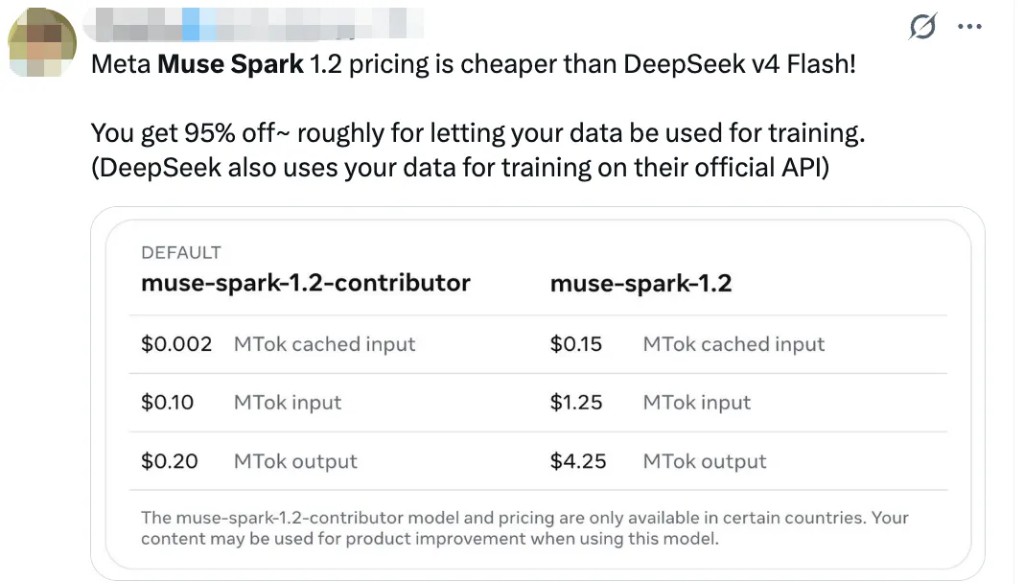
The model’s release immediately sparked heated discussion overseas, with the core focus squarely on its pricing strategy: cheaper than DeepSeek-V4-Flash. If users allow Meta Platforms to use their data to train the model, they can enjoy a 5% discount.
Interestingly, on the same day, DeepSeek issued an announcement stating: “We plan to overall raise API service pricing in the near future, with expected significant increases.” Other leading domestic models also show signs of easing price wars; for instance, the price of Z.AI’s GLM model will rise significantly after the current promotional period ends.

As overseas giants like OpenAI and Meta Platforms plunge into the price war, domestic models like DeepSeek seem to be playing by different rules, making this global melee among large language models increasingly intriguing.
Up to 75-Fold Price Cut: Meta Targets User Data
Zuckerberg stated in a post: “(This model) is positioned as simple to get started with and low-cost, requiring only a single line of code to install and begin using the ‘Contributor Tier.’”


The so-called “Contributor Tier” refers to Meta Platforms offering two API versions: one that allows data sharing and another that does not. The former has an input price of $0.10 per million tokens, which is 12.5 times cheaper than the latter; cached input is $0.002 per million tokens, 75 times cheaper; and output is $0.20 per million tokens, more than 21 times cheaper.

Some netizens joked: “Hilarious. Muse Spark’s input and output costs are both lower than DeepSeek-V4-Flash, and it features uniquely optimized cache hit rates. They don’t care about profits; they just want the data.”

Previously, on July 31, DeepSeek-V4-Flash officially launched its API. The model was priced at 1 yuan per million tokens for inputs without cache hits, 0.2 yuan per million tokens for inputs with cache hits, and 2 yuan per million tokens for outputs.

DeepSeek Is “Too Strong for a Flash Model” Can Meta Keep Up?
DeepSeek-V4-Flash is currently generating a new wave of enthusiasm globally. Since the launch of its API, its reputation for exceptional cost-performance ratio has continued to climb.
The co-founder and CEO of Platzi, a leading online education platform in Latin America, just posted today, remarking: “I completely don’t understand how DeepSeek-V4-Flash achieves this speed and quality. It’s incredible.”
Other netizens were even more direct: “Claude is dead. There is no reason for the world to remain constrained by a supplier whose prices are a hundred times higher while performance is on par with competitors.”

However, DeepSeek-V4-Flash’s reputation stems not only from its low price but also from its performance.
This model’s benchmark results far exceed those of its own “older brother,” DeepSeek-V4-Pro-Preview, which launched in April. To this day, many overseas users continue to express excitement, saying: “It doesn’t feel like a Flash model at all anymore.” In the Almanbench tests, the DeepSeek-V4-Flash 0731 version surpassed Kimi K3, with scores nearly comparable to GPT-5.6 Sol xhigh.

So, how do Meta’s latest Muse Spark 1.2 and Muse Code beta perform as they attempt to compete with DeepSeek on price?
Coding Evaluation Second Only to Opus 5 Muse Spark 1.2 Still Lags Behind Frontier Models
In terms of model performance, Muse Spark 1.2 shows significant improvement over its predecessor, but there is still a certain distance from frontier models.
Muse Spark 1.2 is an updated version specifically optimized for coding. In code capability benchmarks such as Terminal‑Bench 2.1 and DeepSWE 1.1, its overall results were second only to Claude Opus 5, outperforming GPT‑5.6, Grok 4.5, and Gemini 3.6.

In the complex reasoning GDPVal‑AA V2 test, Muse Spark 1.2 ranked second only to Opus 5; in the Agent tool invocation MCP Atlas benchmark, Muse Spark 1.2 took the top spot.

Meta tested the model’s ability to iteratively optimize GPU kernels during over 1,000 tool calls (spanning up to 24 hours). Leveraging the Muse Code agent coding environment, the model performed better than Gemini 3.6 Flash and GPT-5.6 Terra, but lagged behind GPT-5.6 Sol and Opus 5.


Muse Code is positioned as a terminal coding agent capable of handling complete software engineering tasks within large codebases, including planning changes, writing code, and verifying results. Meta has published a series of case studies, but whether it can truly compete with Claude Code and Codex remains to be seen through real-world developer scenarios.
As shown in the case study below, Muse Code employs a simple agent loop, supplemented by a set of asynchronous background agents to enhance the main agent’s capabilities. Their continuous operation reduces latency and minimizes the need for human intervention in complex, multi-step tasks.


The figure below shows a user inputting a house tour video as an MP4 file into the terminal. Muse Code parses the video and generates a visually rich marketing and booking page for the vacation home.

Additionally, Muse Spark 1.2 scored 54 points in the Artificial Intelligence Analysis Index (AII). Compared to previous versions, its agent knowledge work capabilities have improved significantly, tying Meta with SpaceX AI for third place among US labs.

Conclusion: Meta Cuts Prices to Grab Customers, DeepSeek Raises Prices to Prepare for Battle – The AI Price War Masks a Tough Fight for Agents
Following OpenAI’s price cuts, Meta is also engaging in a price war within the US AI circle. Meta aims to carve out a share under the dominance of OpenAI and Anthropic, and has entered the terminal coding agent market for the first time in an attempt to regain a seat at the table. Meanwhile, recent major internal adjustments at Google DeepMind have provided Meta with a window of opportunity.
Low prices may be an effective traffic-driving strategy, but breaking through requires higher model performance and token quality. This is also why DeepSeek-V4-Flash has once again become popular overseas.
Notably, DeepSeek announced today that it plans to overall raise API service pricing in the near future. It is evident that DeepSeek is not limiting competition to a price war but continues to focus on competing on model quality. Recently, DeepSeek has been aggressively recruiting talent for its Agent Harness and actively courting excellent open-source projects. Its Agent Harness product (possibly named DeepSeek Code) is being vigorously developed.
It is foreseeable that the price war is merely the prologue. Competition across all dimensions surrounding agents—including computing power, performance, price, applications, and ecosystem—will intensify.
Source: Zhidx.com
Risk Warning and Disclaimer
The market involves risks, and investment should be approached with caution. This article does not constitute personal investment advice, nor does it take into account the specific investment objectives, financial status, or needs of individual users. Users should consider whether any opinions, views, or conclusions in this article align with their specific circumstances. Investors bear full responsibility for their own investment decisions.
