


Stock Market Plunge: Is South Korea Making Arrests? Latest Response from the Blue House
The South Korean presidential office responded to the stock market plunge and the controversy surrounding Leveraged ETFs, emphasizing its focus on monitoring market volatility and formulating countermeasures. Previously, Kim Yong-beom, Director of the Policy Coordination Office at the Presidential Office, faced criminal accusations for abuse of power after being reported for promoting single-stock Leveraged ETFs. These ETFs were deemed to have exacerbated market volatility, causing massive losses for investors. The whistleblower alleged that he instructed financial authorities to rush the introduction of these products, suspected of obstructing the proper exercise of authority
On August 6, it was reported that Sung Ki-hong, Senior Secretary for Public Relations and Communication at the South Korean Presidential Office, responded to calls holding Kim Yong-beom, Director of the Policy Coordination Office at the Presidential Office, accountable for the launch of single-stock Leveraged ETFs. He stated: “At present, it is more important to closely monitor the market and formulate corresponding countermeasures.” In an interview that day, Sung Ki-hong said, “Both the real estate market and the stock market are experiencing high volatility, which has a significant impact on people's livelihoods,” adding, “All officials at the Presidential Office are carefully examining each situation and studying how to develop relevant measures.”
Kim Yong-beom, Director of the Policy Coordination Office at the South Korean Presidential Office, was previously reported for abuse of power regarding Leveraged ETFs.
On August 3, Korea JoongAng Daily reported that Kim Yong-beom, Director of the Policy Coordination Office at the Presidential Office, faced criminal charges over Leveraged ETFs. The report indicated that Kim Yong-beom faced criminal litigation for charges including abuse of power, coercion, and obstruction of business due to the launch of Leveraged ETFs linked to a single semiconductor stock. These products were considered to have exacerbated market volatility, leading to billions of dollars in losses for investors.
Lee Jong-bae, a former member of the Seoul Metropolitan Council, stated on the 3rd that he had reported Kim Yong-beom to the Supreme Prosecutors' Office over the matter on that day.
Lee Jong-bae believed that Kim Yong-beom had stated in a media interview in January this year, “If Nasdaq can do it, why can't we do it domestically,” and based on this, instructed financial authorities to study the introduction of single-stock Leveraged ETFs.
Shortly after this interview was published, Lee Eui-yeon, Chairman of the Financial Services Commission, immediately stated that the launch of single-stock 2x Leveraged ETF products would be approved.
Lee Jong-bae also claimed that there were signs that the Financial Services Commission had been internally discussing a plan since January this year to “improve systems and infrastructure in the second quarter and launch products in the second half of the year.”
“Without Kim Yong-beom's instructions, financial authorities would not have rushed to introduce single-stock Leveraged ETFs, which were expected to have serious side effects, just before the election, and investors' losses could have been minimized.” Lee Jong-bae stated that although the Financial Services Commission had acknowledged the risks, Kim Yong-beom still ordered the study of introducing single-stock Leveraged ETFs. This constitutes abuse of power and obstruction of the financial authorities' proper exercise of power, amounting to the crime of abuse of power obstructing the exercise of rights; if there was a scenario of forcing the introduction through external pressure, it would also constitute the crimes of coercion and obstruction of work by intimidation.
He further criticized, “Industry players and experts had issued warnings, and the Financial Services Commission had also acknowledged the risks, yet they still rushed to introduce single-stock Leveraged ETFs at the sensitive timing just before the election, causing losses for a large number of investors. This is a malicious act of Painting The Tape orchestrated by the state, tantamount to rare manipulation of state affairs.”
Last week, the South Korean stock market triggered circuit breakers for two consecutive trading days, and market panic spread rapidly. According to a July 29 report by Korea JoongAng Daily, Kim Yong-beom, who was accompanying the President on a visit to Brazil at the time, stated that the government was closely monitoring the market and that it was not yet time to activate the Stock Market Stabilization Fund. He characterized this round of steep declines as a “reassessment process” for the market to find an equilibrium point and stated that the focus would be on studying which structural factors amplified this round of volatility, with further measures to be taken as appropriate.
Kim Yong-beom also attributed the high volatility of the South Korean stock market to structural issues such as active retail trading, the proliferation of derivatives, and the excessive weighting of semiconductor leaders, stating that “not all problems can be attributed to that one cause.”
South Korean online news media Fntoday stated that these remarks quickly sparked a strong backlash in South Korean online communities and among investor groups. Critics argued that regulators had previously hyped the market to attract retail investors, but now that the market has crashed, they are shirking responsibility by citing “market self-regulation,” showing contradictory attitudes.
The South Korean National Assembly also held a heated hearing last week.
Lawmakers from different parties demanded explanations from the government and attempted to reconstruct the sequence of events: Did South Korea move faster than its regulatory framework when launching Leveraged ETFs, thereby exposing retail investors to unnecessary and huge risks?
The South Korean government has long attempted to guide household savings from real estate and overseas investments into its domestic capital market, and the approval of new Leveraged ETFs is part of this strategy.
Therefore, by the end of May, after regulators expedited the approval process, the first batch of single-stock Leveraged ETFs tracking Samsung Electronics and SK Hynix was officially listed in South Korea.
Park Soo-young, a lawmaker from the main opposition People Power Party and a member of the National Assembly's Planning and Finance Committee, stated in an interview: “The entire process was forced through at an unusual speed. Without instructions from the Presidential Office, this would not have been possible so quickly.”
Since July, South Korean regulators have sequentially introduced a series of deleveraging measures to address severe stock market volatility.
According to a August 2 report by Chosun Ilbo, South Korean financial regulators are considering introducing “emergency action authority,” aiming to quickly reduce the leverage multiples of single-stock leveraged products when necessary. Currently, such products generally track 2x returns; if emergency authorization is triggered, the multiple could be reduced to 1.5x or even 1x.
Ahn Dong-hyun, a professor in the Department of Economics at Seoul National University, commented: “If the approach of reducing the leverage multiple of only new purchases to 1.5x and gradually shrinking the scale of existing positions is adopted, it will be able to reduce market volatility.”
Additionally, according to an August 2 report by Dong-A Ilbo, amidst the chaos surrounding individual stock leveraged products leading to a surge in responsive measures, the Korea Exchange has notified major asset management companies that, starting this month, it will effectively make it difficult to normally process new listing reviews for ordinary ETFs. If the exchange's review is delayed, the Securities and Exchange Commission's review of securities registration statements and listing schedules will also be postponed sequentially, potentially hindering the entire ETF issuance process. Although regulatory authorities are not directly rejecting the acceptance and issuance of ordinary ETFs, this will effectively have the effect of restricting new applications.
Amidst the impact of multiple disruptions, the South Korean stock market experienced another severe sell-off on August 3. By the close of trading that day, the South Korean KOSPI Index plummeted 5.12% to 6,257.45 points; heavyweight stocks SK Hynix and Samsung Electronics both fell nearly 9%. In early trading, the South Korean KOSDAQ Index briefly triggered the SIDECAR mechanism due to the decline, suspending program trading for 5 minutes.
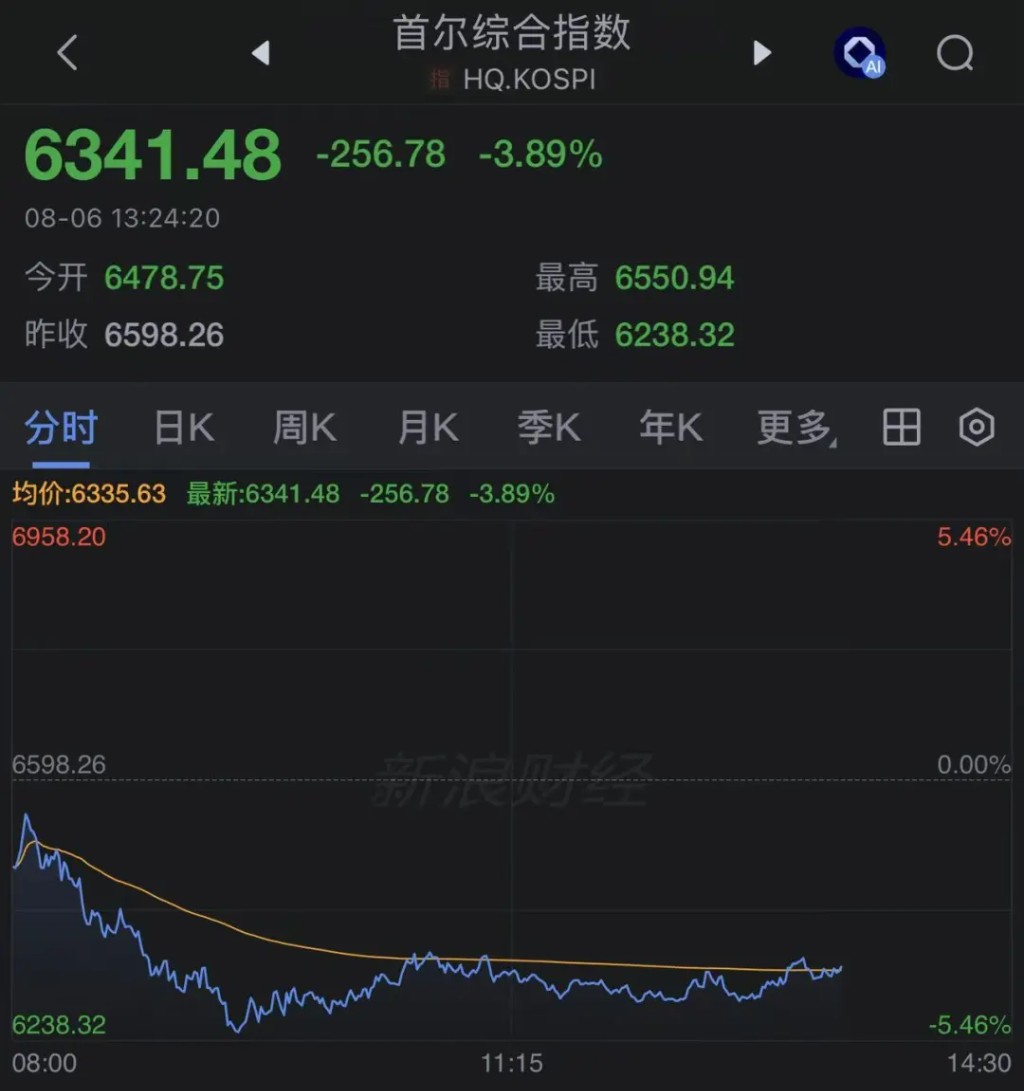
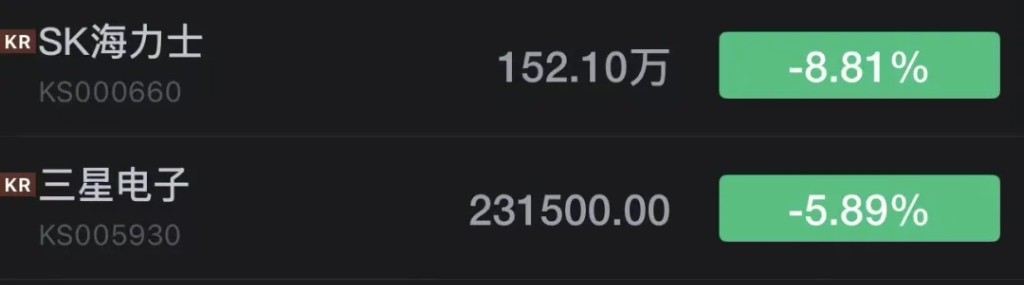
On August 6, the South Korean KOSPI Index once fell more than 5%. As of press time, the decline in the South Korean Composite Index had narrowed to 3.89%. In terms of individual stocks, Samsung Electronics fell nearly 6%, and SK Hynix fell nearly 9%.
CITIC Securities pointed out that retail leverage in South Korea has currently been rapidly reduced, but observed indicators show that risks have not been completely cleared. The balance of broker financing shrunk by 10% in a single day on July 31, marking the largest drop of the year, indicating that on-exchange leverage is still being rapidly reduced. Meanwhile, the amount of retail forced liquidations on July 30 and 31 still exceeded 100 billion South Korean won in a single day, with the liquidation rate remaining at a high level of 7%–8%, far above the 1% level under stable market conditions. The scale of the South Korean stabilization fund is limited, and the entry of the National Pension Service poses moral hazards. It is expected that market volatility will remain at a relatively high level in the future.
Source: National Business Daily
Risk Warning and Disclaimer
The market involves risks; investment should be approached with caution. This article does not constitute personal investment advice, nor does it take into account the specific investment objectives, financial status, or needs of individual users. Users should consider whether any opinions, views, or conclusions in this article align with their specific circumstances. Investors bear full responsibility for their own decisions.
