


Nobel Laureate Steps Aside, Co-Founder Brin Returns—The Power Struggle Behind Google's AI Leadership Shake-up
Demis Hassabis, founder of DeepMind and Nobel laureate, has stepped down from his operational role to become Chief Scientist, handing over daily management to Koray Kavukcuoglu. The center of AI decision-making is shifting from London back to Silicon Valley, with co-founder Sergey Brin deeply involved in Gemini development. This restructuring marks Google's comprehensive transition from a "research-led" approach to "commercial monetization" in its effort to catch up with OpenAI and Anthropic
Google is undergoing a profound restructuring of its artificial intelligence leadership, as its decade-long "research-led" culture gives way entirely to "commercial monetization."
Wall Street News mentions that Demis Hassabis, founder of Google DeepMind and winner of the Nobel Prize in Chemistry, will step down from his actual operational duties. Daily management authority will be transferred to the new Senior Vice President, Koray Kavukcuoglu, while Hassabis himself will transition to the roles of Chief Scientist at Alphabet and Chairman of Google DeepMind.
Meanwhile, citing insiders, the Financial Times reports that control over the company's AI business is fully shifting back from London (DeepMind's headquarters) to Silicon Valley in California, USA. Google co-founder Sergey Brin has re-emerged in the core decision-making circle and has become one of the most influential voices in the company's AI strategy.
This restructuring coincides with the announcement earlier this week that senior AI scientist Jeff Dean is leaving, raising further doubts among outsiders about Google's ability to retain top AI talent.
Major Power Shift: From London Back to Silicon Valley Desks
The most notable aspect of this restructuring is the change in position for Demis Hassabis, founder of Google DeepMind and recipient of the 2024 Nobel Prize in Chemistry.
Taking over the helm is the new Senior Vice President, Koray Kavukcuoglu. The former DeepMind CTO had already moved from London to the headquarters in Mountain View, California, last year. Now, he sits at a desk next to co-founder Sergey Brin, directly leading the development of the core large language model, Gemini.
In fact, Brin, who had been retired from the front lines for years, has returned since the release of ChatGPT. According to the Financial Times, citing insiders, although he holds no formal executive title, he has become one of the most influential voices in Google's AI strategy and is deeply involved in decision-making regarding Gemini's development.
The report states that this restructuring, months in the making, marks a complete centralization of power within Google's AI division. Google is urgently seeking to accelerate the research and development of its flagship AI models to narrow the gap with competitors. Google CEO Sundar Pichai stated when announcing the restructuring:
We must accelerate all our efforts and maintain our focus on the AI frontier. With today's adjustments, we will continue to maintain our momentum.
Conflict Between Research Culture and Commercial Needs
Although Hassabis is highly respected for his scientific leadership, Google executives have reportedly grown increasingly dissatisfied with his insufficient focus on the commercialization needs of the AI business.
One typical point of friction was AlphaFold, the protein structure prediction system that won Hassabis the 2024 Nobel Prize in Chemistry. However, his decision to make it open-source meant the project generated almost no commercial return despite significant investment, sparking internal controversy.
Nevertheless, a source close to Google disputed the notion of "tension," pointing out that Hassabis led the initial launch of Google's most advanced AI model, Gemini. But it is undeniable that Google is facing unprecedented external pressure.
Although Google achieved some recovery last year thanks to the Gemini series of models and the viral success of the image editing tool Nano Banana, senior management and the board remain deeply concerned. In the fields of coding tools and enterprise-grade AI, Anthropic and OpenAI have already established an early lead, and Google urgently needs to prove itself in this high-profit market.
For Hassabis himself, stepping into the background may be a relief. In a statement to employees, Hassabis said that stepping down from daily management allows him to focus on the "big picture" and influence the direction of increasingly powerful Artificial General Intelligence (AGI), which he believes is "just around the corner."
Yann LeCun, former Chief AI Scientist at Meta, expressed understanding. LeCun himself underwent a similar shift in management roles in 2018, stating:
Hassabis has his own vision for AI research. Personally engaging in research and inspiring others to follow is a more efficient way to realize this vision than giving orders as a manager. You just want to focus on things where you can leverage your unique capabilities.
Friends of Hassabis also revealed that he feels "relieved and full of anticipation." This move allows him to retain significant influence while avoiding the hassle of moving to the United States, freeing up more time to devote to Isomorphic Labs, the AI drug discovery company he founded.
Risk of Talent Drain Emerges
This power shift has caused significant upheaval at the DeepMind laboratory in London. Several current and former employees stated they are worried that the "pure research culture" long protected by Hassabis will come to an end.
According to the Financial Times, a former DeepMind executive who has joined a competitor said they have received calls from multiple DeepMind employees preparing to "jump ship."
The crisis of talent loss is not limited to London. Wall Street News mentions that just this week, Jeff Dean, a highly respected AI scientist who spent 27 years at Google, also announced his departure.
He will co-found an AI startup named Discovery Loop with three colleagues (a project that will receive support from Google).
The capital market reacted directly to this turmoil. Following the news on Wednesday, Google's stock price plunged 4%, and continued to fall by more than 1% on Thursday.
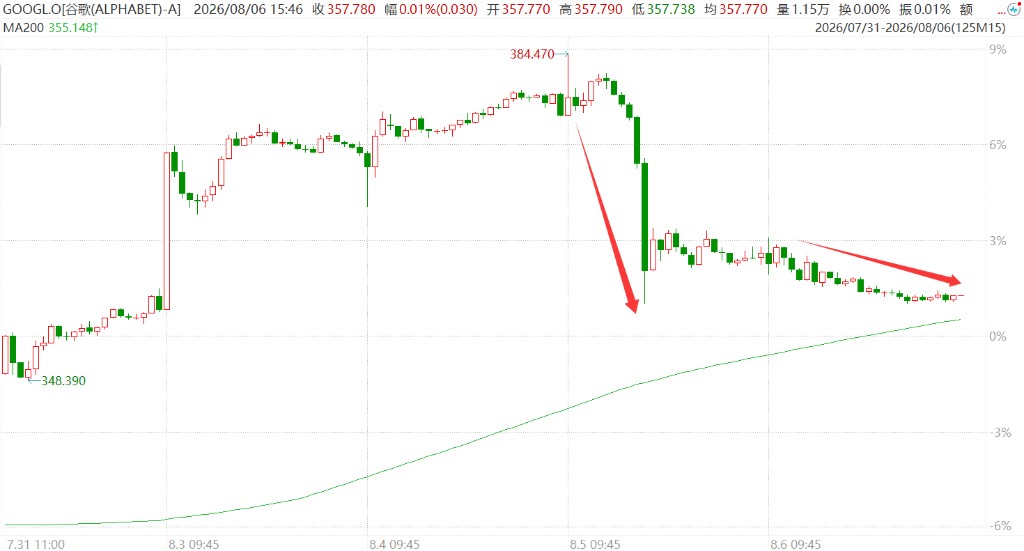
Investors voting with their feet highlights market concerns about the rising costs of Google's AI advancement, as well as strong anxiety over whether Google can translate its "scientific research strength" into "commercially successful products."
