


AAOI Q2 Revenue Surges 86.4% Year-Over-Year; Data Center Revenue Exceeds $100 Million; Demand Outstrips Capacity by 20%; Capital Expenditure to Increase in Second Half
AAOI reported Q2 revenue of $191.9 million, an 86.4% year-over-year increase, with data center revenue surpassing $100 million. AI demand exceeds capacity by 20%-40%. The company is increasing capital expenditure to expand production, expecting 800G volume ramp-up in Q3 and gradual 1.6T volume increase in Q4
U.S. optical communications manufacturer Applied Optoelectronics, Inc. (AAOI) is entering an expansion phase driven by high-end data center optical modules. Q2 revenue grew 86% year-over-year, with 800G products beginning to ramp up quickly. The certification, shipment, and production ramp-up of 1.6T products will be key variables determining the slope of the company's revenue and profit margins in the next stage.
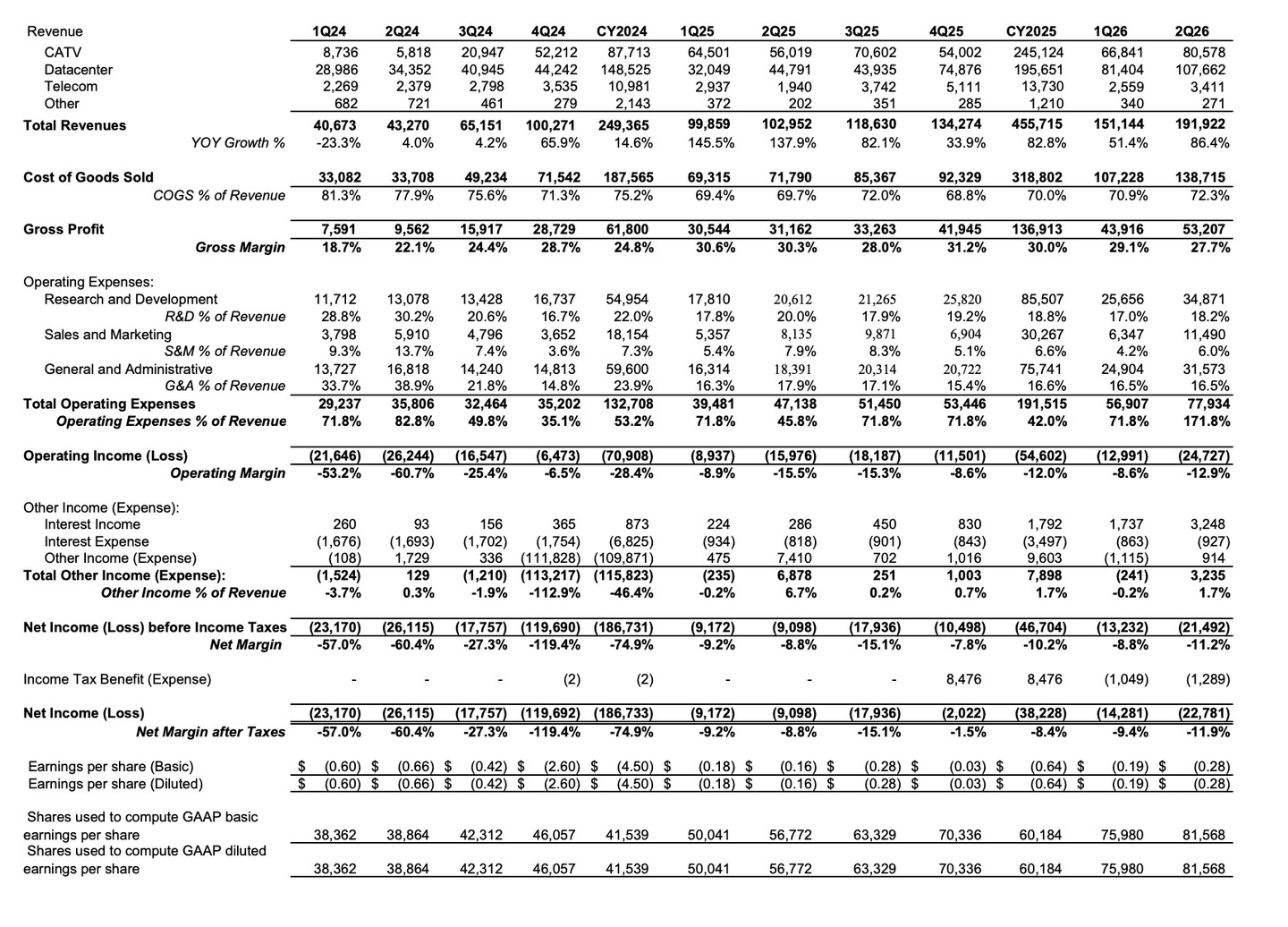
In the second fiscal quarter ended June 30, 2026, AAOI's revenue was $191.9 million, up 86.4% year-over-year and 27% quarter-over-quarter. Notably, data center business revenue exceeded $100 million for the first time, surging 140% year-over-year and accounting for 56% of total revenue, becoming the largest revenue source. The company's non-GAAP net income was $5.48 million, with non-GAAP earnings per share (EPS) of $0.06, returning to quarterly profitability.
During the earnings call, management stated that demand for AI infrastructure remains strong, with customer demand approximately 20% to 40% higher than AAOI's current supply capacity. This means the primary constraint on short-term revenue growth is not orders, but rather manufacturing capacity and the supply of key components such as DSPs and TIAs. The company expects 800G revenue to nearly quintuple quarter-over-quarter in the third quarter, while 1.6T products will begin shipping in late Q3 and gradually ramp up in the fourth quarter.
This growth is accompanied by increased capital investment. AAOI's capital expenditure in Q2 reached $565.5 million, including approximately $280 million in equipment prepayments, primarily used to expand production capacity for 400G, 800G, and 1.6T products. The focus moving forward will shift from demand intensity to the speed of capacity release, supply chain security, return on capital expenditure, and whether high-end products can drive gross margin expansion.
Data Center Revenue Exceeds $100 Million; Growth Focus Shifts from 400G to 800G
AAOI's data center business revenue in Q2 was $107.7 million, up 140.4% year-over-year and 32.3% quarter-over-quarter. This business has surpassed CATV to become the company's primary revenue source.
In terms of product mix, 100G products accounted for 38.3% of data center revenue, 200G and 400G products combined accounted for 45%, 800G products accounted for 11.9%, and 10G and 40G products accounted for 4.4%. Among these, 400G revenue was $48.4 million, increasing more than fourfold year-over-year and 27.4% quarter-over-quarter, remaining a significant revenue pillar for the current data center business.
However, for investors, the changes in 800G are more indicative. Q2 800G revenue was $12.8 million, increasing more than tenfold year-over-year and over 100% quarter-over-quarter. Management expects 800G revenue to nearly quintuple quarter-over-quarter in the third quarter, indicating that the growth focus of the company's data center products is gradually shifting from 100G and 400G to higher-speed products.
Meanwhile, the 100G business may face pressure in the third quarter due to insufficient switch supply from one customer, estimated to result in revenue pressure of approximately $20 million to $25 million. Management attributed this issue to customers' limited access to 100G switches, underlying memory supply shortages. This also reflects that AAOI's revenue rhythm depends not only on its own shipment capacity but also on the supply status of customers' system equipment.
Demand Exceeds Supply; Capacity and Key Components Become Primary Constraints
Management repeatedly emphasized during the conference call that demand for next-generation AI infrastructure is strong, with current customer demand approximately 20% to 40% higher than AAOI's supply capacity. In this context, the company's short-term growth ceiling is primarily determined by capacity and the supply of key materials.
For 800G and 1.6T products, components such as DSPs and TIAs remain tight. Although AAOI has internal laser production capabilities that can alleviate some industry supply pressures, the overall delivery of high-end modules still depends on the coordinated security of key electronic and optical components.
By the end of Q2, the company's combined monthly capacity for 800G and 1.6T products approached 200,000 units, higher than the nearly 100,000 units at the end of Q1. The company plans to increase the relevant monthly capacity to over 650,000 units by the end of 2026, and further to over 930,000 units by the end of 2027, with more than half of the capacity expected to come from Texas.
AAOI's manufacturing footprint in the Greater Houston area has expanded to over 1.6 million square feet. A 210,000-square-foot facility near the company's headquarters is expected to begin initial production in late Q3, dedicated entirely to 800G and 1.6T transceivers. The company is also advancing construction of other facilities in Pearland and Houston, with related capacity expected to come online in early 2027.
Management pointed out that 800G and 1.6T products can use the same production lines and manufacturing processes, with differences mainly reflected in the final testing stage. This arrangement helps the company allocate capacity between different speed products and reduce switching costs caused by fluctuations in demand for a single product.
1.6T Enters Certification and Initial Shipment Phase, Determining Future Revenue Slope
If 800G will be AAOI's main growth source in the second half of the year, then 1.6T will determine the company's growth slope around 2027.
The company expects the first 1.6T product to complete customer certification in the coming weeks and begin shipping in late Q3. Previously secured large 1.6T orders are expected to start in late Q3, enter the volume ramp-up phase in Q4, with some demand potentially extending into Q1 2027.
Management's long-term roadmap shows that by mid-2027, monthly revenue from 100G and 400G products may be around $90 million, 800G monthly revenue may be around $217 million, and 1.6T monthly revenue may be around $164 million. If this pace is achieved, total monthly revenue from data center transceivers will reach approximately $471 million.
However, the realization of this path depends on multiple conditions such as equipment installation, customer certification, material supply, and manufacturing yield. Especially for 1.6T products, although they have higher revenue and gross margin potential, the supply of key components may still limit the speed of short-term volume ramp-up.
Therefore, the significance of 1.6T for AAOI lies not only in adding a new product category, but also in whether it can push the revenue structure further towards high-end products and improve the company's earnings quality.
CATV Continues to Provide Revenue Support; Expected to Exceed $100 Million in Q3
While the data center business accelerates growth, the CATV business remains an important component of AAOI's current revenue structure.
Q2 CATV revenue was $80.58 million, up 43.8% year-over-year and 20.6% quarter-over-quarter, exceeding the company's previous expectation of $75 million to $80 million. This business accounts for about 42% of total revenue, providing stable support while the company's high-end data center module capacity is still ramping up.
Management expects Q3 CATV revenue to rise to $100 million to $110 million, with full-year revenue expected to exceed $325 million. Mediacom has selected AAOI as the primary supplier for its DOCSIS 4.0 network upgrade, with related products including 1.8GHz smart amplifiers and software solutions.
From a revenue composition perspective, data center and CATV constitute AAOI's current dual engines. The former provides higher growth elasticity, while the latter maintains a higher revenue base in the short term. As the proportion of 800G and 1.6T increases, the driving effect of the data center business on the company's overall growth is expected to strengthen further.
Gross Margin Under Short-Term Pressure; High-End Product Mix Determines Improvement Space
AAOI's GAAP gross margin in Q2 was 27.7%, lower than 29.1% in Q1. Non-GAAP gross margin was 29.8%, at the upper end of the company's previous guidance range of 29% to 30%. The company's guidance for non-GAAP gross margin in Q3 is 29% to 30.5%.
The failure of gross margin to improve synchronously with rapid revenue growth in Q2 reflects cost pressures during the production expansion and product introduction phases. The company's operating expenses were $67.6 million, accounting for 35.2% of revenue. Management mentioned that increased transportation costs from the rapid ramp-up of the CATV business, as well as increased customer certification demands for 800G and 1.6T products, drove up R&D and operational investments.
Q2 GAAP net loss was $22.78 million, with a loss per share of $0.28. After adjustments, the company achieved a non-GAAP net income of $5.48 million, with non-GAAP diluted EPS of $0.06. The return to profitability on an adjusted basis is an important signal, but the quarter's non-GAAP profit was also influenced by a $12.97 million tax benefit. Investors still need to monitor whether future earnings improvements can come more from operational aspects.
Management's long-term goal is to raise non-GAAP gross margin to approximately 40%. The path to achieving this mainly includes increasing the proportion of 1.6T products, ramping up higher value-added lasers and CPO-related modules, and improving manufacturing efficiency. In the short term, tight supplies of materials such as DSPs and TIAs, as well as potential expedited fees, may partially offset the gross margin improvement brought by product structure upgrades.
Capital Expenditure Significantly Increases; Production Expansion Progress Will Determine Capital Efficiency
AAOI is significantly increasing capital investment to seize the demand window for high-end optical modules.
By the end of Q2, the company's cash, cash equivalents, short-term investments, and restricted cash totaled $508.8 million, higher than $449.4 million at the end of Q1. The company has raised net proceeds of $538.8 million through a new ATM offering program, providing financial support for production expansion.
Capital expenditure in Q2 reached $565.5 million, of which approximately $280 million was for equipment prepayments, focusing on enhancing manufacturing capabilities for 400G, 800G, and 1.6T transceivers. The company stated that capital expenditure intensity in the second half of the year is expected to be higher than in the first half, with funds coming from existing cash, operating cash flow, partial equity financing, and new debt.
The balance sheet also reflects an accelerated expansion pace. Net property, plant, and equipment at the end of the period increased to $697.1 million, a significant rise from $419.0 million at the end of Q1. Inventory increased from $206.2 million to $278.8 million, mainly to support short-term production ramp-up and raw material reserves.
This means AAOI's core verification metrics for the next few quarters will be more specific: whether equipment can arrive as planned and convert into effective capacity, whether key components can be fully secured, whether customer certification can proceed smoothly, and whether new capacity can bring sufficient revenue and profit improvements to cover capital investments.
Annual Revenue Target Points to Approximately $1.1 Billion; Realization Pace Still Depends on Supply Chain
The company maintains its annual revenue target of approximately $1.1 billion. Based on Q2 revenue of $191.9 million and expectations for high-end product volume ramp-up in the second half, this target relies on the continued strength of the CATV business, rapid 800G ramp-up, and initial revenue contributions from 1.6T.
AAOI's current operational logic is relatively clear: demand side remains strong, with customer demand exceeding the company's supply capacity; 800G will replace 400G as the near-term growth main line; 1.6T will determine the upside space for revenue and gross margin in the next stage; and capital expenditure, U.S. domestic manufacturing expansion, and key component supply constitute the necessary conditions for realizing this growth path.
For the market, AAOI's key risk is no longer whether demand exists, but whether growth can be realized as planned. Delays in any link—capacity construction, material security, customer certification, or high-end product shipment pace—could affect the timetable for revenue ramp-up and earnings improvement.
Risk Warning and Disclaimer
Market risks exist; invest with caution. This article does not constitute personal investment advice, nor does it consider the specific investment goals, financial status, or needs of individual users. Users should consider whether any opinions, views, or conclusions in this article align with their specific circumstances. Investment based on this content is at your own risk.
