


China's July Exports Rose 23.9% Year-on-Year; Semiconductor Exports Nearly Doubled in Value, While Imports Increased 27.5%
The strong performance of high-tech exports was the main highlight of this month's data. Semiconductor exports nearly doubled year-on-year in value, while overall high-tech product exports expanded by 40.7%, driven by sustained robust demand amid the global boom in artificial intelligence infrastructure construction. Meanwhile, demand for renewable energy products spurred by the global energy transition has also become a significant driver of China's export growth
On August 7, data released by the General Administration of Customs showed that China's exports (denominated in US dollars) increased by 23.9% year-on-year in July, compared to a previous increase of 27%; imports rose by 27.5%, compared to a previous increase of 36%; and the trade surplus amounted to $112.5 billion, down from the previous $125.62 billion.

In RMB terms, total imports and exports in July reached 4.66 trillion yuan, exceeding 4 trillion yuan for five consecutive months, representing a year-on-year increase of 19.2%. Of this, exports totaled 2.71 trillion yuan, up 17.8%, while imports totaled 1.95 trillion yuan, up 21.2%. The trade surplus stood at 767.07 billion yuan, down from the previous 859.05 billion yuan.

The strong performance of high-tech exports was the main highlight of this month's data. Semiconductor exports nearly doubled year-on-year in value, and overall high-tech product exports expanded by 40.7%, with related demand remaining robust under the continuous drive of the global boom in artificial intelligence infrastructure construction.
Meanwhile, demand for renewable energy products driven by the global energy transition has also become an important force pulling China's export growth.
AI Construction Boom Continues, Boosting Exports
Large-scale AI infrastructure construction globally has become an important supporting force for China's exports.
According to the General Administration of Customs, in July, exports of high-tech products, including industrial robots and 3D printers, grew by over 50% year-on-year, higher than the 39% year-on-year growth rate in the first half of the year, contributing nearly 60% of the export increment in July. Furthermore, exports of green and low-carbon products such as electric vehicles and lithium batteries have seen double-digit growth for 17 consecutive months.
The significant rise in chip and bulk commodity prices has provided a certain boost to trade data. As global AI investment scales reach hundreds of billions of dollars, supply shortages of electronic components such as semiconductors have pushed some chip prices up by as much as 700% over the past year.
Zhiwei Zhang, President and Chief Economist at Pinpoint Asset Management, stated that China's export engine is expected to remain strong in the third quarter. This judgment is based on the fact that the global technology investment cycle has not yet peaked and external demand remains resilient.
In addition, the proactive actions of Chinese exporters were also an important factor supporting the July data. This "rush to export" behavior had been evident in previous months and, to some extent, explains the phenomenon of export growth consistently exceeding expectations in the first half of the year.
Exports Grew 14% in the First Seven Months
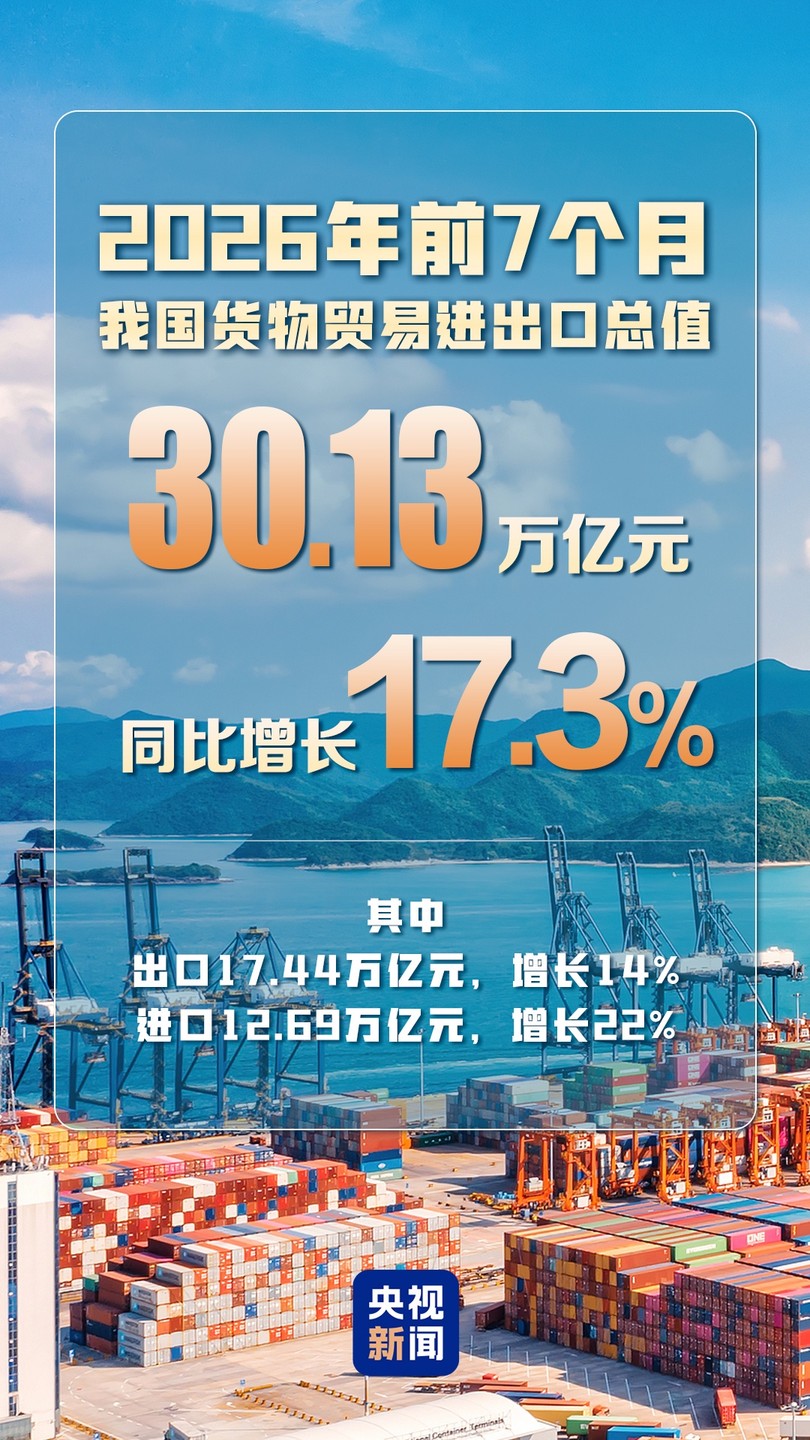
Statistical data released by the General Administration of Customs also showed that in the first seven months of this year, the total value of China's goods trade imports and exports reached 30.13 trillion yuan, a year-on-year increase of 17.3%, continuing a good growth trend. Of this, exports totaled 17.44 trillion yuan, up 14%; imports totaled 12.69 trillion yuan, up 22%.
In the first seven months of this year, China's exports of mechanical and electrical products reached 11.12 trillion yuan, an increase of 21.2%, accounting for 63.8% of China's total exports, an increase of 3.8 percentage points from the same period last year. Specifically:
Exports of green and low-carbon products such as electric vehicles, lithium batteries, and wind turbine generators increased by 71.2%, 35.8%, and 34.8%, respectively.
Exports of 3D printers, industrial robots, and ships amounted to 11.2 billion yuan, 7.34 billion yuan, and 268.14 billion yuan, respectively, representing increases of 1.1 times, 13.2%, and 32.7%, respectively.
From an import perspective, in the first seven months of this year, China's volume of bulk commodity imports increased by 3% year-on-year, with metal ore imports rising by 8.2%. During the same period, imports of mechanical and electrical products totaled 5.31 trillion yuan, up 29.7%, accounting for 41.9% of China's total imports.
Regionally, in the first seven months of this year, China's imports and exports with ASEAN, the EU, Latin America, and Africa increased by 20%, 9.5%, 15.4%, and 18.9%, respectively. Imports and exports with countries participating in the "Belt and Road Initiative" totaled 15.36 trillion yuan, up 15.5%. Trade with other APEC economies reached 18.03 trillion yuan, up 21%.
In the first seven months, China's imports and exports with more than 180 countries and regions maintained growth. Among them, trade with ASEAN and Africa grew by nearly 20%, while trade with the US grew for four consecutive months.
In the first seven months of this year, private enterprises in China recorded imports and exports totaling 17.16 trillion yuan, an increase of 17.2%, accounting for 56.9% of China's total import and export value, thereby maintaining their position as the largest foreign trade entities. During the same period, foreign-invested enterprises recorded imports and exports of 8.78 trillion yuan, up 17.6%; state-owned enterprises recorded imports and exports of 4.14 trillion yuan, up 17.3%.
