


Morgan Stanley's Shawn Kim Turns Bullish: Memory Market Correction "Nearing End," SK Hynix EPS Raised by 13%
Kim released a report stating that the most severe adjustments in the memory chip industry are nearing an end, with current valuations being highly attractive. He maintains a long-term bullish stance and target prices for Samsung and SK Hynix, projecting over 60% upside potential for both stocks from current levels. Although Q3 prices were slightly below expectations, structural expansion in AI demand, a corporate shift towards capital returns, and long-term agreements will support industry fundamentals
Shawn Kim, a Morgan Stanley analyst once regarded as the "voice of bears" in the Korean market, recently released a research report on the memory industry, stating that the most intense correction in this memory market cycle is nearing its end. Current valuations now offer an "attractive tactical entry" opportunity.
Kim believes that the focus of the memory stock market is shifting from price cycles to capital returns. Share buybacks, free cash flow, and Long-Term Agreements (LTAs) are expected to become the next wave of catalysts for stock prices. Morgan Stanley maintains its target prices for Samsung Electronics and SK Hynix, while raising its 2026 Earnings Per Share (EPS) estimate for SK Hynix by 13% and lowering its 2026 EPS estimate for Samsung Electronics by 10%. The target prices for both companies imply over 60% upside potential compared to their current share prices.
Shawn Kim described this correction as "a small ripple in the AI supercycle." He maintains a long-term bullish stance on Samsung Electronics and SK Hynix, expecting their earnings growth to reach 25% to 50% by 2027. The continuous expansion of AI capital expenditure and the rapid advancement of Agentic AI will jointly support industry fundamentals.
Correction Nearing Its End
Wall Street News noted that Morgan Stanley had already issued warnings in early July that memory stocks might face a short-term pullback due to the second derivative of DRAM price increases approaching its peak, compounded by overly concentrated market positions. Subsequently, the memory sector experienced significant volatility and selling pressure in July, with the Korea Composite Stock Price Index (Kospi) and memory giants like Samsung and SK Hynix undergoing substantial corrections. This round of adjustment not only confirmed Morgan Stanley's warning about slowing momentum in price gains but also 叠加 ed the chain reaction of liquidations among highly leveraged overseas AI hedge funds and deleveraging by retail investors using margin loans.
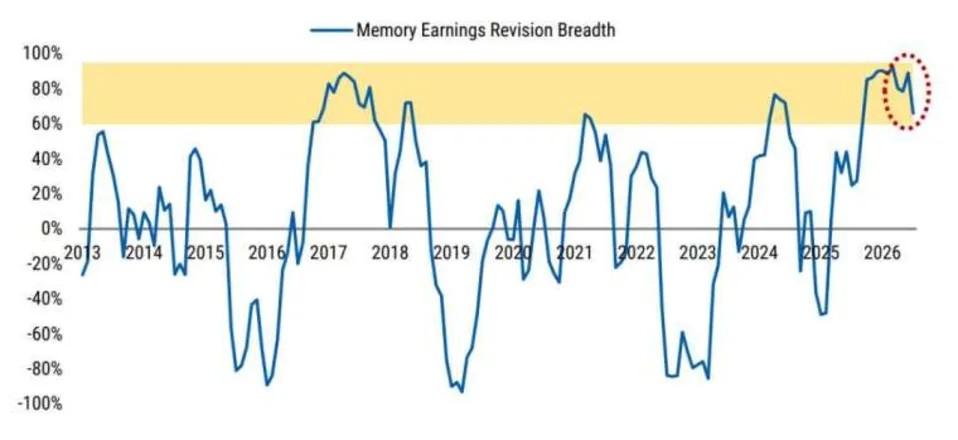
However, Shawn Kim believes that valuations for memory stocks have significantly improved following the recent adjustment. Memory stocks are currently trading at approximately 3 times their forward 12-month Price-to-Earnings ratio (NTM P/E), hardly reflecting any long-term growth premium. The report points out that the rate of change in the breadth of memory earnings estimate revisions has fallen from extreme levels in late June, suggesting that the most pessimistic period may have passed.
After the significant unwinding of positions in July ended, chase-buying funds have flowed back into the market. Morgan Stanley expects that short-term market preference will remain concentrated on segments benefiting most from AI capital expenditure, including DRAM and niche memory (DDR4, SLC NAND), rather than memory module manufacturers.
AI Demand Cycle Scale Far Exceeds History, Room for Valuation Multiple Expansion Remains
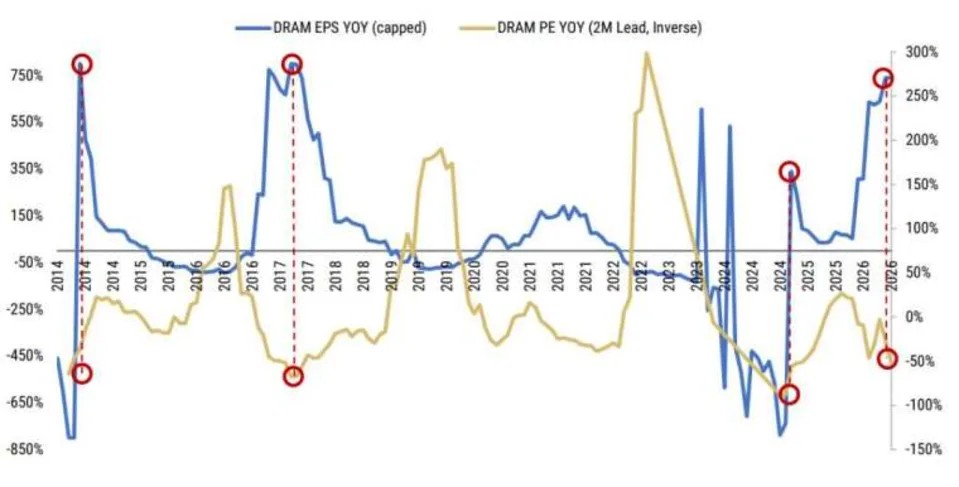
Morgan Stanley emphasizes that AI-driven demand does not contradict traditional memory boom cycles. In this AI infrastructure build-out cycle, the year-over-year increase in DRAM prices once reached as high as 700%, about seven times the historical price peak, and the cycle duration has been unusually long. DRAM has become one of the key bottlenecks in AI infrastructure construction.
Kim believes that AI-driven demand is more likely to represent a structural change rather than a purely cyclical fluctuation. If investors begin to believe that AI will extend the industry's earnings cycle, the method of evaluating the memory industry using past cyclical stock frameworks may no longer be applicable, leaving room for valuation multiple expansion.
Meanwhile, the report notes that the market has largely priced in the risk of slowing EPS growth over the next 12 months, but there is widespread lack of confidence regarding "what factors will drive EPS higher in 2028." This divergence is the core logic behind Shawn Kim's view that there is room for valuation repair.
Individual Stock Adjustments: SK Hynix Revised Up, Samsung Revised Down
Regarding individual companies, Morgan Stanley made opposite adjustments to the earnings estimates for the two Korean memory giants. The 2026 EPS estimate for SK Hynix was raised by 13%, mainly reflecting the positive impact of asset disposal gains in the second quarter; the 2026 EPS estimate for Samsung Electronics was lowered by 10% due to continued weakness in its consumer electronics business. The adjustments to earnings forecasts for both companies for 2027 to 2028 were relatively limited.
Despite the divergence in earnings estimates, Morgan Stanley maintained its target prices for both companies, emphasizing that the target prices imply over 60% upside potential relative to current share prices. The report believes that as the cycle enters its later stages, companies will communicate capital return plans more actively and demonstrate stronger capital discipline in realizing returns on large-scale capital expenditures, supporting a re-evaluation of the industry as a whole.
Industry Survey: Q3 Prices Slightly Below Expectations, Capacity Shifting to eSSD
According to Morgan Stanley's latest industry survey, DRAM contract prices for the third quarter of 2026 rose about 15% quarter-over-quarter in early transactions, slightly below the previously estimated 20%; NAND prices rose about 20% quarter-over-quarter. As the trend of incremental pricing slows in the fourth quarter, the urgency for customers to stock up in advance has decreased, weakening the motivation to lock in low-cost inventory.
On the supply side, the report expects more capacity to shift from consumer products to enterprise SSDs (eSSD). Coupled with the continuous growth in demand for AI servers, this is expected to effectively absorb new supply. Morgan Stanley believes that the memory industry is transitioning to the later stage of the cycle in the fourth quarter of 2026. At that time, the core logic driving stock prices will shift from operating leverage brought by price increases to earnings stability derived from capital returns and long-term supply agreements, as well as sustainable free cash flow performance.
