


Autonomous Driving Companies Accelerate Entry into Unmanned Freight Transport
The autonomous driving industry is accelerating its expansion into the unmanned freight sector, shifting focus from last-mile delivery to heavy-duty trucks and urban distribution projects with mass-production closed loops. As of August 2026, domestic related companies have secured approximately RMB 7.8 billion in financing, with WeRide, Pony AI, and others advancing independent financing or new vehicle mass production. Capital attention has extended to vehicle delivery capabilities and sustained operational revenue, with participants including OEMs, logistics platforms, and industrial capital, as the industry seeks sustainable transportation business models
Author | Zhou Zhiyu
The Physical AI boom is finding a more concrete application in the autonomous driving industry: integrating models, sensors, and execution systems into more real-world vehicles to continuously complete transportation tasks.
This trend is also driving industry financing. According to incomplete statistics by Wall Street News, as of August 7, 2026, there were six current financing rounds with clear amounts for domestic companies involved in unmanned delivery vehicles and unmanned heavy-duty trucks, roughly totaling about RMB 7.8 billion based on the disclosed lower bounds. Several other financing rounds are underway. In contrast, leading companies in the unmanned delivery sector cumulatively raised nearly RMB 10 billion throughout all of 2025.
Furthermore, WeRide plans to seek independent financing for its Robovan business, while Pony AI recently launched an unmanned light-duty truck and is advancing the mass production of its new generation of unmanned heavy-duty trucks.
Participants have expanded from autonomous driving companies to include OEMs, logistics platforms, and industrial capital. Market focus has shifted from last-mile unmanned delivery last year to heavy-duty trucks with mass production and operational closed loops, as well as passenger car companies crossing over into urban distribution projects.
Capital attention has moved beyond autonomous driving software to whether vehicles can be delivered in bulk, whether cargo sources can be continuously accessed, and whether transportation services can be charged based on results.
The question the industry must answer is whether each vehicle can continuously generate transportation revenue and drive the next wave of expansion.
The Boom Arrives
Since the beginning of this year, new developments in the autonomous driving industry have increasingly concentrated on cargo-carrying vehicles.
In April, White Rhino and Shineray integrated autonomous driving technology, complete vehicle manufacturing, supply chains, and channels into a single joint venture; Changan Kaicene pushed Robovan towards batch delivery and partnered with JD Logistics. In June, WeRide advanced independent financing for its Robovan business, with insiders stating that investors valued the business at approximately USD 400 million; in late July, Momenta’s Robovan began operations in Suzhou, utilizing the R7 World Model and map-less solutions validated in its passenger car mass-production business.
The fleet size of low-speed unmanned delivery vehicles has also changed. After the integration of Jushi and Cainiao’s unmanned vehicle businesses, the RoboVan fleet exceeded 20,000 units, covering hundreds of cities. The market is beginning to see fleets available for operation and procurement, rather than just single-point demonstration vehicles.
Financing is the most obvious signal. In February, Jushi completed over USD 300 million in financing; in March, KalPower completed over USD 100 million in Series B financing, and Lingyi Auto completed RMB 1.2 billion in financing; in April, Shenxiang disclosed cumulative fundraising of over USD 310 million in its Pre-IPO round; in May, Lingyi again completed USD 200 million in Series B2 financing; in July, Sinian Intelligent Driving completed RMB 300 million in Series C financing. Roughly calculated based on disclosed lower bounds, these six financing rounds total approximately RMB 7.8 billion.
This is not the entirety of capital activity. White Rhino’s new round of financing did not disclose specific amounts, and WeRide’s independent financing for Robovan was not included in the above statistics; there are also multiple undisclosed financing amounts, proposed independent financings, or strategic integrations in the market.
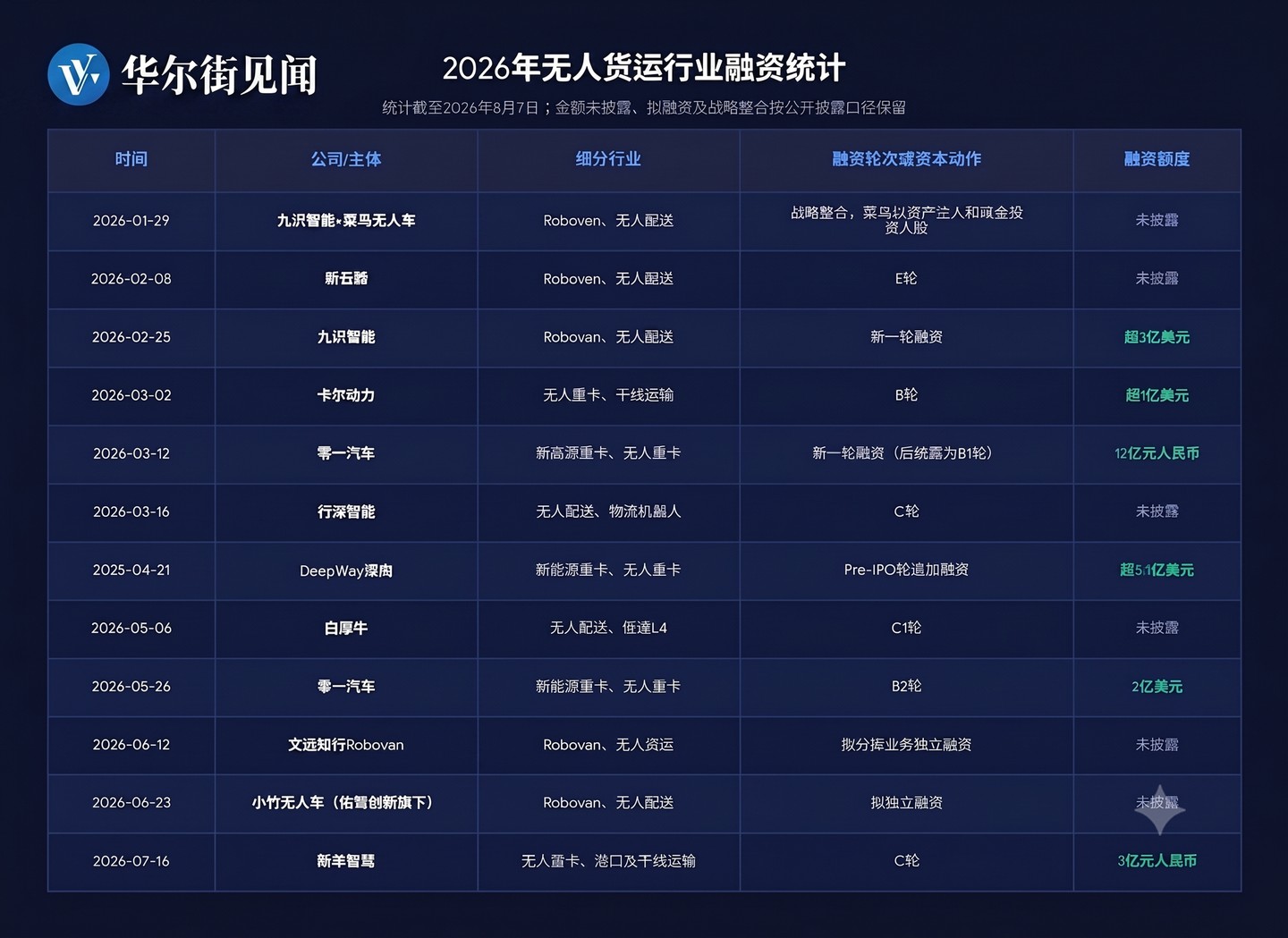
Sources of financing are also changing. Lingyi’s new round of financing saw the participation of industrial capital such as CATL-related entities, Zijin Mining, Yankuang Capital, and Sanhua Holdings; Shenxiang’s Pre-IPO round simultaneously attracted Middle Eastern capital, Australian pension funds, Singaporean impact funds, and local state-owned assets. Investors are no longer looking solely at algorithms, but also at electric chassis, complete vehicle manufacturing, logistics scenarios, and customer orders.
However, a representative from an autonomous driving company told Wall Street News that investors are optimistic about the long-term development of unmanned freight transport and are therefore not rushed in pushing for business spin-offs and listings.
In the past, financing for autonomous driving companies was mainly used for training algorithms, accumulating test mileage, and purchasing sensors. Now, funds must also cover the costs of vehicle mass production, remote operations, station construction, and cargo source organization. Consequently, investors are more concerned about whether capital can flow back through vehicles, orders, and cash flow.
Beyond financing, the industry is organizing unmanned freight transport through strategic integrations, business spin-offs, and new vehicle models. White Rhino established a joint venture with an OEM, Changan Kaicene partnered with a logistics platform, and WeRide is separately financing its Robovan business; Pony AI launched its first unmanned light-duty truck in August and is advancing the mass production of its fourth-generation Robotruck. Technology companies, OEMs, logistics platforms, and capital are beginning to divide labor around the same batch of vehicles.
This surge of interest is not just about valuing software. Scenarios such as ports and mining areas have relatively clear boundaries, allowing heavy-duty trucks to establish stable operations there first; trunk line transportation revolves around road rights, vehicles, and cargo sources. Meanwhile, the aging workforce and high-intensity nature of driving jobs are prompting logistics companies to continuously seek alternative capacity. When autonomous driving companies enter new vehicle models, they can reuse existing systems, operational platforms, and supply chains. These conditions are encouraging capital to provide funding for vehicle mass production, remote operations, and scenario construction.
Vehicle Models Are Just the First Step
Technology reuse is the prerequisite for the rapid launch of new vehicle models.
He Xing, Vice President of Pony AI and Head of the Truck Business Unit, stated to Wall Street News on August 5 that the technology sharing rate between light-duty trucks and Robotaxis exceeds 95%, with overall reuse exceeding 90% including operations and supply chain links; code-level reuse for Robotrucks exceeds 80%, and hardware sharing exceeds 90%.
The boundaries of reuse for these two product types differ: reuse for urban road products is mainly reflected in perception, decision-making, operations, and policy pathways; Robotrucks face long-haul, port, and bulk transportation, where differences in vehicle structure, energy replenishment facilities, and road conditions are greater, so reuse is more concentrated in code, sensors, and supply chains.
To turn this capability into revenue, it must be installed in compliant vehicles, integrated with real cargo sources, and finally allow transportation results to be priced.
The unmanned light-duty truck launched by Pony AI this time is an urban distribution product, not the same type of vehicle as the Robovan. The model jointly created by Pony AI and CATL has a cargo box volume of approximately 18 cubic meters, a maximum speed of 70 km/h on urban roads, and targets B2B urban distribution scenarios such as express delivery sorting, supermarket restocking, and catering cold chains.
From a vehicle classification perspective, N1 light-duty trucks and low-speed unmanned delivery vehicles belong to different product systems. N1 vehicles are motorized cargo products; low-speed unmanned delivery vehicles mainly serve industrial parks, neighborhoods, and last-mile delivery.
This product difference directly impacts commercial scenarios: low-speed vehicles have lower costs and operating speeds, making them suitable for last-mile delivery; unmanned light-duty trucks can handle larger cargo volumes and longer urban distribution routes, but their deployment on public roads still requires product approval, restricted area access permits, and transportation operation qualification reviews. Pilot documents from the Ministry of Industry and Information Technology and three other departments clearly state that intelligent connected vehicles granted access can only conduct road trial operations in designated areas, and those involving transportation operations must also meet the operational qualifications and management requirements of transportation authorities.
Robotrucks follow a different product path. Their goal is not urban last-mile delivery, but rather placing autonomous heavy-duty trucks into trunk line transportation, dedicated lines, and port transportation. In April, Pony AI was approved to conduct demonstrations of unmanned cargo loading for trailing trucks in convoy formations, carrying out “1+N” transportation on routes such as the Beijing-Tianjin Expressway and Beijing-Tianjin-Tanggu Expressway; the lead truck remains under the responsibility of a safety officer for scheduling and exception handling, while trailing trucks operate unmanned.
After entering unmanned freight transport, the operational capabilities of autonomous driving companies also need to improve synchronously. Pony AI’s cooperation with Sinotrans has extended from heavy-duty truck trunk line transportation to urban distribution. Logistics partners provide cargo sources and operational scenarios, while the autonomous driving company is responsible for systems, fleet management, and remote assistance, with both parties deploying vehicles on real routes. He Xing mentioned in communications that the operating sections for light-duty trucks overlap with those already covered by Robotaxis, and the truly new operational steps are loading and unloading.
At a stage when customers are unwilling to hold vehicle assets, technology companies can only build up these operations first, using real orders, attendance rates, and maintenance data to price their technology.
Charging models also change with product maturity. According to a Huatai Securities research report, Robotrucks mainly have two charging methods: charging transportation service fees per kilometer or ton-kilometer, or after selling the vehicle, charging an autonomous driving subscription fee annually or by mileage.
Caocao Mobility has launched vehicle sales, leasing, and RaaS (Robot-as-a-Service) models in the Robovan direction, allowing customers to purchase vehicles, lease vehicles, or directly purchase intelligent capacity services. Vehicle assets, autonomous driving systems, and transportation operations are beginning to be priced separately, but its first batch of Robovans only entered operations in Changsha in July of this year, and the model is still in the verification stage.
The rollout of a vehicle model is merely turning the system into supply; real cargo sources and transportation accounts will determine whether it is a viable business.
What Is the Market Calculating?
Once vehicles enter operation, the autonomous driving system is just one variable in the single-vehicle account.
Cargo source density determines whether vehicles have work to do; load factors and empty-run rates determine how much mileage can be charged; waiting and loading/unloading times determine how many shifts can be completed in a day. Transportation revenue must deduct depreciation, energy consumption, maintenance, remote assistance, insurance, and downtime losses, with the remainder being the single-vehicle contribution to cash flow.
Xiao Ping, Product Head of Pony AI’s Truck Business Unit, gave an example: the core shifts for express and fast freight companies run from 5 am to 11 pm. To ensure vehicle availability, two shifts of drivers are usually required, but during the approximately 10 hours of daytime, a significant portion of time is spent waiting for orders. After completing original transportation tasks, unmanned light-duty trucks can access freight platform orders during the 4 to 5 hours originally spent waiting.
In the model for low-speed unmanned delivery vehicles like Robovan, the remote monitoring ratio and vehicle operating duration are another set of key parameters. According to Huatai Securities’ calculations, in scenarios such as transfer direct delivery, the single-item transportation cost for unmanned delivery vehicles can drop from RMB 0.47 in traditional human-driven modes to RMB 0.22; however, the model assumes a remote monitoring ratio of 1:100 and an increase in effective daily operating time from 8 hours to over 10 hours.
These calculations show that cost advantages depend on one remote operator managing enough vehicles and vehicles achieving longer effective operating times. Simply moving drivers from the vehicle to the backend does not automatically reduce single-vehicle costs.
Robotrucks mainly face line and operational efficiency challenges, which means the “N” in the “1+N” convoy should not fall into a simple numbers game. Xiao Ping stated that technically, “1+4” or “1+5” convoys are possible, but convoy size should be determined by specific operational requirements. If loading and unloading speeds cannot keep up, “1+2” or “1+3” should be adopted; “N is not better the larger it is.”
For trunk line transportation, road rights themselves are part of the expansion speed. New lines require permits along the route, and the Beijing-Tianjin-Tanggu line only obtained permission for unmanned trailing trucks after accumulating sufficient mileage. Autonomous light-duty trucks entering urban motor vehicle roads also require product approval and local operating permits.
Therefore, the real market competition is not about which company can get cars driving, but who can place vehicles into higher-density cargo source networks.
Technology companies ultimately hope to return to the position of autonomous driving solution suppliers, leaving vehicle assets and transportation operations to partners; but whether customers are willing to buy vehicles first depends on vehicle attendance rates, accident rates, and payback periods. Capital can advance R&D and fleet construction, but it cannot replace customer orders. Whether vehicles can use transportation revenue to cover depreciation, insurance, maintenance, and remote labor determines whether leasing, insurance, and financial capital will follow.
Insurance companies are also waiting for the same set of operational data. He Xing introduced that the premium for Pony AI’s early intelligent connected vehicles with a RMB 5 million coverage limit once reached tens of thousands of yuan, but now the single-vehicle premium is lower than that of human-driven fleets; behind the change in premiums are still accident rates, maintenance costs, and actual attendance records.
The watershed moment for unmanned freight transport will ultimately come down to three numbers: average daily effective paid mileage, empty-run and waiting times, and single-vehicle investment payback period.
The market carries risks, and investment requires caution. This article does not constitute personal investment advice, nor does it take into account the specific investment goals, financial status, or needs of individual users. Users should consider whether any opinions, views, or conclusions in this article align with their specific circumstances. Responsibility for investments made based on this lies with the investor.
