


Is the Gold Bull Market Back? UBS: Gold Prices Expected to Return to $5,000 in the First Half of Next Year
UBS identifies three major medium-to-long-term supports for gold: declining real interest rates reigniting investment demand, a weaker US dollar driving diversified allocation, and sustained high-level gold purchases by central banks. It suggests viewing a pullback in gold prices to $4,000 as a strategic opportunity to build positions. The Chief Strategist at BCA Research also stated that gold prices may have further upside potential, with even the possibility of setting new ATHs (All-Time Highs)
After months of sluggish performance, gold prices have staged a strong rebound, with UBS looking further ahead—gold prices are expected to return to $5,000 in the first half of 2027.
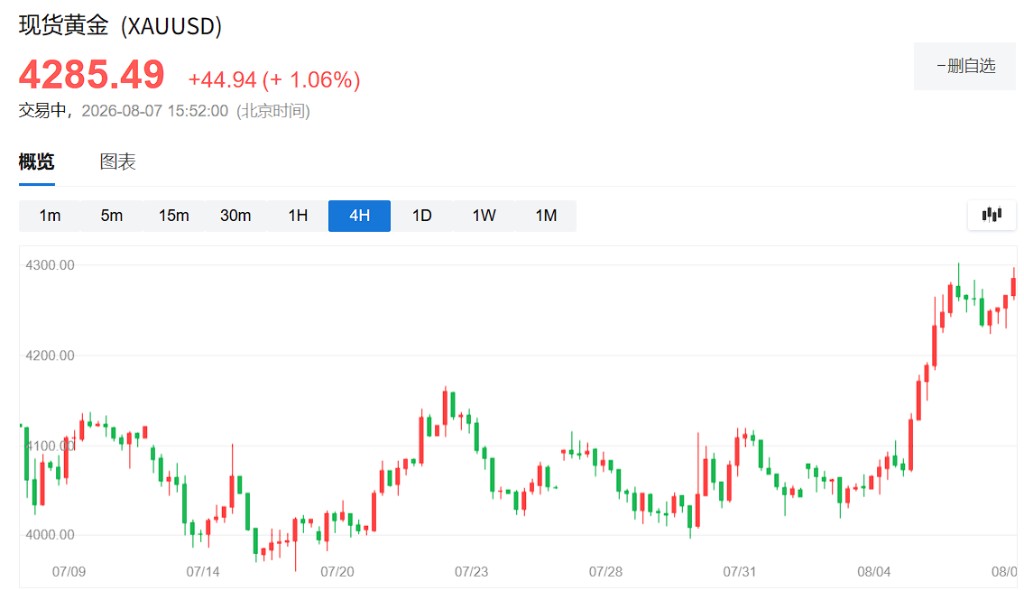
Gold prices broke through the $4,250 per ounce mark this week, briefly surpassing the $4,300 threshold to hit a new high since June. This move decisively broke out of the previous consolidation range of $4,000 to $4,100, with weekly gains exceeding 5%, marking the largest weekly increase since early February this year. Sustained inflows of institutional buying, the return of ETF funds, and the alleviation of US Treasury sell-off risks brought about by the US-Japan joint effort to stabilize the yen exchange rate collectively drove this round of gains. Noah Weisberger, Chief Strategist at BCA Research, stated that the rise in gold prices and the strength in gold mining stocks reflect deepening investor concerns about inflation prospects and the Federal Reserve's ability to combat inflation. Gold prices may have further upside potential, with even the possibility of setting new ATHs (All-Time Highs).
Regarding the medium-to-long-term trend, UBS maintains an optimistic stance, believing that the structural drivers supporting gold prices remain solid. It advises distinguishing short-term trading risks from long-term investment logic and viewing periods where gold prices fall back to $4,000 or below as opportunities to establish strategic positions.
After Falling 30% from Its Peak, Gold Prices Stage a Strong Rebound from the Bottom
In January this year, gold prices hit a historical high of over $5,600 per ounce during a parabolic rally in precious metals, but the bull market subsequently took a sharp downturn. As investors shifted their attention to popular semiconductor and artificial intelligence-related stocks, bullish sentiment towards gold cooled rapidly. Last month, gold prices briefly fell below $4,000, accumulating a decline of approximately 30% from the January peak.
However, the market situation has shown a clear turnaround in recent weeks. As of press time, international spot gold was quoted at $4,285.49 per ounce, up $244 for the week, a gain of nearly 6%. It has recorded gains in two of the past three weeks. The core logic driving this rebound lies in the renewed heating up of market concerns regarding the persistence of inflation and the credibility of Federal Reserve policy.
Noah Weisberger pointed out that the shift in investor sentiment stems partly from the market reaction following Federal Reserve Chair Kevin Warsh's July press conference, when the Federal Open Market Committee decided to keep the target range for the federal funds rate unchanged. Weisberger said:
"The market did not give him much leeway; as long as inflation persists, any erosion of the Federal Reserve's credibility will be reflected in higher gold prices and gold mining stock prices."
UBS: Three Structural Pillars Support Medium-to-Long-Term Upside for Gold Prices
In its latest report, UBS noted that although the market still faces volatility risks in the short term—especially if US economic data remains strong, oil prices prolong inflation concerns, or the market further prices in a more hawkish interest rate path from the Fed—in the medium to long term, the logic for rising gold prices is supported by three pillars.
First, declining real interest rates will reignite investment demand.
Gold does not generate yield; the higher the real yield, the greater the opportunity cost of holding gold. UBS expects inflation to gradually decline. After maintaining interest rates unchanged this year, the Federal Reserve will restart rate cuts in 2027. The shift in policy rate expectations will lower real yields and weigh on the US dollar, thereby providing a more favorable macroeconomic environment for gold investment demand.
Second, a weaker US dollar and the need for diversified allocation constitute strong medium-term support.
UBS believes that while the US dollar may remain resilient in the short term, the US's massive fiscal and current account deficits, along with investors' already overweight position in US dollar assets, mean there is room for the US dollar to weaken again. Historically, a weaker US dollar has been the most powerful tailwind for gold, and increased market attention to de-dollarization and diversified allocation is also beneficial for gold.
Third, central bank gold purchases provide lasting bottom-line support for the market.
Even if private investment demand is weak, central bank demand remains an important pillar of the gold market. UBS expects that annual central bank gold purchases will remain at high levels, driven by the long-term willingness to reduce exposure to US dollar assets. Central bank gold purchases reached 289 metric tons in the second quarter of this year, showing strong performance. UBS maintains its forecast of 750 to 1,000 metric tons for the full year. While this scale is insufficient to drive a significant surge in gold prices on its own, it is enough to stabilize the market and hedge against weak areas such as jewelry demand.
UBS explicitly stated that if gold prices fall back to $4,000 or below, it may ultimately prove to be an opportunity to establish strategic positions rather than a bearish signal. Against the backdrop of rising inflation expectations, uncertainty in the Federal Reserve's policy path, continued central bank accumulation, and expectations of a medium-term weakening of the US dollar, the medium-to-long-term investment logic for gold remains intact.
Gold Mining Stocks: An Undervalued Alternative to Gold
For investors looking to benefit from the rise in gold, gold mining stocks offer another path with potentially greater elasticity, in addition to futures and ETFs.
According to MarketWatch, the largest gold mining stock ETF, the VanEck Gold Miners ETF (GDX), has assets under management totaling $25.4 billion, passively holding 59 mining stocks from nine countries. According to FactSet data, GDX has a trailing P/E ratio of 14.1x and a forward P/E ratio of 10.4x, whereas the S&P 500 Index has a trailing P/E ratio of 28.1x and a forward P/E ratio of 20.2x, indicating that gold mining stocks are significantly undervalued.
Noah Weisberger believes that the low valuation of gold mining stocks is "worth noting," and that many companies have significantly improved profit margins and optimized their balance sheets. "The biggest risk comes from the price of gold itself, but gold mining stocks are a fairly clean equity play, which is why we are bullish on them," he said.
He also particularly emphasized the diversification value of gold mining stocks:
"If you are looking for a diversified bet unrelated to the AI theme, GDX has no correlation with any AI themes we can identify. In a market where the upward trend is dominated by companies with negative cash flow, holding companies that can generate cash flow as a ballast is not a bad thing."
