


The U.S. Economy Just Experienced Its 5th Largest Month of Job Losses Since 2020. Here's Why It's Both Good and Bad News
The U.S. economy experienced its fifth-largest monthly job loss since 2020 in July, with non-farm payrolls declining by 23,000. This unexpected weakness has shifted market expectations from a Fed rate hike to holding rates steady, as a softer labor market may curb inflation. However, the report also signals economic fragility, leaving the Fed's September decision dependent on upcoming inflation and employment data.
The July jobs report delivered a surprise to the downside, forcing investors to rethink their view of monetary policy for the rest of the year.
The U.S. economy saw a 23,000 decline in non-farm payrolls, well below economists’ estimates calling for an 83,000 gain. Interestingly, the unemployment rate also declined slightly to 4.1%, as fewer Americans participated in the labor force last month.
The 23,000 decline is the fifth-largest monthly decline since 2020.
The report brings both good and bad news. On the positive front, a weaker labor market could prevent the Fed from raising interest rates at its September meeting. On the downside, the report could indicate that the labor market remains fragile, implying the economy may not be as strong as initially perceived.

Image source: Getty Images.
Weakness in the labor market is an argument for the Fed to hold
Heading into this jobs report, it was unclear how the Federal Reserve would proceed with interest rates at its September meeting.
However, following the July jobs report, the market shifted from expecting a quarter-point rate hike to expecting the Fed to hold rates steady. According to CME Group’s FedWatch, there is roughly a 58% likelihood that the Fed keeps rates in the current 3.50%-3.75% range as of this writing. Yesterday, the likelihood had been around 45%.
A strong labor market can fuel inflation because people have money to spend. But if the labor market is perceived as weaker, the market will likely also assume inflation may cool.
The report showed some real softness, aside from the 23,000 job losses in July, largely in local government, retail, financial activities, and hospitality. The end of the World Cup could have impacted numbers.
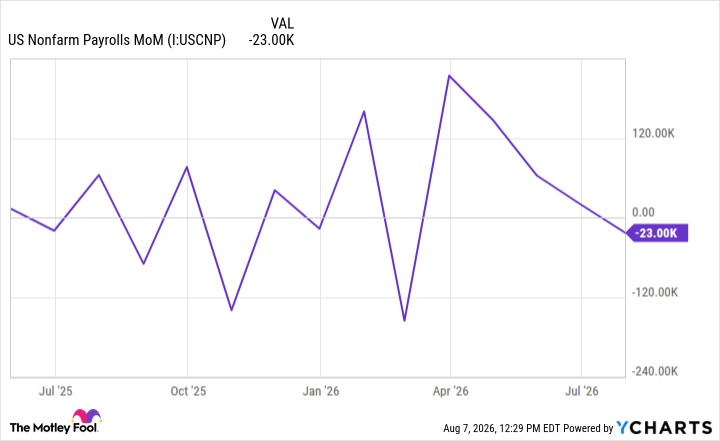
US Nonfarm Payrolls MoM data by YCharts
The Bureau of Labor Statistics also revised down the June jobs report from 57,000 new jobs to 20,000.
Furthermore, average hourly earnings came in roughly flat from the prior month. While unemployment dipped, that largely occurred because the labor force participation rate declined to 61.4%, its lowest level in over five years.
“This morning’s report is a game changer in the sense that all of the recent focus has been on inflation and this report highlights the risks that are embedded in the labor market as well,” Northlight Asset Management’s Chief Investment Officer Chris Zaccarelli said, according to CNBC. “Before today, many were expecting that the Fed had no choice but to raise rates in order to fight stubbornly high inflation, because the job market was so strong, but this report shows that isn’t the case.”
More data will decide what happens in September
This one jobs report will not decide what the Fed does in September.
There are still multiple inflation reports to come this month, and in August, that will further inform the Federal Open Market Committee how to proceed with interest rates.
A hotter-than-expected inflation report could once again tilt the odds in favor of the Fed hiking rates in September.
There will also be another jobs report next month before the Fed’s September meeting, which very well could show a resurgence in the labor market. After all, there have now been six months of job declines since June 2025, so there’s not a clear trend.
That’s why investors should never try to trade based on short-term market events because things change quickly.
