


Non-farm payrolls plunge drags down USD, JPY surges over 1% intraday! Japan's Finance Minister says close communication with US maintained, action will be taken if necessary
US July non-farm payroll data unexpectedly turned negative, causing a significant weakening of the US dollar and driving a rapid appreciation of the yen on Friday. Meanwhile, Japanese Finance Minister Katsunobu Kato stated that Japan and the US are maintaining close communication and will not hesitate to intervene in the foreign exchange market if necessary, further reinforcing market expectations of joint intervention. Analysts believe that this round of yen appreciation is mainly driven by expectations of a narrowing interest rate differential between the US and Japan, while official intervention signals continue to support the forex market
The unexpected and significant weakening of US non-farm payroll data, coupled with intervention warnings from Japan's Finance Minister, caused the yen to surge again on Friday.
According to reports, Japanese Finance Minister Katsunobu Kato stated shortly after the release of the non-farm payroll data that Japan and the US have been maintaining close communication and neither side will hesitate to take intervention actions when necessary. He also revealed that he had reached a consensus with US Treasury Secretary Yellen that recent fluctuations in the foreign exchange market were driven by non-fundamental demand.
These remarks further heated up market expectations that Japan and the US might take action to intervene in the forex market.
As a result, the yen rose rapidly, with the USD/JPY pair falling 1.1% to 156.68 at one point, before narrowing its decline to about 0.5%. Citing analysts, the report pointed out that the yen's strength this time was mainly driven by weak non-farm payroll data, with expectations of a narrowing US-Japan interest rate differential becoming the main driver, while the risk of potential official intervention continues to support market sentiment.
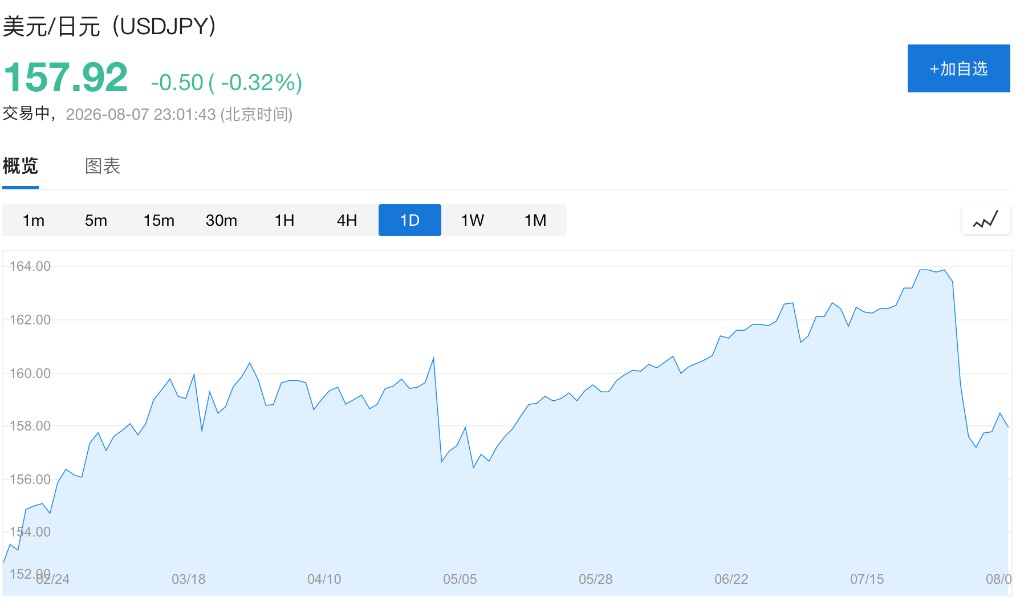
Non-farm data plunges USD, triggering sharp rise in JPY
Data released by the US Department of Labor on Friday showed that non-farm employment decreased by 23,000 in July, far below the expected increase of 80,000 by economists surveyed by Reuters. The June figure was also revised down to an increase of 20,000. This is a rare negative non-farm figure in recent years, significantly cooling market expectations for the Federal Reserve's monetary policy path.
Lee Hardman, Senior Foreign Exchange Analyst at MUFG (Mitsubishi UFJ Financial Group), stated, "The significant miss in non-farm payrolls makes the decline in the US dollar logical—look at the trend of the short-end of the US yield curve—this exchange rate movement appears to be fundamentally driven." He also pointed out that the sharp drop in the 2-year US Treasury yield confirmed this judgment.
Lee Hardman added, "Negative non-farm payrolls are extremely rare; this is a major downside surprise that has clearly lowered market expectations for the Federal Reserve. We expect to see a significant reaction and a broad-based sell-off of the US dollar."
US and Japan continue coordinated stance, market wary of renewed intervention
This yen volatility occurred just days after the joint US-Japan intervention. According to a previous article by Wallstreetcn, on August 3, the Japanese Ministry of Finance confirmed that Japan and the US jointly entered the market to buy yen last week, utilizing nearly $100 billion over two days. This marked the first coordinated forex intervention by both sides since 2011 and one of the largest yen intervention actions in history.
However, the market generally believes that intervention can only suppress short-term volatility and is difficult to change the medium-to-long-term trend of the yen. Goldman Sachs previously pointed out that the root cause of the yen's continued pressure still lies in the US-Japan interest rate differential and the Bank of Japan's difficulty in further raising interest rates. As long as this fundamental situation remains unchanged, the role of official intervention is closer to "buying time" rather than reversing the trend.
Citing analysts, the report suggested that against the backdrop of a weakening US dollar driven by weak non-farm payroll data, the continuous release of intervention signals by officials will continue to increase traders' caution in shorting the yen.
