


Wiping out half of the intervention gains! The yen is once again approaching 160, and Bessenet declares "at all costs" but cannot hide the limited ammunition
U.S. Treasury Secretary Janet Yellen stated that she would spare no effort to support Japan in stabilizing the yen, but the market questions the limited scale of its foreign exchange stabilization fund. On Monday, the yen fell 1%, erasing half of the previous gains from the U.S.-Japan joint intervention, approaching the 160 mark. Analysts pointed out that the Federal Reserve did not directly fund the intervention but only assisted in executing the operations, indicating that the U.S. intervention capability is not unlimited
According to the Zhitong Finance APP, U.S. Treasury Secretary Scott Bessenet suggested an unlimited approach to help Japan rescue the yen, a statement that may raise doubts among market participants who believe his actual firepower is limited.
On Monday, the yen fell by as much as 1%, erasing half of the gains made since the first joint intervention by the U.S. and Japan since 1998. After the intervention on July 31, the yen had briefly approached 155 yen to 1 dollar, but has now fallen below the 159 mark.
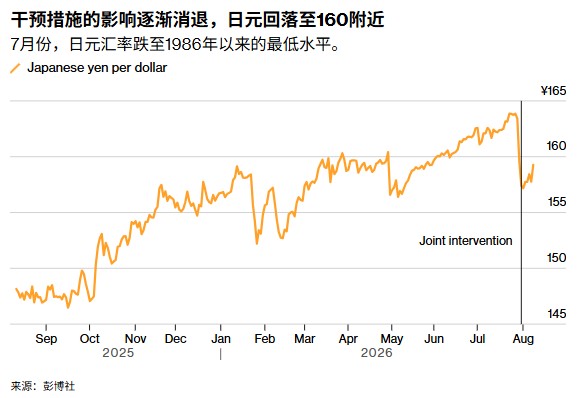
Following that unusual action, Bessenet stated, "We will support them at all costs to help the U.S. economy, U.S. taxpayers, and stabilize the global economy."
The issue is that, in terms of ammunition for exchange rate intervention, Bessenet seems constrained by his main special tool—the foreign exchange stabilization fund, which is insufficient at less than $220 billion. In comparison, Japan reportedly used $53 billion for yen operations just on July 30 (the day before the U.S.-Japan coordinated action).
"While the U.S. can influence public opinion through coordinated intervention with Japan, it cannot change the fundamental facts," said Nathan Tuft, senior portfolio manager at Manulife Investment Management. Regarding the capabilities of U.S. authorities, he stated, "They have substantial financial resources, but they are not unlimited."
The Federal Reserve, with "unlimited" firepower, has not directly entered the fray
In the U.S., the Federal Reserve theoretically has unlimited firepower for foreign exchange intervention to weaken the dollar, as it can essentially create dollars. However, in last month's action, the Fed's role was limited to executing yen purchases on behalf of the U.S. Treasury.
Historically, the Fed has sometimes used its own funds to jointly intervene with the U.S. Treasury to show support for intervention measures. For example, in the 1998 yen intervention, both the Fed and the U.S. Treasury contributed 50% each. Similar equal funding distribution was used in the joint yen sell-off in 2011 and the joint euro purchase in 2000.
Derek Tang, an economist at a monetary policy analysis firm, stated on Monday that media reports indicate the Fed "did not contribute funds" to support the U.S. intervention actions. Official data may not confirm this until later this year.
Tang pointed out that the Fed's "intervention capability is theoretically limited only by its own willingness."
The Fed declined to comment on U.S. intervention measures on Monday. The U.S. Treasury did not respond to a request for comment.
Bessenet highlighted another way the Fed could provide assistance: the Foreign and International Monetary Authorities Repurchase Agreement (FIAM). This tool allows Japan to exchange a portion of its over $1 trillion in U.S. Treasury reserves for dollar cash. Two days after the intervention action, Bessenet suggested "expanding" the scale of this tool.
Data released by the Fed last Thursday showed that Japan has not yet used this tool. However, earlier this month, Japanese Finance Minister Shunichi Suzuki hinted that this tool might be used at some point in the future Market Focus on the 160 Level
If the yen falls below the key psychological level of 160 yen per dollar, whether Japan acts alone or the US and Japan team up again, intervention pressure may rise. In the summer of 2024, when the yen fell below this level, authorities intervened to support the yen.
Marco Casiraghi and Lu Gang from Evercore ISI wrote in a report on Monday: "If the US and Japan allow the yen to continue trading above 160, the market may interpret the lack of intervention as a signal that the US is unwilling to sell dollars. This could invite additional market pressure, testing the commitment of all parties to a stronger yen."
Economists and market participants believe that the main motivation for Bank of Japan Governor Kazuo Ueda to support the yen is likely to prevent a crisis from spreading to US Treasuries. Occasional selling of Japanese government bonds can spill over to US Treasuries, and if Tokyo sells dollars, it could push up US yields. The benchmark 10-year US Treasury yield recently reached its highest level since Ueda took office.
"If Ueda is concerned that yen trading could put upward pressure on US Treasuries and long-term US Treasury yields, the best way to address this issue is to curb US fiscal extravagance," said Mark Sobel, who served at the US Treasury for over thirty years. "Foreign exchange intervention and the use of FIMA tools are merely stopgap measures."
Macro strategist Skylar Montgomery-Cohen stated: "A renewed weakening of the yen, coupled with rising US Treasury yields, may prompt Washington to re-engage. If the US ultimately sells dollars instead of euros as it did in July, this would pose a stronger deterrent to investors still shorting the yen."
Yen Depreciation Pressure Expected to Reemerge
With Japan closed for a holiday on Tuesday, traders are wary that tightening liquidity may create conditions for a new round of intervention, as authorities may achieve greater effects with smaller inputs. However, Monday's exchange rate fluctuations highlighted the limitations of intervention in changing the overall trend of the yen, especially when the main factors behind the yen's depreciation remain.
These factors include the significant interest rate differential between the US and Japan, concerns about Japan's fiscal outlook, and geopolitical uncertainties. On Monday, while the yen fell, oil prices rose due to ongoing tensions in Iran. Japan relies heavily on imports for most of its energy, making it vulnerable to rising oil prices.
In terms of policy interest rates, the Bank of Japan's benchmark rate is currently 1%, while the Federal Reserve's target range for key rates is 3.5% to 3.75%.
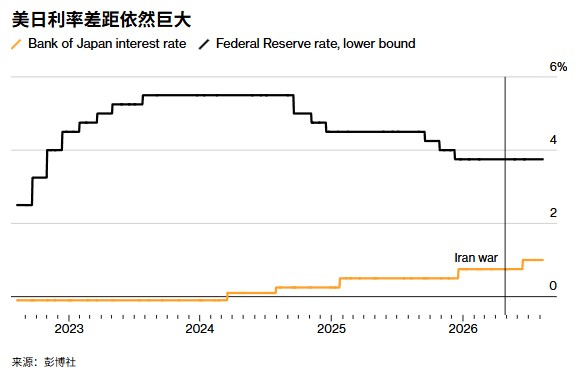
The minutes from the Bank of Japan's most recent policy meeting indicate that the risk of rising inflation is increasing, with one member suggesting that the pace of interest rate hikes may accelerate. Swap trading shows that traders believe there is about a 63% chance of a rate hike by the Bank of Japan in September, while the possibility of a rate hike in October has almost been fully priced in Goldman Sachs Group strategists Kamakshya Trivedi and others wrote in a report: "We believe the market's reaction to this intervention has been relatively muted, highlighting the underlying reasons for the yen's weakness." The team expects that "unless there is a change in the global situation or unexpected policies, the depreciation pressure on the yen will re-emerge over time."
