


Responding to "Questioning of $500 Billion Financing"! Jensen Huang: NVIDIA's "AI Factories" Are Becoming "Investment-Grade Assets," Demand Is Real, Absolutely Not "Circular Financing"
Jensen Huang stated that the funds are third-party capital, with financial institutions conducting independent due diligence, and emphasized that AI demand is genuine. He highlighted that NVIDIA's "AI factories" possess long-term economic value and a broad ecosystem. NVIDIA has partnered with six major financial institutions, including Apollo, BlackRock, and Blackstone, to establish an independent financing platform. "Dr. Doom" Jim Chanos compared this to the 2008 financial crisis, remarking, "The next time these people sit at the same table to explain AI financing, it might be at a congressional hearing in 2031..."
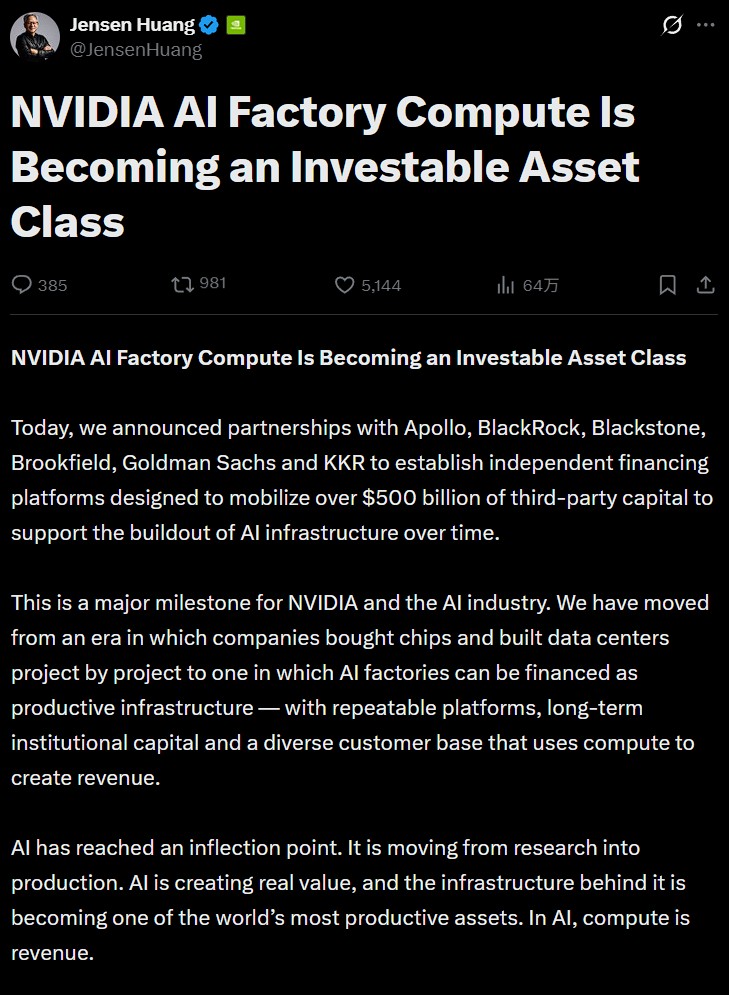
NVIDIA CEO Jensen Huang personally stepped in to defend the company's plan to mobilize over $500 billion in AI infrastructure financing in collaboration with six major financial institutions. He clearly stated that NVIDIA's AI factory computing power is becoming an investable asset class, with demand stemming from real-world business scenarios. Independent institutional investors will conduct separate due diligence on each project, making this absolutely not the "circular financing" questioned by outsiders.
On August 10, Huang announced on the social media platform X that NVIDIA had reached agreements with Apollo, BlackRock, Blackstone, Brookfield, Goldman Sachs, and KKR to jointly establish an independent financing platform, aiming to mobilize over $500 billion in third-party capital over time to support AI infrastructure construction. He emphasized that this $500 billion represents the total amount of third-party capital the platform is designed to mobilize, "which is neither NVIDIA's revenue nor a commitment to a single fund or a single customer."
Following the announcement, NVIDIA's stock price fell by 3.2% at one point. The price of 5-year credit default swaps (CDS), which measure the company's credit risk, rose to 77.215 basis points on Monday, an increase of about 5.3 basis points from the previous trading day, marking the largest single-day increase in two weeks. Analysts believe that this reflects growing market concern about NVIDIA's potential credit risks under the massive financing model.
Wallstreetcn Article reported earlier that, according to the UK's Financial Times citing informed sources, NVIDIA is seeking to join forces with Wall Street giants such as Apollo, Blackstone, GIP (under BlackRock), Brookfield, Goldman Sachs, and KKR to raise up to $500 billion for AI infrastructure projects in a consortium format. The funds will be used for AI chip procurement, power generation, and data center construction.
After these reports emerged, "Dr. Doom" Jim Chanos posted sarcastically about NVIDIA's joint financing of AI infrastructure with financial giants like Blackstone, comparing it to the financial engineering operations of the 2008 financial crisis. He implied that if the AI bubble bursts, the relevant parties might repeat the fate of Wall Street executives being held accountable by Congress back then.
AI Factories: From "Buying Chips" to "Financable Infrastructure"
In his post, Huang systematically explained the asset logic of NVIDIA's AI factories, attempting to redefine the market's cognitive framework for this business model.
He stated that the AI industry has moved from an era where "companies purchased chips project-by-project and built their own data centers" to a new stage where "AI factories can be financed as productive infrastructure"—featuring replicable platforms, support from long-term institutional capital, and a diverse customer base utilizing computing power to generate revenue.
Huang emphasized that NVIDIA's computing power is not merely chips, but a complete AI factory platform encompassing accelerated computing, networking, system software, AI frameworks, and a global developer ecosystem.
He pointed out that an NVIDIA AI factory can serve multiple customers and various workloads simultaneously, offering flexibility and substitutability. When one customer's needs change, the factory can be transferred to another customer, another cloud service provider, or another operator. "This broad ecosystem gives NVIDIA's computing power a deep potential user market, helping to protect residual value."
Huang characterized the aforementioned cooperation in the article as "the beginning of an open capital market for AI infrastructure." He stated that these financial institutions are all global leaders in infrastructure investment, possessing profound expertise in underwriting long-term productive assets. Both sides will jointly create a replicable financing platform to help build the factories required for the AI ecosystem.
CUDA Software Continues to Appreciate, A100 Still in Commercial Use After Six Years
Huang heavily emphasized the long-term economic value of NVIDIA's computing assets, supporting his claims with specific data.
He stated that CUDA software continuously enhances the performance, efficiency, and total cost of ownership of installed infrastructure, enabling AI factories to produce more intelligence at lower costs throughout their lifecycle, thereby extending their economic useful life.
Using the A100 as an example, Huang noted that NVIDIA launched the Ampere architecture-based A100 in 2020. Six years later, the product remains actively used in commercial applications for AI training, fine-tuning, inference, and high-performance computing, with customers continuing to sign multi-year capacity contracts. "The economic life of the A100 is extending towards ten years."
Regarding GPU leasing pricing, Huang cited market data showing that the one-year lease price for the H100 rose from approximately $1.70 per GPU-hour in October 2025 to about $2.35 in March 2026. The median on-demand pricing across service providers increased from around $2.00 in October 2025 to $2.70 in June 2026. The premium for the Blackwell series is even more significant, with cloud quotes for the B200 ranging from approximately $5.30 to $7.05 per GPU-hour.
He believes that the above data confirms the durability of the economic value of NVIDIA's computing power.
Direct Response to "Circular Financing" Questions
Addressing the market's most concerning question regarding "circular financing," Huang dedicated a Q&A section in his article to respond.
He stated that the design intent of this financing arrangement was precisely to address this concern. Demand comes from frontier AI labs, AI-native startups, enterprise customers, cloud service providers, and nations building AI services; "the demand is real." Each capital provider will independently conduct due diligence on every project, evaluating dimensions such as customer qualifications, demand status, utilization rates, cash flow, and residual value. "NVIDIA provides the platform, while investors make independent financing decisions."
Regarding NVIDIA's own risk exposure, Huang disclosed that in some cases, NVIDIA might provide a residual value support mechanism of up to 25% for individual projects, assessed "prudently on a project-by-project basis." He emphasized that this ratio is "far lower than other computing power financing arrangements" and is natured as residual value support, aimed at supplementing rather than replacing independent due diligence.
At the end of his post, Huang placed the construction of AI factories within a broader historical framework. He stated that every industrial revolution was built on infrastructure—electricity, transportation, communication, and computing—and every construction effort relied on external financing. "AI factories are the infrastructure of the intelligent age."
He summarized the business logic of AI as a positive cycle: Enterprises use AI to write software, develop drugs, design products, serve customers, automate operations, and build new services; more computing power brings better AI, better AI brings more usage, more usage brings more revenue, and more revenue drives more investment in computing power.
"This is the virtuous cycle of the AI industrial revolution."
Huang stated that through this cooperation, NVIDIA and leading global financial institutions will jointly provide infrastructure financing for this industrial revolution, making AI factories more accessible to enterprises, industries, and nations.
Wallstreetcn Article reported earlier that this cooperation is not NVIDIA's first deep involvement in financing the AI industry chain.
Previous reports indicated that NVIDIA was negotiating to provide up to $25 billion in financing guarantees for OpenAI and discussing financing $350 billion for OpenAI's chip procurement plans. Last month, NVIDIA also announced an expansion of its cooperation with South Korea's SK Group, with the total business scale between the two parties exceeding $500 billion. These moves indicate that NVIDIA is gradually transforming itself from a chip supplier into the core capital mobilizer of the AI infrastructure ecosystem.
"Dr. Doom" Compares to 2008: Next Congressional Hearing?
At the same time Huang posted, James Chanos, a well-known Wall Street short-seller known as "Dr. Doom," issued a meaningful comment on social media. He wrote:
"The next time these people sit at the same table to explain AI financing, it might be at a congressional hearing in 2031..."
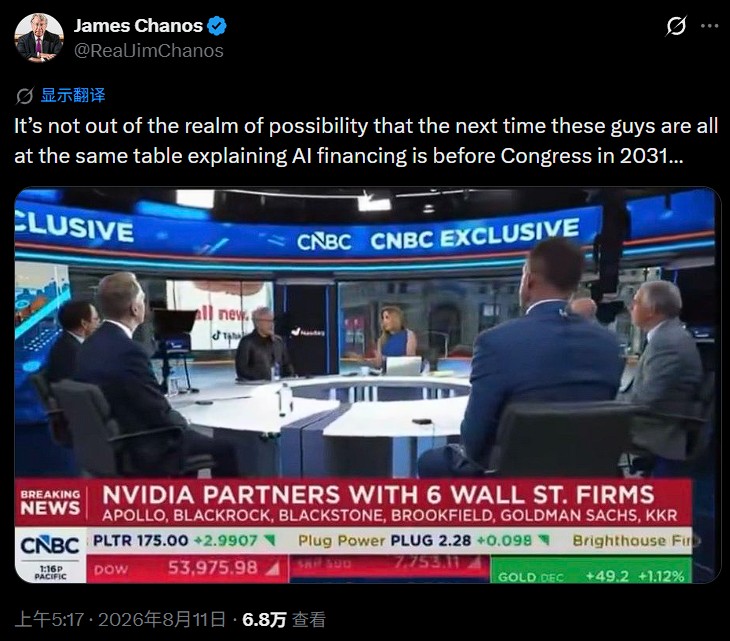
Chanos's implication pointed to the 2008 financial crisis—at that time, executives from major Wall Street financial institutions were forced to attend congressional hearings due to systemic risks triggered by the subprime mortgage crisis, credit default swaps, and complex financial instruments like CDOs. He compared NVIDIA's joint financing arrangement with Apollo, BlackRock, Blackstone, Brookfield, Goldman Sachs, and KKR to the financial engineering of that era, implying that if the AI infrastructure investment bubble bursts in a few years, Huang might face congressional inquiries alongside these financial institution executives.
Notably, when someone asked in the comments below his post whether the relevant parties would face criminal liability, Chanos explicitly stated: "No one said anything about going to jail."

