


Who Takes the Baton After Joint Intervention: Timing of BOJ Rate Hike Becomes Market Focus
The impact of yen intervention is rapidly fading—after rebounding from a 40-year low of 164 to 155, the currency is once again approaching the 160 threshold. The core issue has shifted from "whether to intervene" to "when to raise rates": the European Central Bank's exclusion from the coordination mechanism has significantly undermined the credibility of joint intervention; market consensus is gradually clarifying that without a rate hike by the Bank of Japan, any exchange rate support will be short-lived. September or December? This debate over the timing of the rate hike is determining the fate of global carry trades
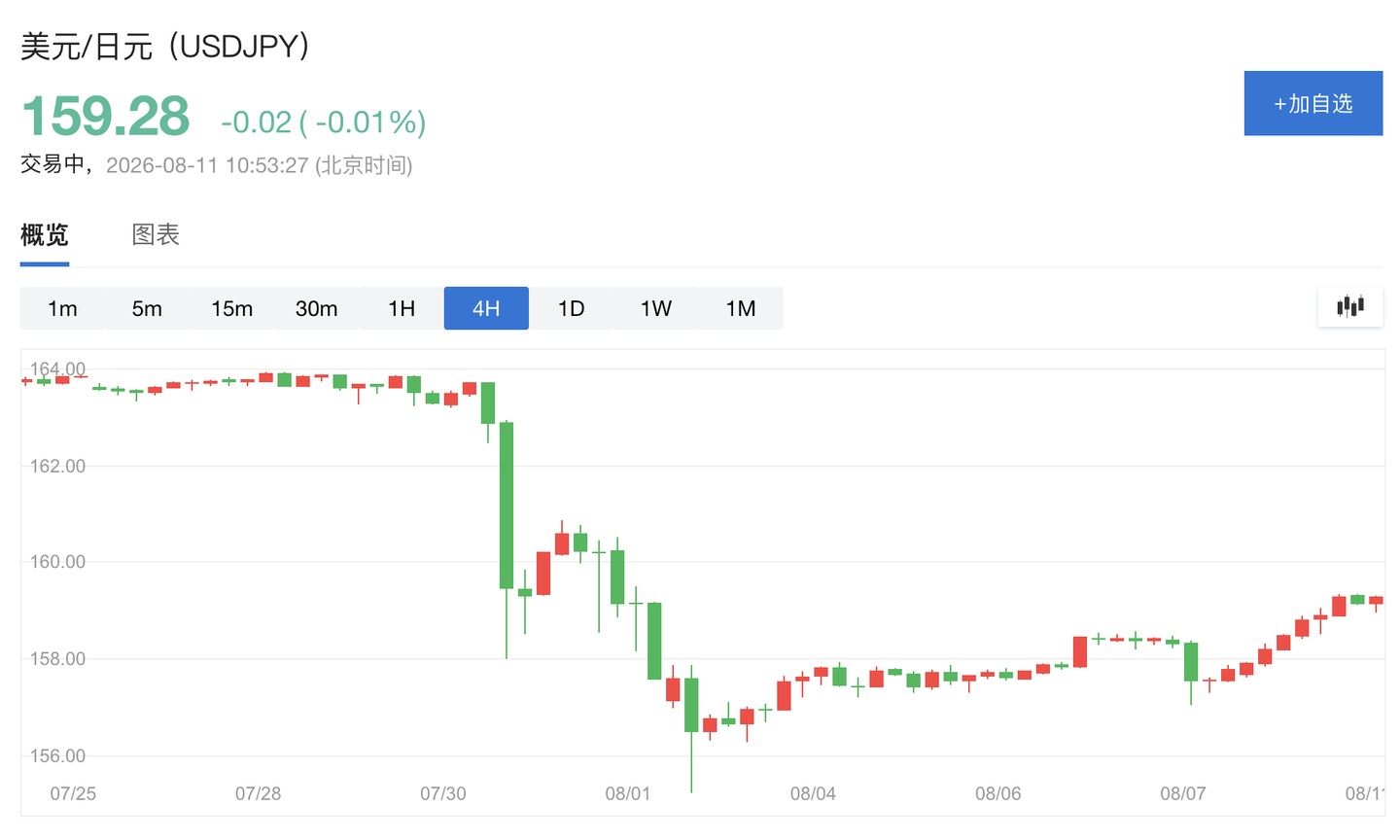
The effect of yen intervention is waning. After rebounding from near a 40-year low of 164 yen per dollar to around 155, the yen has softened again and is currently trading at 159.28. Market attention has shifted from the U.S. Treasury Secretary to the Bank of Japan, with the debate over the timing of a rate hike becoming the central game in the current foreign exchange market.
According to a Tuesday report by the UK's Financial Times, investors generally believe that the impact of this joint intervention was weakened by a lack of a "unified voice"—the European Central Bank was not notified in advance and failed to participate in the coordinated action. Van Luu, Head of Global Solutions Strategy at Russell Investments, stated that the intervention's effects are fading and that "more measures" are needed to create sustained support.
The market's core judgment is becoming increasingly clear: Without a supporting rate hike from the Bank of Japan, any exchange rate intervention will be difficult to sustain. This expectation is reshaping traders' pricing logic and directly transmitting pressure to the Bank of Japan's policy decisions.
Limited Intervention Effect, Yen Under Pressure Again
The US-Japan joint intervention set a historical precedent, but its market impact has been greatly diminished. After rebounding from the forty-year low of around 164 to near 155, the yen recently fell back below the 160 level, touching a low of 159.36 on Monday.
Guy Miller, Chief Market Strategist at Zurich Insurance, pointed out that the European Central Bank's exclusion from the coordination mechanism was "not helpful to the market," because coordination among central banks could have sent a signal of a "unified voice." This stands in sharp contrast to the G7's coordinated intervention to weaken the yen following the 2011 earthquake in Japan.
The latest data from the U.S. Commodity Futures Trading Commission shows that traders in futures and options markets still hold short positions in the yen, although position sizes have shrunk somewhat since the intervention. The unilateral interventions by Japan's Ministry of Finance in April and May also provided only brief support, further lowering market expectations for the sustainability of this intervention based on historical experience.
Rising Rate Hike Expectations: September or December?
The Bank of Japan's next move has become the focus of the market. The current benchmark interest rate is 1%, while the Federal Reserve's rate range is 3.5% to 3.75%; the interest rate differential is the fundamental reason for the yen's continued weakness.
The minutes from the Bank of Japan's July meeting showed that one board member explicitly stated that, given that core CPI inflation is close to 2%, "attention to upside price risks should be greater than in the past, and the pace of policy rate hikes may be faster than market expectations." Based on this, Goldman Sachs analysts in Tokyo pointed out that the risks are clearly skewed toward an earlier rate hike.
Traders are currently pricing in approximately a 50% probability of a 25 basis point rate hike by the Bank of Japan in September. Citigroup analysts predict a "shift in policy mechanism" for the Bank of Japan, involving a more aggressive hiking pace starting in September and raising rates to 2% by the end of next year.
However, several institutions remain cautious about a September hike. Masayuki Nakajima, an analyst at Mizuho Securities, believes that from the perspective of Japan's domestic economy, the threshold for action in September remains high—Japan has experienced decades of low growth, low inflation, and ultra-low interest rates, and concerns persist about the impact of rate hikes on households with mortgages and small and medium-sized enterprises. He stated that the Bank of Japan prefers gradual normalization, observing for about six months after each 25 basis point hike, making December the most natural timeline and the baseline forecast for Mizuho's Tokyo macro team.
Barclays analysts Naohiko Baba and his team also list October as the baseline scenario but state they remain "wary of a September hike." They pointed out that the Summary of Opinions released by the Bank of Japan on August 10 is crucial—if multiple board members explicitly express support for an early hike, the probability of action in September will rise significantly.
Notably, if the Bank of Japan raises rates in September, the interval between two consecutive hikes would shorten to about three months, a pace not seen since the asset price bubble contraction phase of 1989–1990, which would constitute a historic policy turning point.
Dual Risks of Yen Undervaluation and Carry Trades
Calculations by Costas Milas, a professor at the University of Liverpool, show that the yen is currently undervalued by approximately 21%, and the divergence between the exchange rate and interest rate differentials has clearly exceeded normal ranges, which is also an important basis for the US and Japan to characterize the market as "disorderly."
If the yen falls below 160 again, it will further exacerbate domestic inflation pressures in Japan, deepen US policymakers' anxiety about an overly strong dollar, and trigger market concerns about whether Japan needs to sell its massive holdings of US Treasury bonds to support larger-scale foreign exchange intervention.
Some investors compare the current market situation to August 2024—when the yen suddenly surged, causing severe volatility in global financial markets. Van Luu pointed out that with concentrated short positions and low valuation in the yen, the risk of rapid unwinding of carry trades cannot be ignored if the Federal Reserve turns dovish simultaneously with the Bank of Japan turning hawkish.
However, Ayako Fujita, Chief Japan Economist at JPMorgan, holds a more moderate view. She believes that even if the Bank of Japan accelerates its rate hiking pace, short-term interest rate differentials will remain wide enough, making the possibility of large-scale, rapid unwinding of carry trades relatively limited. The convergence of long-term Japanese government bond yields with those of other major economies is a "story for the more distant future" and does not pose a systemic shock in the short term.
