


NVIDIA's $500 Billion "Circular Financing"? Morgan Stanley Counters: Investment Led by Third Parties, NVIDIA Provides Only "Residual Value Support" and Enjoys Long-Term Revenue Sharing
Morgan Stanley believes that NVIDIA provides no more than a 25% "residual value support mechanism" in this structure, with decision-making authority and funding sources borne by independent third parties, structurally addressing concerns about "circular financing." This arrangement also opens a channel for annuity-style revenue sharing with nearly 100% gross margin for NVIDIA, with projected FY29 shared revenue exceeding $10 billion and EPS upside of over 10%
NVIDIA announced the mobilization of $500 billion in third-party capital for AI infrastructure investment. Morgan Stanley believes this structural arrangement fundamentally alleviates market concerns about "circular financing" while opening a high-gross-margin channel for long-term revenue sharing for NVIDIA.
Wall Street News Article reported that on August 10, NVIDIA announced the formation of a so-called "independent computing power financing platform" jointly with six institutional partners, with a potential investment scale of $500 billion for the construction of AI factories. In this structure, NVIDIA provides only a "residual value support mechanism" capped at 25%, with lead decision-making authority and funding sources borne by independent third parties.
In a research report on August 11, Morgan Stanley pointed out that the core value of this arrangement lies in: The third-party-led decision-making mechanism effectively reduces external doubts about NVIDIA's "self-circular" investments, while simultaneously opening a repeatable, annuity-style revenue source with nearly 100% gross margin for NVIDIA through revenue sharing agreements.
Morgan Stanley analyst Joseph Moore calculated that if NVIDIA shares 35% of the returns above the break-even point, the revenue sharing from computing power per watt could exceed $10 billion in FY29, corresponding to an EPS upside of over 10%.
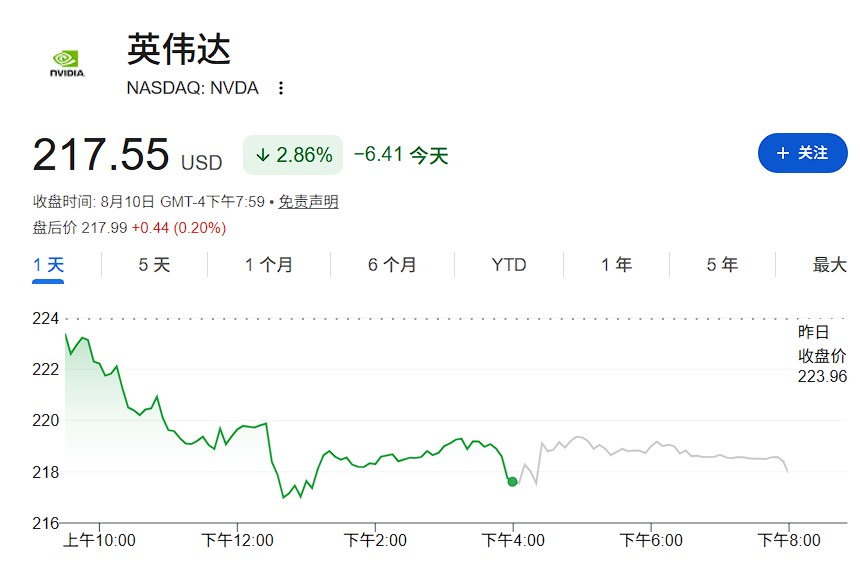
Morgan Stanley maintains an Overweight rating on NVIDIA with a target price of $288. With the current stock price at $217.55, this implies an upside potential of approximately 32%.
$500 Billion Mobilization: Structural Design is Key
Morgan Stanley believes that what NVIDIA announced is not a finalized investment commitment, but rather the formation of an independent computing power financing platform with six institutional partners, with a total potential investment scale of $500 billion. Each partner will decide whether to invest based on their independent judgment of the projects, and no specific investment decisions have been finalized yet.
NVIDIA's role in this structure is defined as an "ecosystem supporter," providing a "residual value support mechanism" capped at 25% of a single investment. NVIDIA officially describes this mechanism as "limited, residual-value-based support aimed at supplementing rather than replacing independent underwriting."
Morgan Stanley points out that the core significance of this structural design is: NVIDIA's participation ratio is strictly limited to a minority equity stake, with dominant decision-making authority belonging to professional third-party investment institutions, thereby institutionally cutting off the conditions for the logic of "NVIDIA lending to customers, who then buy NVIDIA chips" to hold.
NVIDIA CEO Jensen Huang previously stated clearly on social media that "this measure was designed precisely to address concerns about circular financing."
Concerns About Circular Financing: An Exaggerated Risk
Morgan Stanley clarified and addressed the narrative of "circular financing" circulating in the market in its research report.
The report pointed out that NVIDIA's direct credit exposure to date is actually quite limited, mainly concentrated on credit endorsements for a few smaller emerging cloud service providers (neoclouds). According to NVIDIA's latest 10-Q filing, its total exposure to lease guarantees for partners is approximately $3.5 billion.
Furthermore, although NVIDIA has made equity investments in some customers and ecosystem partners, Morgan Stanley emphasized that these are equity investments, not grants or credit guarantees. Regarding public market investments, the relevant holdings have performed well overall; while the returns on private company investments are difficult to assess precisely, they remain equity assets in nature.
Morgan Stanley also noted that some media reports tend to exaggerate NVIDIA's off-balance-sheet risks by citing large credit facilities that have not yet occurred and are planned to be rolled out gradually over the next decade. The report believes that NVIDIA remains prudent in managing its credit exposure.
Revenue Sharing: Opening a High-Margin Annuity Channel
Another layer of strategic value in this financing structure lies in its deep integration with NVIDIA's revenue sharing plan.
Morgan Stanley pointed out that NVIDIA's press release explicitly mentioned that the platform would "achieve long-term usage-linked revenue," meaning that related investment projects will be included in NVIDIA's disclosed revenue sharing framework.
According to Morgan Stanley's calculation model:
If NVIDIA shares 35% of the GPU usage returns above the break-even point, in a scenario where the market GPU rental price is $13 per hour and annual new computing power capacity increases by 5 gigawatts, NVIDIA can obtain approximately $51 billion in incremental annual revenue, corresponding to an FY29 EPS upside of about 9.83%.
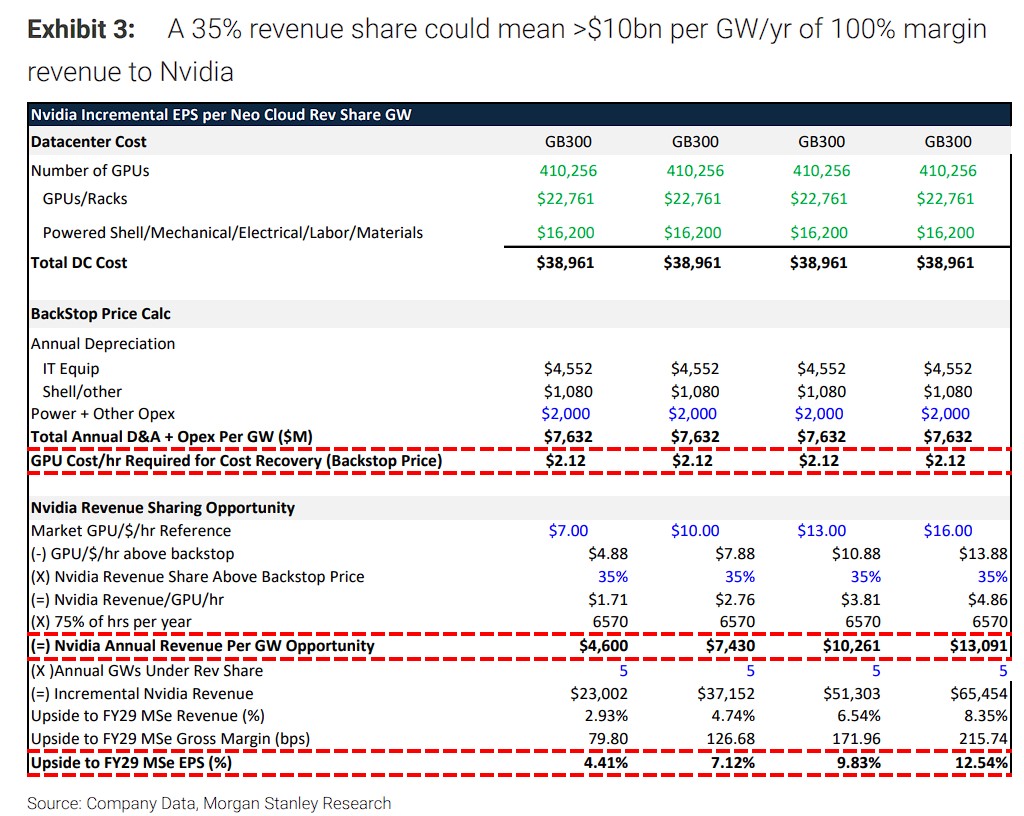
The key characteristic of this revenue source lies in its gross margin structure: Since NVIDIA does not bear hardware depreciation and operating costs in the sharing arrangement, the related revenue approaches a 100% gross margin and is repeatable, similar to the annuity nature of software subscriptions or cloud services.
Morgan Stanley believes that this is an important step in NVIDIA's transformation from a "hardware vendor" to an "AI infrastructure ecosystem operator."
Potential Risks: Uncertainties Remain
While affirming the positive significance of this structure, Morgan Stanley also listed several counter-arguments worth noting.
- Uncertainty in capital deployment. The $500 billion is a nominal potential investment scale. Each partner will evaluate projects independently, and there is no mandatory mechanism requiring capital deployment, leading to significant uncertainty in the actual realized scale.
- NVIDIA still bears certain credit risks. Even with a participation cap of 25%, NVIDIA will still bear credit exposure in some projects. Morgan Stanley stated that it prefers NVIDIA to provide support in the form of GPU usage rights rather than pure credit guarantees—the former has lower actual costs because NVIDIA itself has a need to use GPUs for developing its own open-source models.
- Controversy over rising leverage in the ecosystem. Even if NVIDIA itself does not provide leverage, the debt level of the entire AI ecosystem will still rise with large-scale investments from sovereign wealth funds and emerging cloud service providers. Morgan Stanley pointed out that some major hyperscale cloud service providers are currently in a cash-flow-neutral or even negative state, and there is divergence in the market regarding whether the AI ecosystem can sustain continued leveraging.
Morgan Stanley Maintains Top Pick: Valuation Remains Attractive
Combining the above analysis, Morgan Stanley believes that the positive significance of this financing structure significantly outweighs the potential risks. It maintains an Overweight rating on NVIDIA with a target price of $288 and lists it as the top pick in the semiconductor sector.
Morgan Stanley predicts that NVIDIA's revenue in fiscal year 2026 will increase by 82% year-over-year, and further grow by 52.4% in fiscal year 2027, corresponding to EPS of $4.77 and $8.98, respectively.
Based on Morgan Stanley's ModelWare framework, the EPS forecast for fiscal year 2027 is $8.96, corresponding to a P/E ratio of approximately 24 times at the current stock price. This is lower than comparable computing semiconductor companies such as AMD and Broadcom, making the valuation relatively attractive.
Meanwhile, Morgan Stanley pointed out that NVIDIA's Blackwell series products remain the mainstream solution for generative AI workloads, with computing demand continuing to exceed supply. The next-generation Rubin architecture is expected to continue its performance leadership advantage, and the logic supporting valuation through the product cycle remains valid.
