Ming-Chi Kuo clarifies rumors of Apple chip backlog: Apple produces according to materials, and large-scale backlog of work-in-progress at Taiwan Semiconductor is not common
Tianfeng International analyst Guo Mingqi clarified the rumors of Apple chip backlog, pointing out that Apple and Taiwan Semiconductor have a close supply chain collaboration, adhering to the principle of "production based on materials," and there is no large-scale passive backlog of work in progress. Although the DRAM shortage has led Apple to adjust some shipment plans, it is not a case of producing first and waiting for materials. The increase in Taiwan Semiconductor's inventory is mainly due to the ramp-up of 2nm mass production and multiple customer factors, not solely caused by Apple
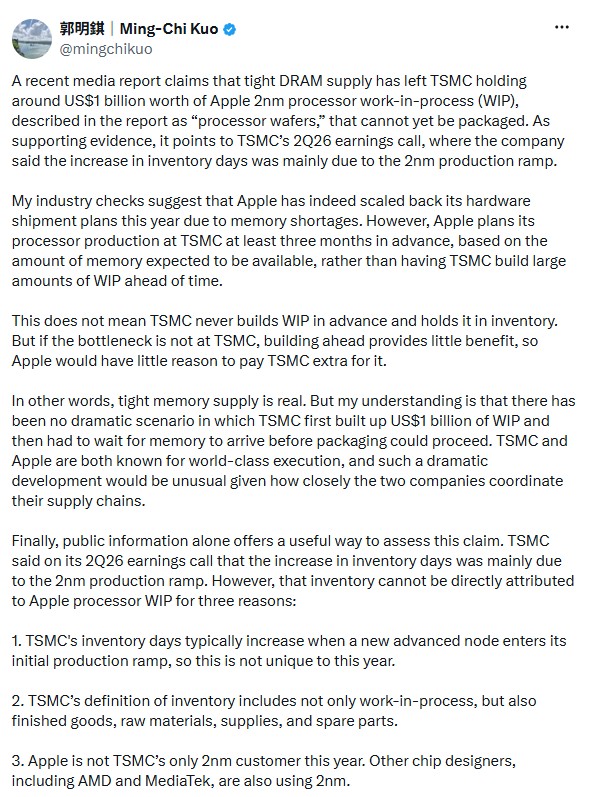
According to the Zhitong Finance APP, in response to recent reports about "TSMC having approximately $1 billion worth of Apple 2nm processors in backlog due to DRAM shortages," well-known analyst Ming-Chi Kuo from Tianfeng International Securities clarified on social media platform X. He believes that Apple (AAPL.US) and TSMC (TSM.US) have maintained a highly close collaboration in supply chain management for a long time, and large-scale backlog of work-in-progress is not common.
Ming-Chi Kuo pointed out that Apple did indeed lower some hardware shipment plans this year due to memory shortages, but this does not mean that the supply chain is in a passive situation of "producing first and waiting for materials." According to his industry survey, Apple typically plans TSMC's processor production rhythm at least three months in advance based on the expected available memory, following the principle of "production based on materials," rather than having TSMC produce a large amount of work-in-progress in advance and accumulate inventory.
Ming-Chi Kuo emphasized that there has not been a scenario where "TSMC first accumulates $1 billion worth of work-in-progress processors and then waits for memory to arrive for packaging." He noted that both TSMC and Apple are top companies in global supply chain execution, and both have maintained a highly close collaboration for a long time. Under such a supply chain management system, the occurrence of such large-scale passive backlog of semi-finished products is not common.
Additionally, Ming-Chi Kuo analyzed inventory data from the perspective of publicly available information. TSMC stated in its Q2 2026 earnings call that the increase in inventory days is mainly due to the ramp-up of 2nm process mass production, but this inventory cannot be directly attributed to Apple’s work-in-progress processors. The main reasons are threefold: first, TSMC's inventory days typically rise during the initial ramp-up phase of advanced processes, which is not unique to this year; second, TSMC's inventory definition includes various items such as work-in-progress, finished goods, raw materials, consumables, and spare parts; third, Apple is not TSMC's only 2nm customer this year, as other chip design companies like AMD and MediaTek are also using the 2nm process.
In summary, while the tight supply of DRAM has indeed had some impact on iPhone shipments, the mature supply chain collaboration mechanism established between Apple and TSMC is sufficient to effectively respond to such upstream material fluctuations, making the possibility of large-scale semi-finished product backlog extremely low. The previous rumors appear to be exaggerated.