


RKLB: Neutron may be delayed; can it challenge SpaceX?
$Rocket Lab.US released its Q2 2026 results after the U.S. market close in the early morning of Aug 10 Beijing time. The quarter was solid, but next-quarter guidance significantly missed on GM and Adj. EBITDA vs. the Street. Details below:
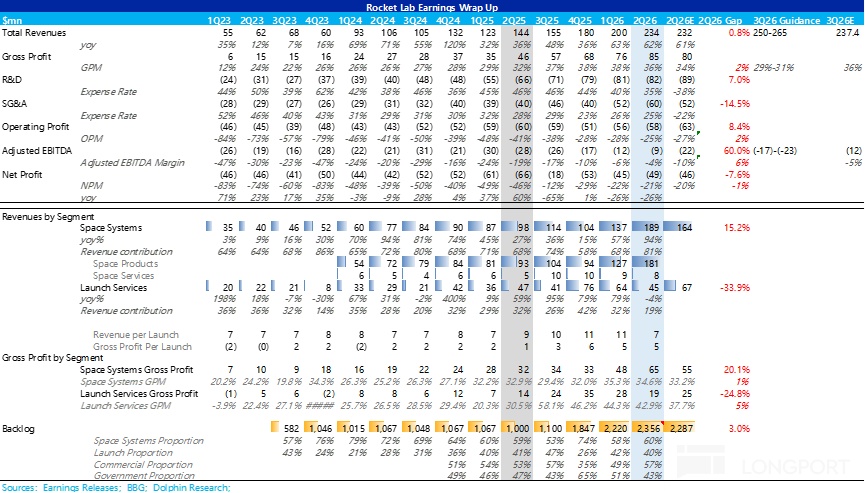
① Revenue slightly beat: In Q2, Rocket Lab reported total revenue of $230 mn, +62% YoY, modestly ahead of consensus. By segment:
a. Space Systems revenue was $189.5 mn, +94% YoY, with growth further accelerating. The strength was driven by two key factors:
First, satellite manufacturing contracts moved into peak delivery, lifting over-time revenue recognition for large, multi-year programs such as SDA Tranche II and Tranche III. These whole-satellite projects carry far larger contract values than component sales, directly accelerating segment revenue.Second, the quarter closed the strategic acquisitions of Mynaric and Motiv, which were consolidated. Mynaric (laser comm terminals) contributed $13 mn incremental revenue in Q2, while filling a supply-chain gap in core comms components for satellite constellations.
b. Launch services revenue was $45 mn, -4% YoY, now in decline. YoY turned negative despite more launches.
Launch count rose from five to six YoY, but revenue timing weighed on reported ASPs. Q2 included two HASTE sub-orbital hypersonic test missions recognized over time (with much revenue recognized earlier), while last year’s standard Electron missions were recognized at launch success (one-time). This diluted apparent per-launch ASP, from ~$9.3 mn down to ~$7.4 mn.
② GM beat but shows structural pressure: Q2 blended GM was 36%, down 2 ppt QoQ yet above the Street at 34%. The QoQ decline was mainly mix-driven:
a. Mix impact: lower-margin Space Systems rose 13 ppt QoQ to 81% of revenue, while higher-margin launch mix fell. This mix shift weighed on consolidated margins.
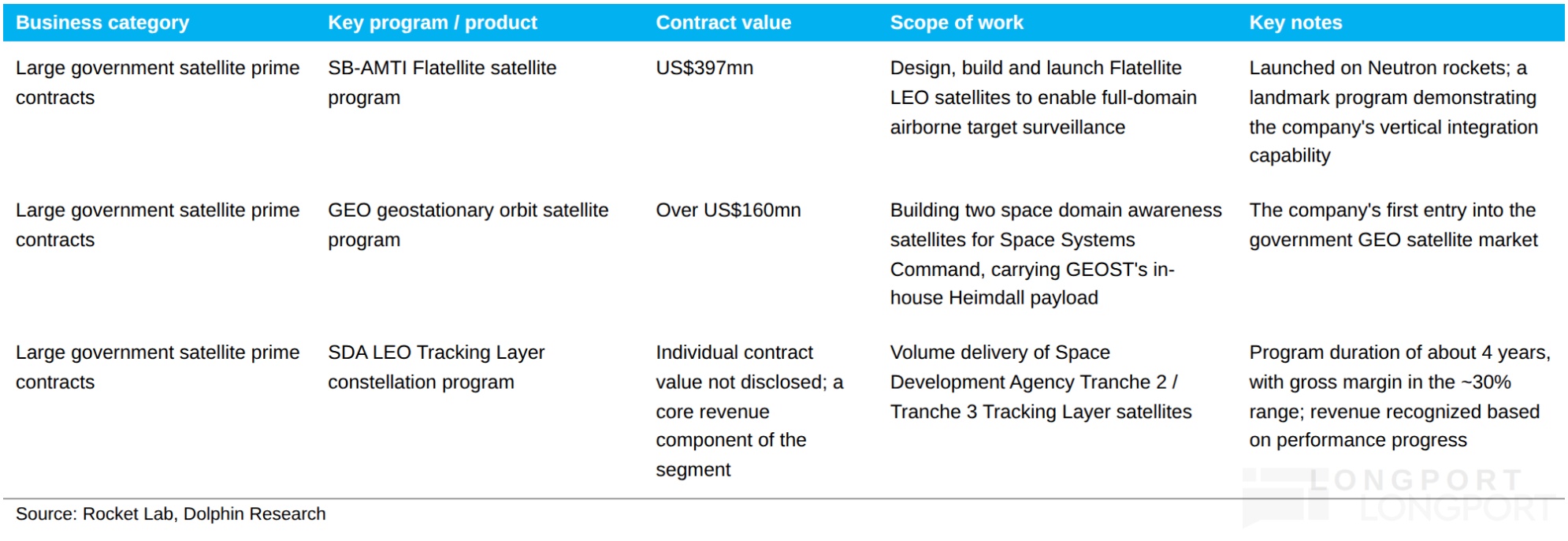
b. Space Systems margin fell as lower-margin satellite platform revenue mix increased. Q2 Space Systems GM was 34.6%, down 0.7 ppt QoQ, as satellite platform deliveries (SDA Tranche II/III LEO constellations) accelerated and took a larger share.
Platform projects carry ~30% project-level margins, well below high-margin components (reaction wheels, star trackers, separation systems, some >70%), pulling down segment profitability. In addition, Mynaric, consolidated in Q2, had pre-deal supply-chain bottlenecks and went through restructuring; its GM is currently low, and, similar to SolAero’s prior integration, margin repair will take several quarters.
c. Launch services margin also fell QoQ. Q2 launch GM was 42.9%, -1.5 ppt QoQ, mainly due to HASTE revenue timing and lower margins on HASTE, with limited in-period recognized revenue under over-time accounting, dragging the overall GM.
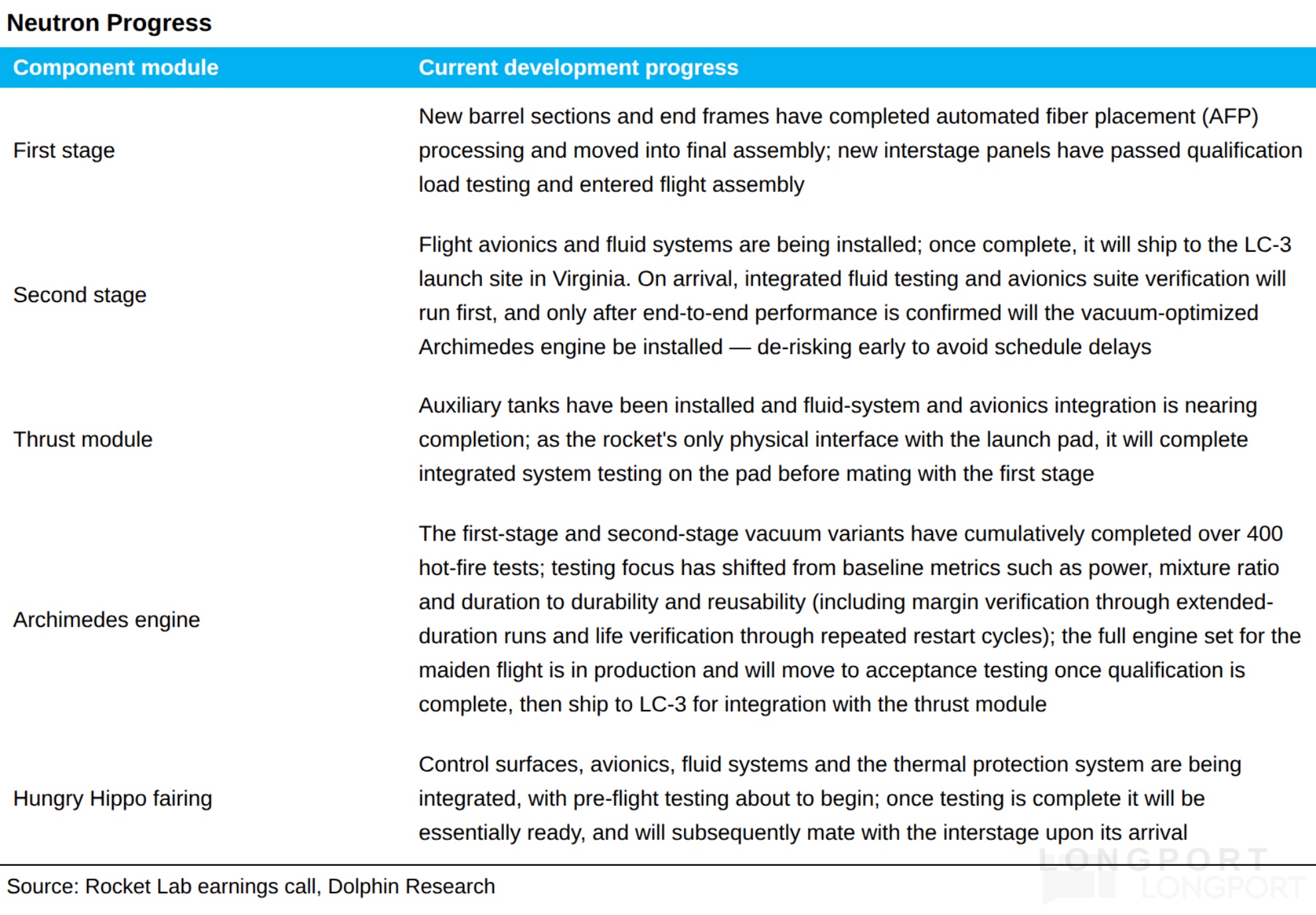
③ Opex still expanding for future investment: R&D rose 25% YoY to $82 mn, as Neutron moved into key pre-first-flight validation: first-stage assembly, second-stage integration, >400 hot fires of the Archimedes engine, and fairing tests progressed in parallel. Related engineering payroll and test costs rose materially YoY.
SG&A rose 50% YoY to $60 mn, driven by multiple concurrent deals (Iridium, Mynaric, Motiv), incurring one-off legal, DD, and financial advisory expenses. Transaction costs were the main driver.
④ OP and Adj. EBITDA better than expected: Supported by revenue and GM, OP came in at -$58 mn vs. -$63 mn expected, despite rigid opex. OPM improved 3 ppt QoQ to -25%.
⑤ Backlog continued to rise QoQ: Q2 backlog was $2.4 bn, with ~40% launch services ($940 mn) and ~60% Space Systems ($1.42 bn). Of the backlog, 45.5% is expected to be recognized within 12 months ($1.09 bn), with the remaining 54.5% beyond 12 months.
Q2 plus post-quarter new awards topped $1.0 bn, including $437 mn in launch and $581 mn in Space Systems. By sub-segment:
a. Launch services: 26 launches were added in Q2, and post-quarter launch backlog rose to 90+ missions, a record high.
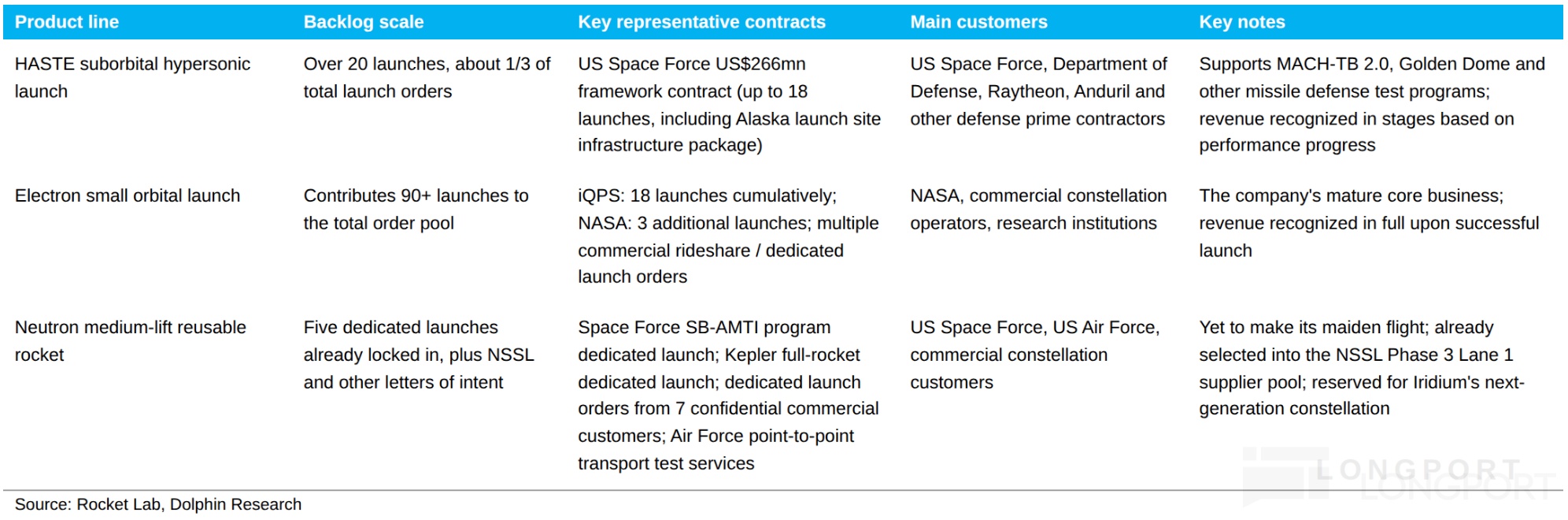
b. Space Systems: Q2 + post-quarter new awards totaled $581 mn, including a $397 mn U.S. Space Force SB-AMTI space-based airborne target monitoring program and >$160 mn to build three GEO satellites. The pipeline is broadening.
⑤ 3Q26 GM and EBITDA guidance well below consensus, down QoQ:
3Q26 GAAP GM guidance of 29%–31% is well below the Street at ~36%. Mix is the primary headwind as large whole-satellite programs like SDA Tranche II/III enter peak deliveries in Q3, further lifting low-margin revenue share.
Newly signed GEO satellites and Flatelite projects are at early delivery and ramp stages, with added costs from capacity ramp and process tuning. Combined with a relatively lower share for high-margin launch, the blended GM faces structural drag.
With GM well below expectations, Adj. EBITDA is guided to -$17 mn to -$23 mn, vs. -$12 mn expected. Adj. EBITDA margin is seen at -6% to -9%, down 2–5 ppt QoQ.
Overall, Q2 was decent, with revenue, profit, and backlog all slightly ahead of expectations. However, next-quarter guidance for GM and Adj. EBITDA missed materially, largely due to higher mix of low-margin whole-satellite builds, early ramp on newly signed GEO and Flatelite projects, and potential further decline in the share of high-margin launch.
Rocket Lab is replicating key elements of SpaceX’s playbook: scaling lift capacity with the reusable mid-lift Neutron, advancing first-stage recovery/reuse, and, via the Iridium acquisition, owning a ready-made proprietary constellation (akin to Starlink’s model). The endgame is a closed-loop across 'launch–build–operate'.
Specifically:
① Neutron first flight targeted for 26Q4, with delay risk
Neutron is pivotal for RKLB’s transition from a 'small launch' company to a 'SpaceX challenger', benchmarking Falcon 9 with first-stage reuse (13t to LEO vs. ~23t for F9). It is the biggest variable in the valuation framework, with execution risk directly impacting the stock.
The first-flight timeline has slipped twice: originally 2025Q4 → 2026Q1 → now 2026Q4, with the company still targeting a 2026 first flight. With ~4.5 months left to year-end, the window is narrowing.
In Jan 2026, the Neutron first-stage tank ruptured during hydrostatic qualification, traced to a manual layup defect by a third party. The company shifted future tank production to in-house AFP (automated fiber placement), eliminating manual defects and enabling scalable mass production. AFP shortens cycle time, and the second airframe carries only material variable costs, requiring no added headcount or capex.
The delay reflects a deliberate trade-off between earliest launch and mass-production readiness. Rather than rushing the earliest date, the goal is to have Neutron ready for high-frequency launches at first flight. Moving tanks to automation lowers quality risk and unit build cost long term, while giving other critical components (Hungry Hippo fairing, second stage, Archimedes engine) more test time.
By end-Q2 2026, all Neutron flight hardware entered assembly and integration, Archimedes completed 400+ hot fires, the new AFP tank was in planned production, and second stage plus fairing were nearing integration. Management says progress supports delivering the launch mount in Q4, but the year-end first-flight window is narrowing, with delay risk tied to first-stage qualification and full-vehicle integration outcomes.
② Acquiring Iridium: integrating 'launch–manufacture–applications' to build differentiated space services
Through consecutive deals for Motiv (space robotics), Mynaric (laser comms), and Iridium Communications (Iridium), plus in-house electric propulsion, the company now spans the three critical links of the space value chain: access to space/launch, hardware manufacturing, and space applications. Rocket Lab becomes one of only two players globally with both high-frequency commercial launch and scaled satellite manufacturing/operations.
Iridium’s control of L-band is a 'golden scarce' spectrum asset. While throughput is Kbps to Mbps (not for consumer HD broadband), it offers strong weather penetration, zero-angle pointing needs, and omnidirectional connectivity.This 'absolute reliability over headline speed' profile makes it a lifeline in extreme no-outage environments, positioning it in differentiated competition vs. SpaceX Starlink’s high-bandwidth consumer broadband.
Use cases span industrial IoT, DTC/D2D phone-to-satellite devices, advanced PNT (timing/positioning), defense and national-security private networks, and aviation/maritime safety comms. Coverage is broad and mission-critical.
Building a LEO constellation and securing global spectrum licenses typically takes 10+ years. This deal lets Rocket Lab skip the high-risk, cash-burn network build, instantly acquiring 66 in-orbit satellites, >2.5 mn high-retention subscribers, exclusive global spectrum rights, and ~$870 mn of recurring annual revenue. The mature cash engine will fund Neutron and next-gen platforms.
The transaction is progressing through Iridium shareholder approval and regulatory review, with close expected mid-2027. Near term, focus is on integration planning and the growth roadmap.
Successful recovery and reuse on Neutron would also directly reduce constellation deployment costs for Iridium. Synergies run both ways.
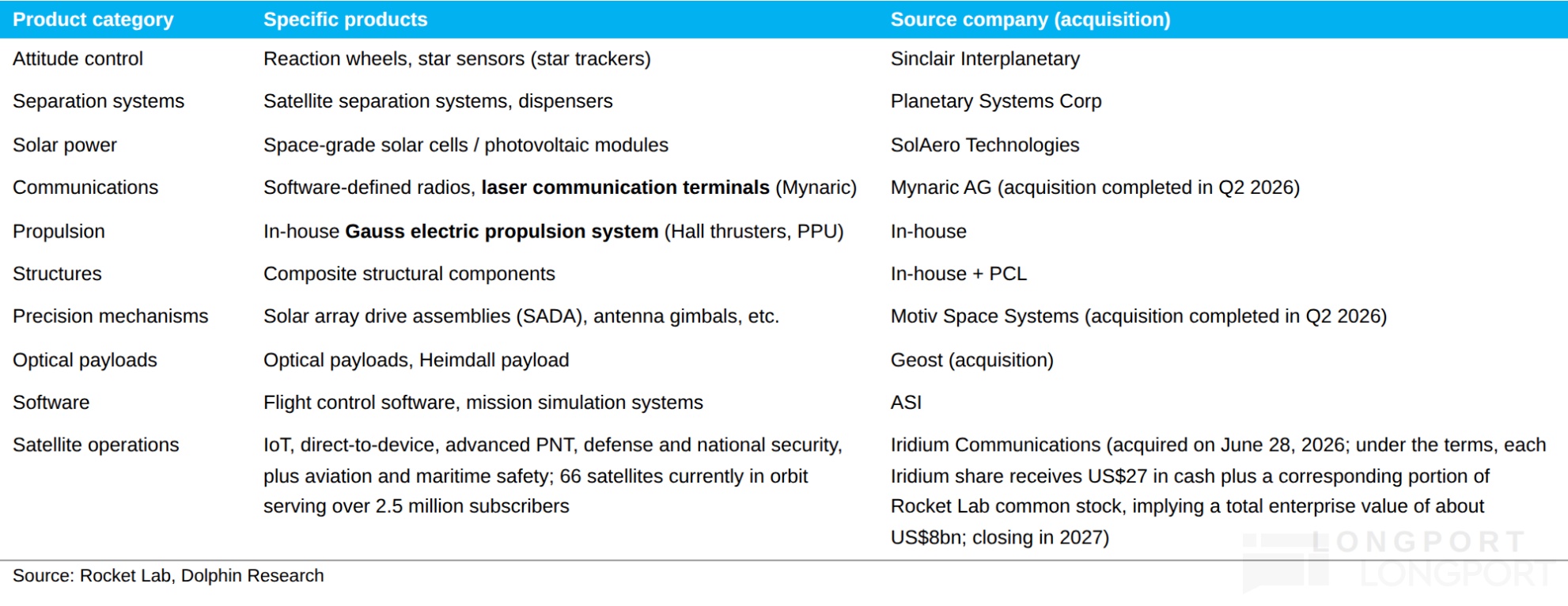
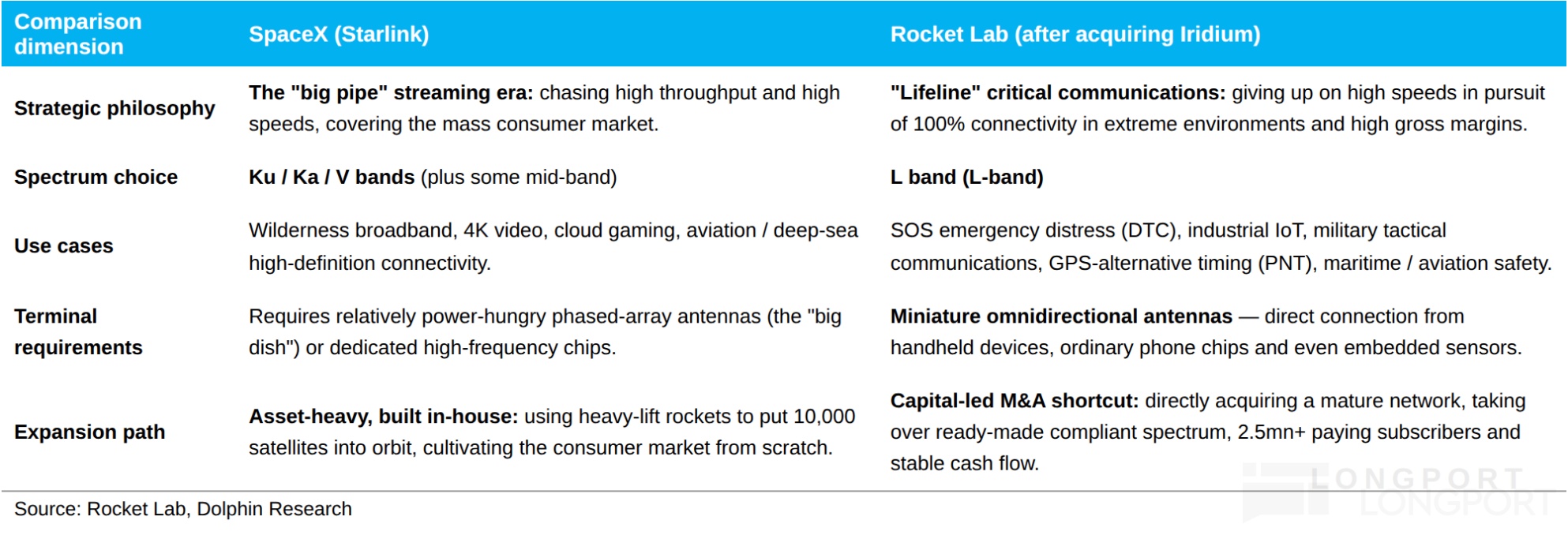
For RKLB’s stock, Dolphin Research outlines three scenarios:
Long-term mgmt. targets: Management guides the Electron launch business to $500–$1,000 mn revenue in 3–5 years, Neutron to ~$1,000 mn, and ~30 Electron launches in 2026. Scale is set to expand materially.
Management also expects Space Systems to remain larger than launch, with a long-term revenue mix of ~55%–60% for Space Systems (vs. ~68% in 26Q1, rising to ~81% in 26Q2). Mix is shifting further toward Space Systems.
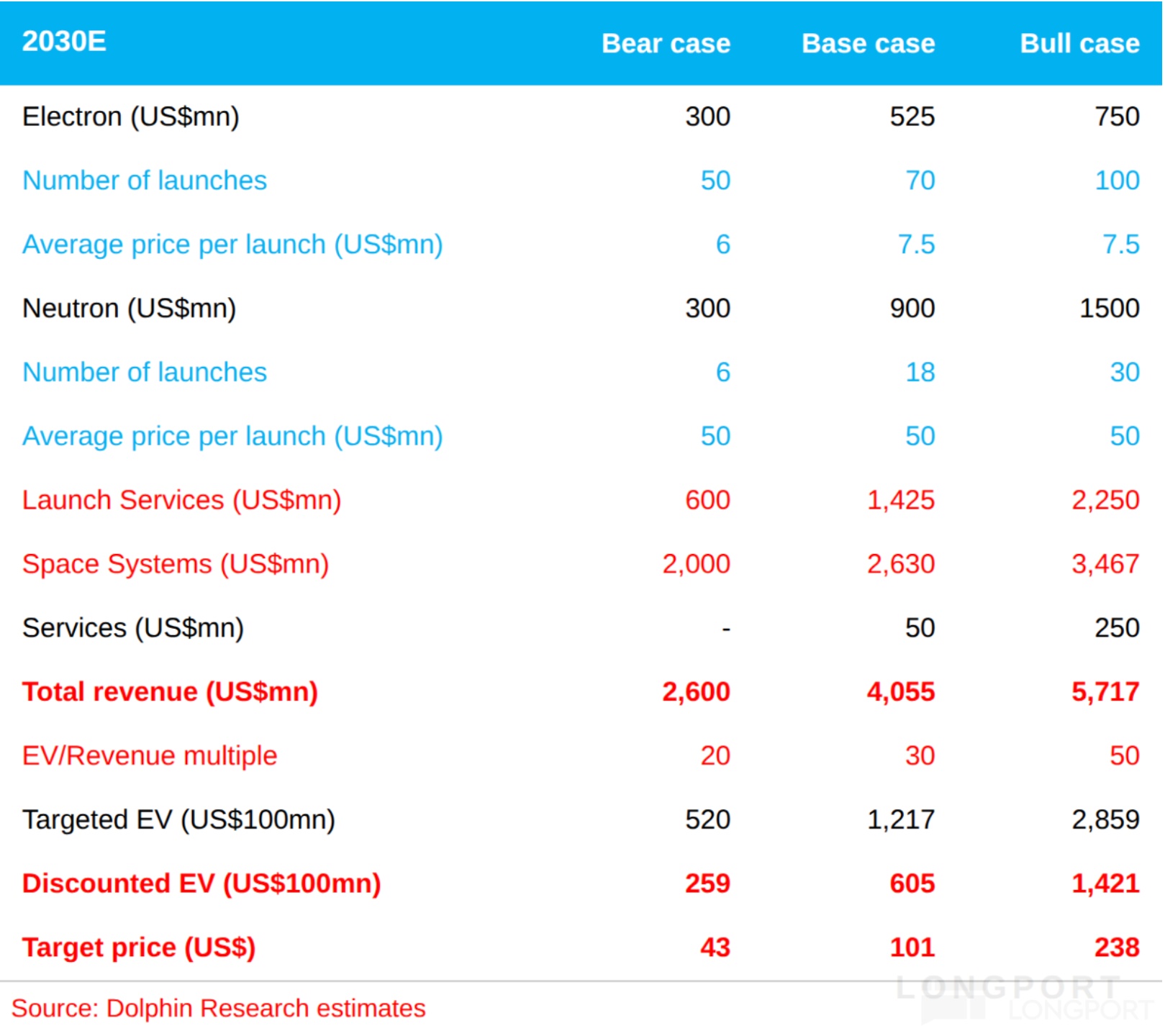
Base case: We assume Electron at $530 mn revenue by 2030, Neutron’s test and development proceed as planned with $900 mn revenue, and Space Systems grows at a 40% CAGR to ~$2.6 bn by 2030. Total revenue would be ~$4.1 bn by 2030.
For valuation comps, we reference SpaceX’s base case contribution from launch + Starlink at ~$1.0–1.1 tn equity value, implying a 2026 P/S of ~48–50x for Starlink + launch. We apply a ~40% discount to RKLB (execution risk vs. SpaceX, Neutron reuse not yet proven, and RKLB’s current focus on manufacturing without a Starlink-like space SaaS), implying ~30x P/S for RKLB in 2030. Discounted back, the base-case target price is $101.
Bear case: We assume 2030 total revenue of ~$2.6 bn (launch ~$600 mn—Electron growth slows and Neutron first flight delays or lower cadence; Space Systems ~$2.0 bn at ~30% CAGR due to constellation delays with Neutron). We apply ~20x P/S for 2030 (a ~60% discount vs. SpaceX), yielding a bear-case TP of $43.Morgan Stanley’s bear-case TP is $40, implying ~21x 2030 P/S with a 60% discount.
Bull case: We assume 2030 total revenue of ~$5.7 bn and apply ~50x P/S (no discount vs. SpaceX). That implies a bull-case TP of $238.
The bull case hinges on Neutron achieving first-stage reuse and accelerating constellation deployment in Space Systems (via lower launch costs), enabling a Starlink-like space SaaS, but positioned in differentiated segments focused on absolute reliability at mid-to-low bandwidth vs. SpaceX’s high-throughput consumer broadband. Differentiation is key.
Therefore, Neutron is the core 'option' in RKLB’s valuation. The company targets delivering the rocket to the pad in Q4 2026 (within the year) but flags delay risk dependent on test progress.Each delay discounts this option value and exerts downside on the stock.
The CFO noted that after Neutron’s first successful test flight, Adj. EBITDA could turn positive the following quarter. FCF breakeven would take another 18–24 months, as the company must pre-build subsequent airframes and expand launch inventory; the first flight directly sets the profitability inflection.
Neutron’s immediate risks are in engineering execution—full-stage tests, first full-propellant ignition, and final integration of engine and avionics are all high-risk gates. Demand is clearer, with tangible orders from commercial and defense customers, and five Neutron launch orders already booked.The main question is 'can it fly on time,' not 'is there demand.' Given the possible delay signaled on the call, near-term stock pressure is likely; Dolphin Research suggests gradually adding on pullbacks into the bear/base band ($43–$101).
<End here>
Historical articles:
Deep dive: 'Rocket Lab: SpaceX’s Most Dangerous Rival?'
