


Jensen Huang's $500 Billion Financing Plan 'Tears Market Apart': Asset Management Giants Celebrate as Tech Stocks Fall for Two Consecutive Days
The market interpreted this financing arrangement as a direct boon to private credit and alternative investments—the massive capital pipeline signals long-term growth prospects for fee income, driving shares of alternative asset management giants like KKR and Apollo Global up by 3% to 7%, while large-cap tech stocks faced continued pressure. This divergence reflects deeper concerns: Is NVIDIA personally securing financing for its customers a sign of robust demand, or does it indicate that demand needs to be 'created' through financing?
NVIDIA's plan to join forces with six major Wall Street financial institutions to create an AI infrastructure financing platform has triggered sharply divergent reactions in the capital markets—shares of alternative asset management giants surged across the board, while tech stocks faced continued pressure. This divergence reflects deep-seated 分歧 in the market regarding this financing model.
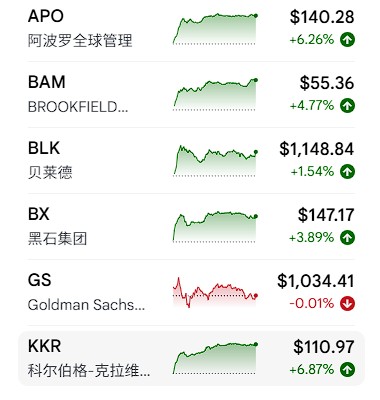
On Tuesday (August 11), the alternative asset managers participating in the collaboration emerged as the biggest winners. KKR led the pack with a 6.88% surge, followed by Apollo Global Management up 6.26%, Brookfield Asset Management up 4.77%, Blackstone Group up 3.89%, and BlackRock up 1.54%.
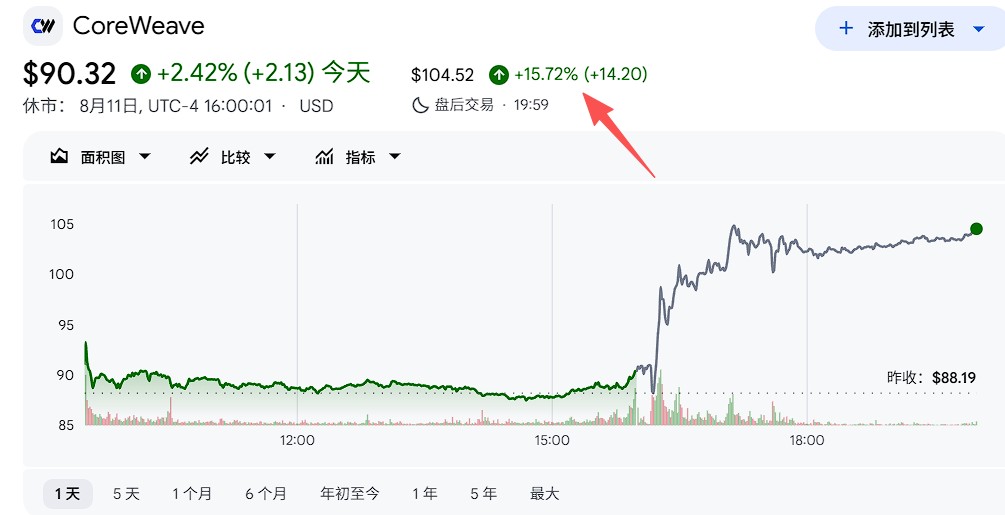
GPU cloud computing service provider CoreWeave rose 2.42% during regular trading hours and soared more than 16% in after-hours trading at one point. The market interpreted this financing arrangement as a direct boon to private credit and alternative investments—the massive capital pipeline signals long-term growth prospects for fee income.
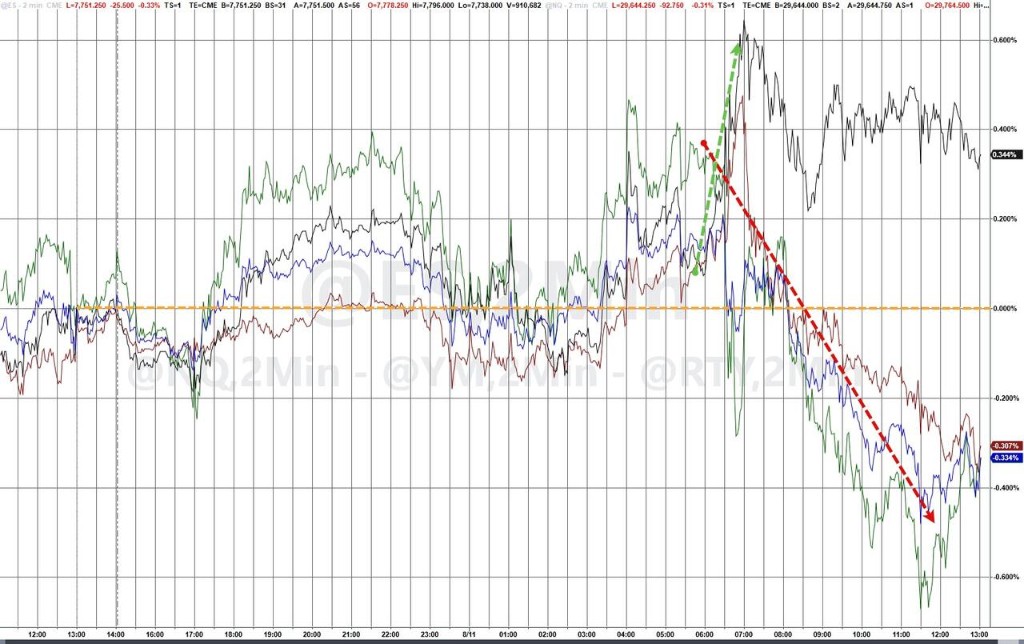
Meanwhile, an article by Wallstreetcn noted that large-cap tech stocks weakened for the second consecutive day. Google closed down 3.84%, marking its largest single-day drop in nearly six months. Amazon fell 2.09%, while NVIDIA's own stock price remained virtually unchanged, dipping slightly by 0.02%. The three major U.S. stock indices closed lower for the second straight day, with the Nasdaq Composite falling 0.6%.
The market's deeper concern lies in this question: Does NVIDIA's need to personally step in and help customers secure funding mean that AI computing power demand is so strong that it requires financial innovation to meet it, or does it suggest that some of the demand itself needs to be 'created' through financing conditions?
Jensen Huang's 'Grand Vision': AI Infrastructure Becomes a New Asset Class
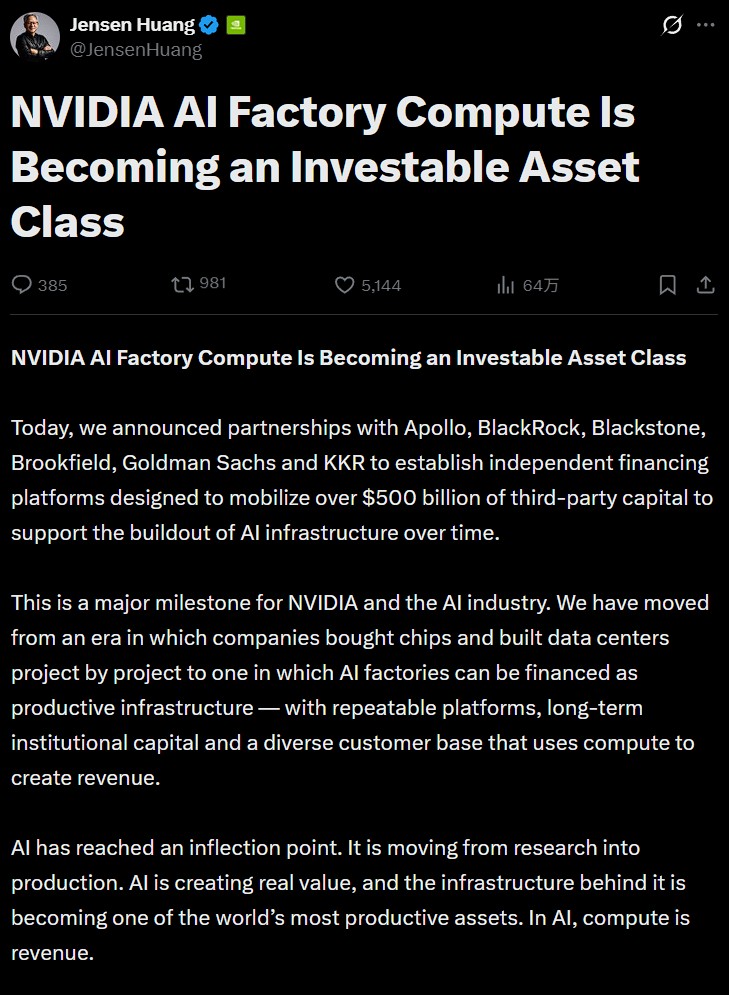
On Monday, NVIDIA CEO Jensen Huang appeared alongside executives from Goldman Sachs, BlackRock, Blackstone, KKR, Apollo, and Brookfield in an interview with CNBC, announcing that the six institutions had signed memoranda of understanding. Each will build independent computing power financing platforms to raise capital for AI infrastructure construction through third-party capital markets, with a target scale of $500 billion, potentially even higher.
Huang referred to this plan as a 'Grand Vision,' with the core logic being the redefinition of AI computing power as an investable asset. 'These systems are not like our PCs, not like our phones,' Huang told CNBC, 'They are now revenue-generating assets, possessing productivity, long lifespans, replaceability, and flexibility.'
Waldemar Szlezak, Head of Digital Infrastructure at KKR, further elaborated on the financial implications of this logic:
'You can view it as an income stream, then securitize it, or effectively slice the risk and sell it to investors who wish to participate at any level.'
Goldman Sachs CEO David Solomon stated:
'It is not surprising to start seeing asset-backed financing for this infrastructure construction, because these are real assets with real value.'
Under the arrangement, the six financial institutions will make lending decisions independently. NVIDIA is responsible for connecting customers with financing partners and may choose to assume a guarantee exposure of no more than 25% for each loan. Jensen Huang later clarified on the social platform X that this support is 'based on residual value and aims to supplement, not replace, independent underwriters.'
The day after the news broke, the shares of the alternative asset managers involved in the collaboration became the most prominent winners in the market. The market logic was clear: the massive financing pipeline directly corresponds to long-term growth expectations for fee income.
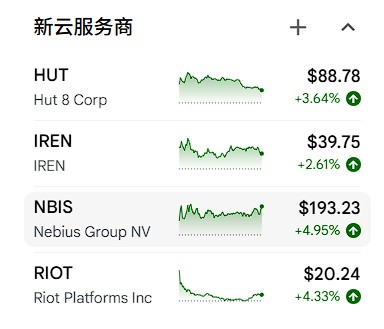
Meanwhile, 'New Cloud' service providers were also boosted. NEBIUS rose 4.95%, RIOT rose 4.33%, Hut 8 rose 3.64%, and IREN rose 2.61%.
The Philadelphia Semiconductor Index closed up 0.87% for the day, with 24 of its 30 components rising. Entegris rose 4.16%, KLA rose 4.01%, Teradyne rose 3.96%, and ASML rose 3.8%. Most memory-related stocks moved higher, with SK Hynix up 4.7%, SanDisk up 2.68%, and Seagate Technology up 2.44%. Optical communication concepts strengthened overall, with CRDO up 3.23% and Marvell Technology up 1.8%.
CoreWeave's after-hours surge was particularly noteworthy. As a GPU cloud computing service provider, CoreWeave is the most direct potential beneficiary of this financing model among 'New Cloud' representatives—it has genuine computing power demand but lacks the balance sheet support of hyperscale cloud providers, making it precisely the target customer base NVIDIA's financing platform intends to serve.
Tech Giants Under Pressure, Market Divergence Sharpens
In stark contrast to the strength of the computing infrastructure chain, large-cap tech stocks weakened for the second consecutive day.
Google closed down 3.84%, recording declines in four of the past five trading days since announcing the restructuring of its artificial intelligence department last week, dragging the Communication Services sector to lead the declines among the S&P 500's 11 sectors. Amazon fell 2.09%, Apple fell 1.09%, Broadcom fell 1.5%, and Microsoft fell 0.44%.
This divergence hints at the market's deeper concerns: Asset management institutions surged on expectations of fee income, but the share prices of tech giants and NVIDIA itself received no boost.
The underlying logic is this—if AI computing power demand were truly that strong, hyperscale cloud providers should have been the most direct beneficiaries; the fact that NVIDIA needs to personally step in to build financing channels for customers has instead led some investors to worry whether this means the balance sheets of potential demanders are already under pressure.
Notably, NVIDIA's five-year credit default swaps (CDS) have surged approximately 90% year-to-date. Although they narrowed by 5 basis points to 72.11 basis points on Tuesday following Huang's clarifying remarks, they remain near historical highs, indicating that the credit market has not fully digested the skepticism surrounding 'circular financing.'
'Circular Financing' Controversy: GPU Residual Value is the Core Uncertainty
The core logic of NVIDIA's financing platform is not complex: The bottleneck in the AI industry is shifting from chips and power to capital.
New customers outside of hyperscale cloud providers—AI labs, emerging cloud computing companies, sovereign AI projects—have genuine computing power needs but lack balance sheets like those of Google and Microsoft. A 1-gigawatt AI data center costs approximately $50 billion to build, yet OpenAI still does not have an investment-grade credit rating.
BlackRock CEO Larry Fink compared this model to the early stages of the mortgage-backed securities market:
'This is a very early stage, just like when I began entering the mortgage-backed securities market in the 1970s. I see this as the next future of financial engineering.'
Apollo Global President Jim Zelter acknowledged certain risks: 'There will be excesses, there will be pullbacks,' but he also stated that the large number of participants helps 分散 concentration risk.
However, the market's most pressing question remains unanswered: What is the long-term residual value of GPUs as collateral?
NVIDIA's chip iteration cycle has accelerated from every two years to every year, with each generation's performance leap eroding the market value of the previous generation. The foundation upon which the financing model rests—chip residual value—has not yet undergone a full cycle test.
Furthermore, this announcement is merely a memorandum of understanding, with no contractual binding. Specific borrowers, interest rate levels, facility locations, and start dates have not been disclosed, and the lack of details has kept some investors on the sidelines.
Brookfield CEO Bruce Flatt offered a more macro perspective: 'Jensen Huang is leading the creation of these structures because there are hundreds of trillions of dollars in capital worldwide.' This may well be the strongest support for this 'Grand Vision,' as well as its greatest unknown.
