


Trend funds are betting heavily on stubborn inflation, with record bond short positions awaiting tonight's CPI "verdict"!
Affected by stubborn inflation expectations and high oil prices, the global bond market has seen a historic long-short battle. According to UBS data, trend-following funds (CTA) doubled their short positions on U.S. Treasuries by the end of July, with every 1 basis point change in the 10-year U.S. Treasury yield resulting in a profit and loss exposure of $300 million, reaching a 30-year high. As of Tuesday's close, the 30-year U.S. Treasury yield remained at a high level of around 5.25%. Exchange data shows that trend-following funds have established a net short position of 1.29 million contracts in U.S. Treasury futures, marking a historic high and creating a self-reinforcing momentum bet
According to the Zhitong Finance APP, on the eve of the release of the U.S. inflation data for July tonight, a historic long-short battle is unfolding in the global bond market. UBS Group data shows that commodity trading advisors (CTAs) tracking market trends have doubled their short positions in bonds by the end of July compared to two weeks earlier, and these bets have remained high since then. According to UBS strategist Nicolas Le Roux, for every 1 basis point change in the 10-year U.S. Treasury yield, the profit and loss exposure for CTAs reaches approximately $300 million, marking the highest level since the bank began tracking this data in 1990.
This bond sell-off, driven by high oil prices, interest rate hike expectations, and a surge in government borrowing, has pushed the 30-year U.S. Treasury yield to its highest level since 2007. As of Tuesday's close, the 30-year U.S. Treasury yield remained at a high of around 5.25%.
1.29 million net short contracts: a "self-reinforcing" momentum bet
The starting point of this epic short bet was a wave of bond sell-offs triggered by inflation concerns. In May 2026, the 10-year U.S. Treasury yield soared above 4.6%, reaching a high not seen in over a year, impacting numerous fixed-income portfolios and confirming the bearish logic: persistent inflation, the Federal Reserve maintaining a hawkish stance, and a timeline far exceeding previous market participants' expectations.
Trend-following funds—namely CTAs—are essentially momentum trading machines. They do not form independent subjective judgments about the economy but trade based on price signals. When bond prices continue to fall, this trading exhibits self-reinforcing characteristics: more funds flow in the same direction, further depressing bond prices, which again strengthens the trend signal, attracting more shorts to enter.
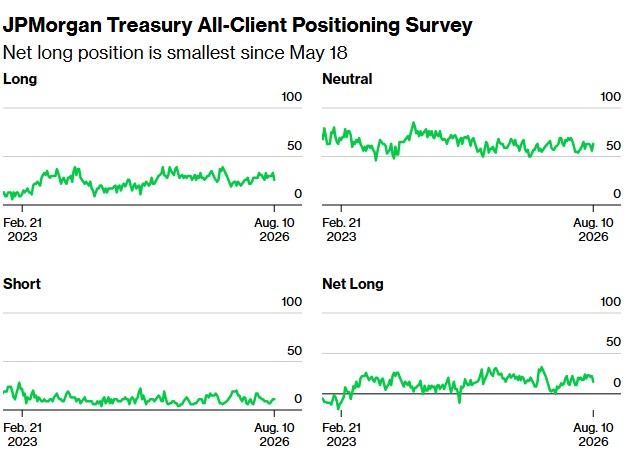
By the end of July, this negative feedback loop created historically high short positions. Exchange data shows that trend-following hedge funds and leveraged investors established 1.29 million net short contracts on U.S. Treasury futures, marking the largest scale in history. The shorts are not concentrated in a single maturity but are distributed across multiple maturities on the U.S. Treasury yield curve, further amplifying overall risk exposure. UBS data indicates that by the end of July, CTAs had doubled their underweight positions in bonds compared to two weeks earlier, and their holdings have remained relatively stable since then. It is estimated that the assets managed by CTAs exceed $400 billion.
Bank of America strategists have also monitored the extremely bearish CTA positions, noting that this group remains in a "massive shorting" state, particularly concentrated in short-term Treasuries—making Wednesday's inflation report particularly critical.
Asymmetric risk: crowded shorts face "short squeeze" pressure
An excessive tilt in positions toward one side brings significant reversal risks. Phoebe White, head of U.S. interest rate strategy at UBS, bluntly stated: "There is little room to further increase short positions, and the risks are clearly asymmetric." She pointed out that if bonds rise, the likelihood of traders covering their shorts is much greater than their willingness to add to their positions if bonds continue to fall This means that once the CPI data is mild enough to weaken the expectations for a rate hike in September, the crowded short positions may trigger a massive short covering wave, driving bond prices to rebound sharply and yields to decline rapidly. Conversely, if the CPI data is on the hot side, the space for short positions to increase is limited—this asymmetry itself is the biggest risk facing the market.
U.S. Bank strategists, including Meghan Swiber, wrote in a report on Monday: "If the data does not support a rate hike in September, it could challenge the crowded bearish positions, especially given the large size of CTA shorts and the low allocation of active funds."
After last Friday's non-farm payroll data came in weaker than expected, White and her colleagues have advised clients to buy two-year U.S. Treasuries. The bullish reasons she provided include signs that inflation may have peaked and that the currently highly crowded short positions could provide additional momentum during a bond rebound.
CPI Determines Fate: 50-50 Odds for Rate Hike at a Market Crossroads
The July CPI data, to be released at 20:30 Beijing time tonight, will directly determine the fate of this historically large short position. Dow Jones market consensus expectations show: overall CPI is expected to rise 0.1% month-on-month and 3.4% year-on-year; core CPI is expected to rise 0.2% month-on-month and 2.5% year-on-year. Both year-on-year indicators are down 0.1 percentage points from June. Notably, the month-on-month growth rate will shift from -0.4% in June to positive growth, reflecting a narrowing decline in energy prices and a rebound in some inflation components.
Goldman Sachs' economic team predicts a more dovish outlook, expecting July's core CPI to rise 0.19% month-on-month (below the market consensus of 0.2%), with overall CPI rising only 0.05%. Goldman also warns that a rebound in oil prices will make it difficult for the market to fully relax.
J.P. Morgan has modeled five scenarios, with the most likely outcome (40% probability) being core inflation between 0.2% and 0.25%, which is expected to drive the S&P 500 index up by 0.25% to 0.75%.
Deutsche Bank expects the CPI month-on-month to record 0.15%, with core CPI month-on-month growth potentially reaching 0.26%. Analysts at U.S. Bank believe that if the inflation data unexpectedly comes in lower than expected, the dollar may react more strongly, as this would largely eliminate the possibility of a Fed rate hike in September.
CME's "FedWatch" data shows that as of August 12, the market expects a 52.0% probability that the Fed will keep rates unchanged in September, and a 48.0% probability of a 25 basis point hike. This probability has gradually declined from nearly 80% at the beginning of the month and is currently at a critical 50-50 juncture.
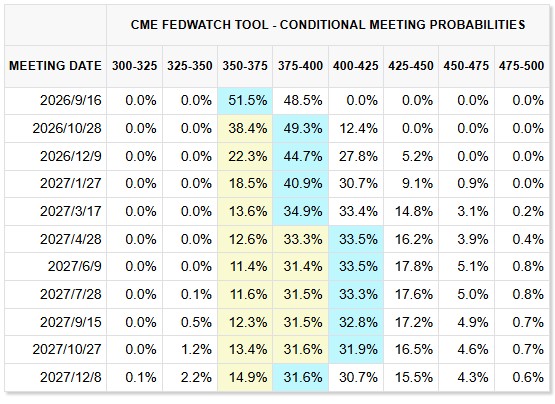
Last Friday, following the weaker-than-expected non-farm payroll report, White and her team advised clients to buy two-year U.S. Treasuries—besides signs that inflation may have peaked, the extremely crowded short positions in bonds themselves have also become one of the key factors supporting their bullish decision The yield on 30-year U.S. Treasuries reached its highest level since 2007 last month and has since remained near that high. As of Tuesday's close, the yield on 10-year Treasuries was 4.6904%, while the 30-year yield was 5.2413%.
Tonight, if the data is mild, the crowded short positions will face "short squeeze" pressure, and the bond market may see a sharp rebound; if the data is hot, there will be limited room for short positions to increase, but expectations for a rate hike by the Federal Reserve in September will be further solidified. Regardless of the outcome, this bond game dominated by $400 billion in trend funds will reach a critical "judgment moment" tonight
