


Wall Street Interprets TENCENT's Earnings: Core Business Stabilizes, but AI Investment Cycle Lengthens, Profit Realization Still Takes Time
TENCENT's core business remained robust in the second quarter, but capital expenditure surged to RMB 52.8 billion in a single quarter, turning free cash flow negative. The AI bill has materially impacted the income statement, with capital expenditure expected to expand further in the second half of the year. UBS estimates show that the full-year capital expenditure forecast has been raised from the previous RMB 170 billion to RMB 250 billion. Major investment banks including Goldman Sachs and UBS have collectively lowered their earnings forecasts. The core issue is whether the commercialization speed of the Hunyuan model, WeChat Agent, and WorkBuddy can keep pace with the continuously rising training and inference costs
TENCENT's second-quarter financial report shows that advertising and domestic games continue to support growth and profits, but AI investment has moved from strategic layout to a phase of heavy capital investment. The consensus on Wall Street is that TENCENT's core business has not lost momentum; the issue is that the AI bill has already been reflected, while commercial returns still await.
After the Hong Kong stock market closed on August 12, TENCENT released its results for the second quarter of 2026. The company's revenue for the quarter was RMB 204.785 billion, a year-on-year increase of 11%; Non-IFRS operating profit was RMB 75.64 billion, a year-on-year increase of 9%. Both revenue and profit slightly exceeded market expectations, but the profit growth rate was lower than the revenue growth rate, reflecting that AI-related investments are eroding some operating leverage.
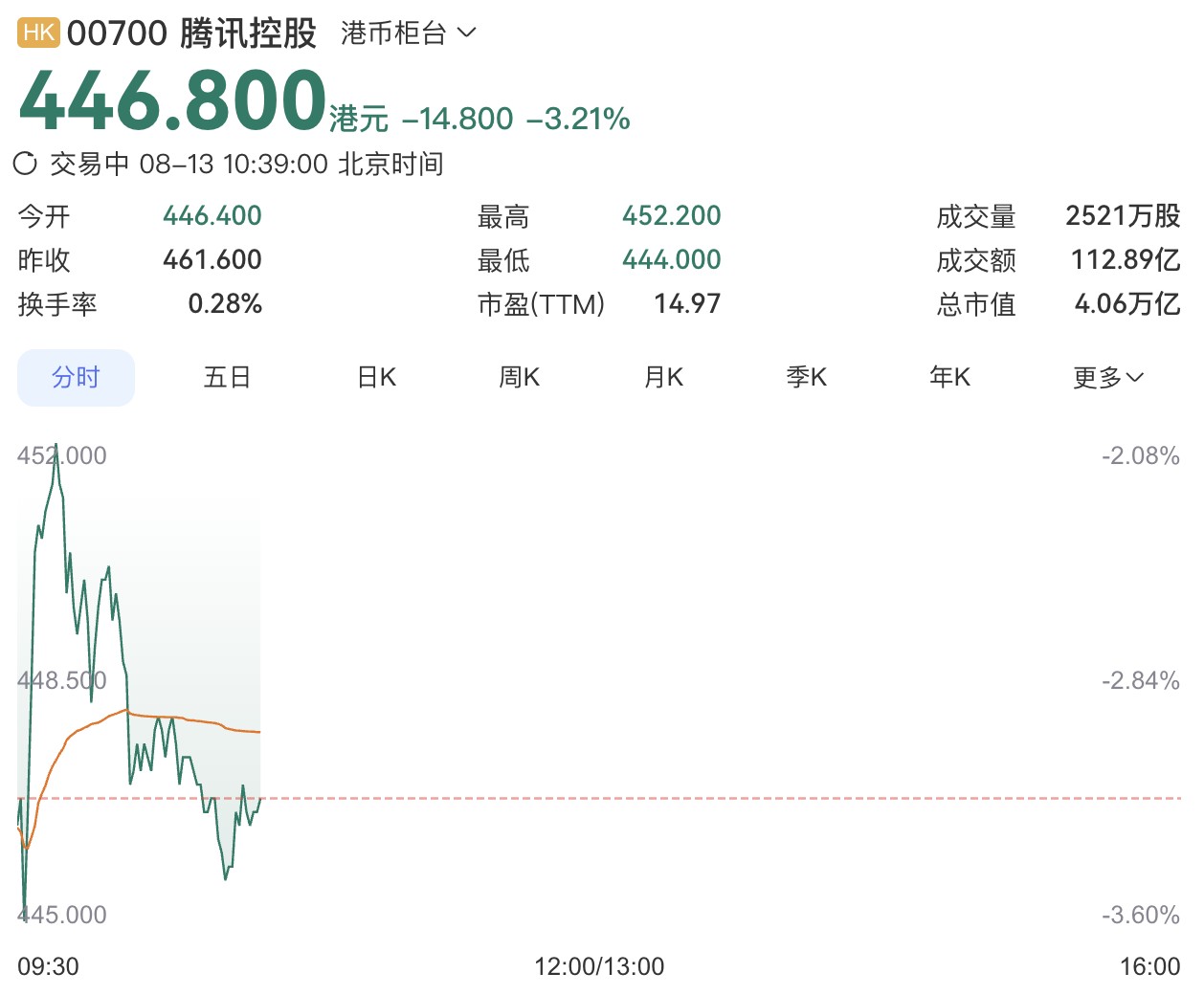
Following the earnings release, TENCENT's stock opened lower on August 13, falling more than 3%. Market focus has shifted from whether single-quarter results beat expectations to rising capital expenditure, negative free cash flow, and when AI products will generate verifiable revenue.
According to Zhui Feng Trading Desk, Goldman Sachs, UBS, Jefferies, and JPMorgan all maintain positive ratings on TENCENT, but have generally lowered or re-evaluated short-term earnings expectations and target price frameworks. The divergence among the four institutions is not about whether TENCENT possesses AI competitiveness, but rather whether the commercialization speed of the WeChat ecosystem, Hunyuan model, productivity tools, and cloud services can cover the continuously rising training, inference, and infrastructure costs.
Core Business Remains Stable, Advertising and Domestic Games Support Performance
TENCENT's core business performance in the second quarter was better than previously feared by the market.
Marketing services revenue was RMB 43.565 billion, a year-on-year increase of 21.8%, further accelerating from the 20% growth in the first quarter. Goldman Sachs, Jefferies, and JPMorgan all view advertising as one of the most important growth engines this quarter. AI-enhanced recommendations, automated delivery tool AIM+, ad formats with higher eCPM, and increased ad load rates in Video Accounts jointly drove improvements in advertising monetization efficiency.
Video Accounts remain the main incremental space for TENCENT's advertising business. Goldman Sachs pointed out that usage time on Video Accounts increased by more than 20% year-on-year, but the ad load rate is still below the industry average, meaning TENCENT still has room to increase monetization density without significantly affecting user experience.
The highlights of the gaming business mainly came from the domestic market. Domestic game revenue in the second quarter was RMB 47.314 billion, a year-on-year increase of 17.2%, significantly faster than the 6% in the first quarter. Products such as "Delta Force," "VALORANT," and "Roco Kingdom: World" provided incremental growth, while the operation and content updates of existing games also supported revenue recovery.
International games were relatively weak. International game revenue for the quarter decreased by about 1% year-on-year in RMB terms, but grew by 4% at constant exchange rates. Weak performance in some Supercell games offset the growth of "Wuthering Waves" and the PC version of "VALORANT." Consequently, Goldman Sachs lowered the valuation multiple for international games, believing that overseas business is difficult to price at higher growth expectations in the short term.
FinTech and business services revenue was RMB 60.286 billion, a year-on-year increase of 8.6%, showing relative stability. Cloud business growth has entered the low twenties percentage range, but this is not yet enough to change the group's overall profit structure.
AI Investment Accelerates, Cash Flow and Profits Under Pressure First
Compared to the slight beat on the revenue side, the market is more concerned about the rapid rise in TENCENT's capital expenditure.
TENCENT's capital expenditure in the second quarter was approximately RMB 52.8 billion, higher than RMB 31.9 billion in the first quarter, accounting for about 26% of the quarter's revenue, a year-on-year increase of 176%. JPMorgan pointed out that TENCENT's free cash flow turned negative to RMB 13.8 billion in the quarter, and net cash dropped from RMB 146.9 billion at the end of the first quarter to RMB 58.2 billion. AI investment has transformed from a long-term strategic narrative into real costs on the cash flow statement and balance sheet.
UBS calculations show that TENCENT's capital expenditure in the second quarter rose to about RMB 53 billion, and the full-year capital expenditure forecast has been raised from the previous RMB 170 billion to RMB 250 billion. Goldman Sachs also significantly raised its capital expenditure forecast for TENCENT for the next few years, estimating capital expenditures of RMB 210 billion, RMB 245 billion, and RMB 247 billion for 2026, 2027, and 2028, respectively.
While different institutions have varying judgments on specific figures, the direction is consistent: TENCENT's AI investment intensity is higher than previously expected, and it may continue to rise in the second half of the year.
In the second quarter, investment in new AI products was about RMB 10.5 billion, higher than RMB 8.8 billion in the first quarter. UBS believes that if the impact of AI investment is excluded, TENCENT's adjusted operating profit year-on-year growth could reach 19%, whereas the reported Non-IFRS operating profit growth was only 9%. JPMorgan similarly pointed out that excluding new AI products, TENCENT's Non-IFRS operating profit could reach RMB 86.1 billion, a year-on-year increase of 19%.
This means that TENCENT's traditional businesses are still generating profit elasticity, but AI is absorbing this increment. The core issue now is not whether TENCENT has the ability to continue investing, but how long the period of pressure on profit margins will last.
From Models to WeChat Agent, Monetization Path Still Needs Verification
TENCENT's current round of AI investment is not primarily aimed at renting out computing power externally, but prioritizes serving internal model training, AI-native applications, and the WeChat ecosystem.
Goldman Sachs believes that TENCENT is directing more resources to products such as the Hunyuan model, WorkBuddy, CodeBuddy, Yuanbao, and WeChat's "Xiao Wei." Such investments differ from directly renting GPUs to external customers; the latter usually generates short-term revenue more easily, while the value realization of internal models and applications relies more on user scale, retention, payment rates, and ecosystem synergy.
The Hunyuan model is the first line of observation. UBS pointed out that HY3 was launched in July, with daily Token consumption growing sixfold compared to the preview version; the larger-scale HY4 may be launched sooner. The market will focus on its performance in complex workflows, Agent capabilities, inference costs, and practical application effects, rather than just model rankings.
Productivity tools are the second line. WorkBuddy and CodeBuddy have become important carriers for TENCENT's AI commercialization. UBS stated that TENCENT's PC-side productivity AI tools reached 27.5 million interactions in June, higher than the 12.8 million of the second-largest peer listed. JPMorgan believes that WorkBuddy's user growth, retention, and willingness to pay for Tokens provide preliminary positive signals, but are not yet sufficient to constitute group-level revenue proof.
WeChat's "Xiao Wei" is the variable with the most long-term imagination but also the hardest to quantify. TENCENT is testing a WeChat Agent driven by a customized WeLM model, hoping to embed AI capabilities into WeChat's content discovery, service execution, and transaction loop. Goldman Sachs believes that if WeChat gradually evolves into an AI-first ecosystem, Agent-driven services and transactions could become new commercial entry points.
However, this concept also implies continuous inference costs. Goldman Sachs estimates that the incremental inference cost of "Xiao Wei" in the fourth quarter of 2026 could be equivalent to 0 to 5% of TENCENT's EBIT, and by 2027, the impact range could expand to 0 to 14% of EBIT. The wide range is precisely because user penetration, Token prices, and product usage frequency remain highly uncertain.
Cloud Business Is Benefiting, But Still Struggles to Cover the AI Bill
Tencent Cloud is the link in AI investment closest to revenue realization, but its current scale is not yet sufficient to fully offset capital expenditure pressure.
In the second quarter, Tencent Cloud's revenue growth entered the low twenties percentage range, driven by AI demand, international expansion, and increased use of general cloud services. Goldman Sachs stated that as of August, the daily Token usage on Tencent Cloud's MaaS platform, TokenHub, had reached 25 trillion, a fivefold increase in two months. AI demand is gradually translating into revenue from GPU leasing, MaaS, and productivity tools.
Management also mentioned that the pricing environment for cloud business has improved since May, with price increases and reduced discounts helping to optimize pricing.
However, investment banks generally believe that accelerated cloud revenue does not mean AI investment has achieved complete returns. AI cloud, model services, and productivity tools can provide some profit support, but in the short term, they are still difficult to cover large-scale server procurement, depreciation, training, and inference costs.
UBS's judgment is that TENCENT's AI business is currently closer to a "revenue option" rather than a mature business that can significantly drive group profits. The market has seen the costs, but has not yet seen an AI revenue line of sufficient scale and auditability.
Short-Term Earnings Forecasts Under Pressure, Revaluation Depends on Verification Milestones
Goldman Sachs has lowered its net profit forecast for TENCENT from 2026 to 2028 by 1% to 4%, with the 2026 EPS forecast lowered from RMB 30.07 to RMB 29.73, and the 2027 forecast lowered from RMB 32.55 to RMB 31.19. The bank expects that TENCENT's EPS growth in the third and fourth quarters of 2026 may be only 4% and 0%, respectively.
UBS expects that TENCENT's revenue growth in the second half of 2026 will be about 7% to 8%, and adjusted operating profit may decrease by about 1% year-on-year; revenue in 2027 is expected to grow by 10%, but adjusted operating profit will remain roughly flat. In the short term, the squeeze on the income statement from AI investment will continue.
At the valuation level, the four institutions still maintain positive ratings, but target prices reflect caution regarding short-term profit realization. Goldman Sachs maintains a "Buy" rating, lowering the target price from HKD 700 to HKD 670; UBS maintains a Buy rating, lowering the target price from HKD 780 to HKD 770; Jefferies maintains a Buy rating with a target price of HKD 750; JPMorgan maintains an "Overweight" rating with a target price of HKD 690.
JPMorgan's judgment is closer to the current core market sentiment: TENCENT has a more solid profit floor and has clearly disclosed the scale and boundaries of AI investment, making it suitable for holding on a 12-month horizon; however, in the absence of clear catalyst dates and auditable AI revenue, the stock price may remain in a stage of "low valuation but difficult to revalue quickly."
Next, the market will focus on observing the progress of subsequent Hunyuan models, retention and payment data for WorkBuddy and CodeBuddy, user adoption of WeChat's "Xiao Wei," and whether Tencent Cloud can continue to increase AI-related revenue. TENCENT has proven that its core business can support the investment; the next step is to prove whether the continuously rising AI bill can ultimately correspond to a sufficiently clear revenue and profit curve.
