


From PC Giant to Server Player: Lenovo's AI Transformation Enters Harvest Phase
Lenovo Group has seen significant results from its AI transformation, with its stock price surging 20% in a single day and its market capitalization exceeding HK$440 billion. The core driver was its first-quarter performance: AI server backlog reached $54 billion, a staggering 157% quarter-on-quarter increase, locking in revenue for the next year and a half. The ISG business turned profitable, with operating margins rising from -2.0% to 9.1%, boosting overall gross margins. Despite a decline in the broader PC market, Lenovo successfully shed its "PC seller" label thanks to high growth in AI servers, entering a phase of valuation re-rating
For over two decades, capital markets have labeled Lenovo as merely a "PC seller"—characterized by thin margins, slow growth, and valuations stuck in single digits.
But in the AI era, this label is being rapidly shed.
On the afternoon of August 13, Lenovo Group's stock price surged vertically, closing up 20% and pushing its market capitalization above HK$440 billion.
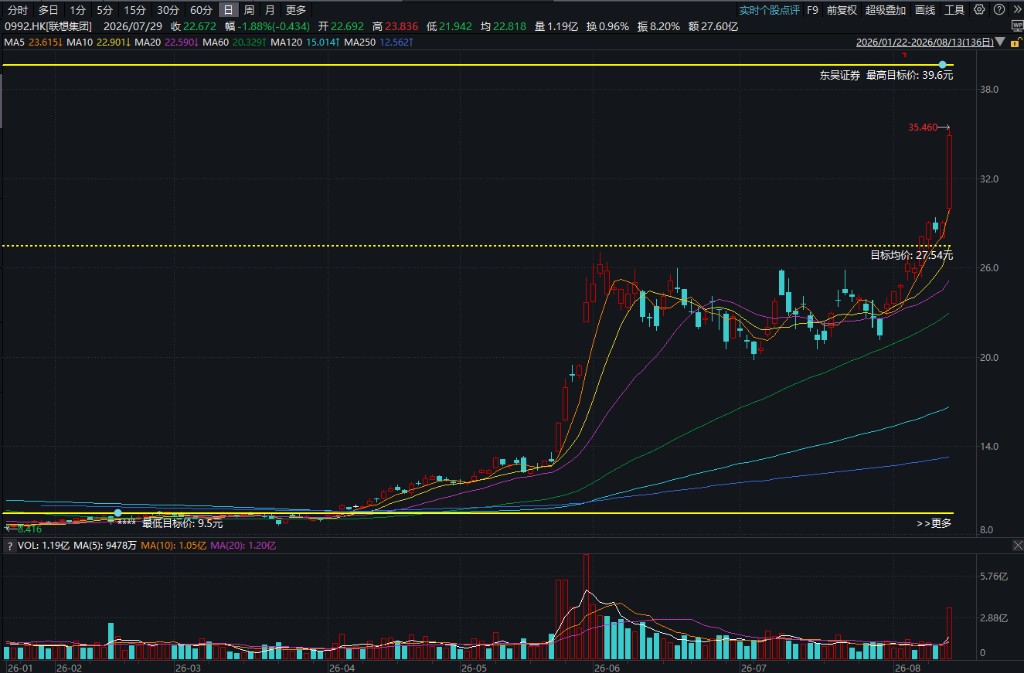
The catalyst for this re-rating was a single figure in the first-quarter earnings report: a $54 billion backlog of AI server orders.
$54 Billion: A Ticket into the AI Era
As of June 2026, Lenovo's AI server order backlog reached $54 billion, a 157% quarter-on-quarter increase (from $21 billion in the previous quarter, Q4 FY26).
The significance of this figure lies in two aspects.
First, the order growth is extremely rapid.
Just three months ago, this figure stood at $21 billion. It more than doubled to $54 billion in a single quarter, representing a 157% quarter-on-quarter increase. Meanwhile, ISG's revenue growth for the quarter was 98%—orders are growing faster than revenue, indicating that future revenue will continue to rise rather than having peaked.
Second, it locks in future revenue.
With ISG (Infrastructure Solutions Group) generating $8.5 billion in quarterly revenue, the $54 billion backlog essentially fills its server business schedule for the next year and a half. For a company shedding its "PC seller" label, this visibility is more valuable than any single quarter's profit figures.
The Biggest Change in This Earnings Report
The most striking change in the earnings report lies in the profit margins.
ISG's operating margin climbed from -2.0% in the same period last year to 9.1% this quarter.
Last year, ISG recorded a loss of $85.52 million; this quarter, it generated a profit of $777 million.
The company raised its overall gross margin from 14.7% to 16.5%, directly attributing this improvement to ISG. In other words, the business segment once most disparaged by the market has proven for the first time that it can not only drive revenue but also generate profits.
How Lenovo Held Its Ground Amidst a Declining PC Market
Beyond ISG, Lenovo's other pillar, IDG (Intelligent Devices Business Group), delivered $17.1 billion in revenue for the quarter, a 27% year-on-year increase, with operating margins stable at 7.1%.
The PC story must be viewed through the lens of "contrast." Global PC shipments declined 4% year-on-year this quarter, while Lenovo's own PC shipments fell by only 2%—the broader market declined more sharply than Lenovo.
By increasing its market share (24.2%, +0.5 percentage points year-on-year, widening its lead over the second-largest vendor for ten consecutive quarters) and raising the proportion of AI PCs, Lenovo achieved a 27% revenue increase.
AI PC share reached 25.1%, a historical high for Lenovo's first fiscal quarter.
In smartphones, the Motorola brand achieved a new first-quarter high for single-quarter revenue. High-end products, including the Razr, Signature, and Edge series, accounted for 37% of smartphone revenue, also a historical high.
The rising proportion of high-end models has moved the mobile phone business beyond pure economies of scale. This balance provides Lenovo with a buffer.
Even if ISG experiences fluctuations in order conversion pace in any given quarter, IDG's stable profitability ensures the company maintains positive overall profits during the transition period.
The Market Is Repricing Lenovo
Following the earnings announcement, Lenovo Group's stock price jumped from an opening of HK$29.96 to HK$35.46, finally closing at HK$34.90, up 20.18%.
Goldman Sachs analysts maintained their Buy rating and kept their target price at HK$31 (implying a 17.3x P/E on expected 2027 EPS), noting that the 9.1% server margin significantly exceeded expectations, confirming four positive logics: AI spending, general server demand, product mix upgrades, and cost control.
Citigroup analysts also maintained their Buy rating with a HK$31 target price (using Sum-of-the-Parts valuation: IDG/SSG at 10x P/E, ISG at 16.7x P/E), emphasizing that "revenue +43% significantly exceeded the market's 20% expectation."
Among domestic institutions, Guolian Minsheng analysts maintained their Buy rating with a target market capitalization of HK$700 billion, implying an upside potential of approximately 60%.
More noteworthy than the specific target prices offered by various analysts is the shift in market narrative.
A year ago, Lenovo's valuation was anchored to PC sales volume; after today, the valuation anchor has shifted to ISG margin trajectory and the $54 billion order backlog.
Four key variables to track next quarter:
The conversion pace of the $54 billion AI order backlog; the digestion of inventory (+34%) and accounts receivable (+33%) (affecting the sustainability of operating cash flow); the ramp-up of the Vera Rubin GPU platform (listed by multiple sell-side firms as the next catalyst); and the continued impact of non-cash revaluation of warrants (until the end of FY2027/28).
Lenovo is transitioning from a PC giant to a server player, with its AI transformation entering a harvest phase—but the true test lies in turning this quarter's "harvest" into "sustainability" for the next quarter and the one after.
Risk Warning and Disclaimer
The market involves risks; investment requires caution. This article does not constitute personal investment advice, nor does it consider the specific investment objectives, financial status, or needs of individual users. Users should consider whether any opinions, views, or conclusions in this article align with their specific circumstances. Investment decisions made based on this content are the sole responsibility of the investor.
