


The Real "Oil Price Crisis": Widespread Shutdowns at Global Refining Hubs, Wall Street Warns of a "Perfect Storm" in Refined Products
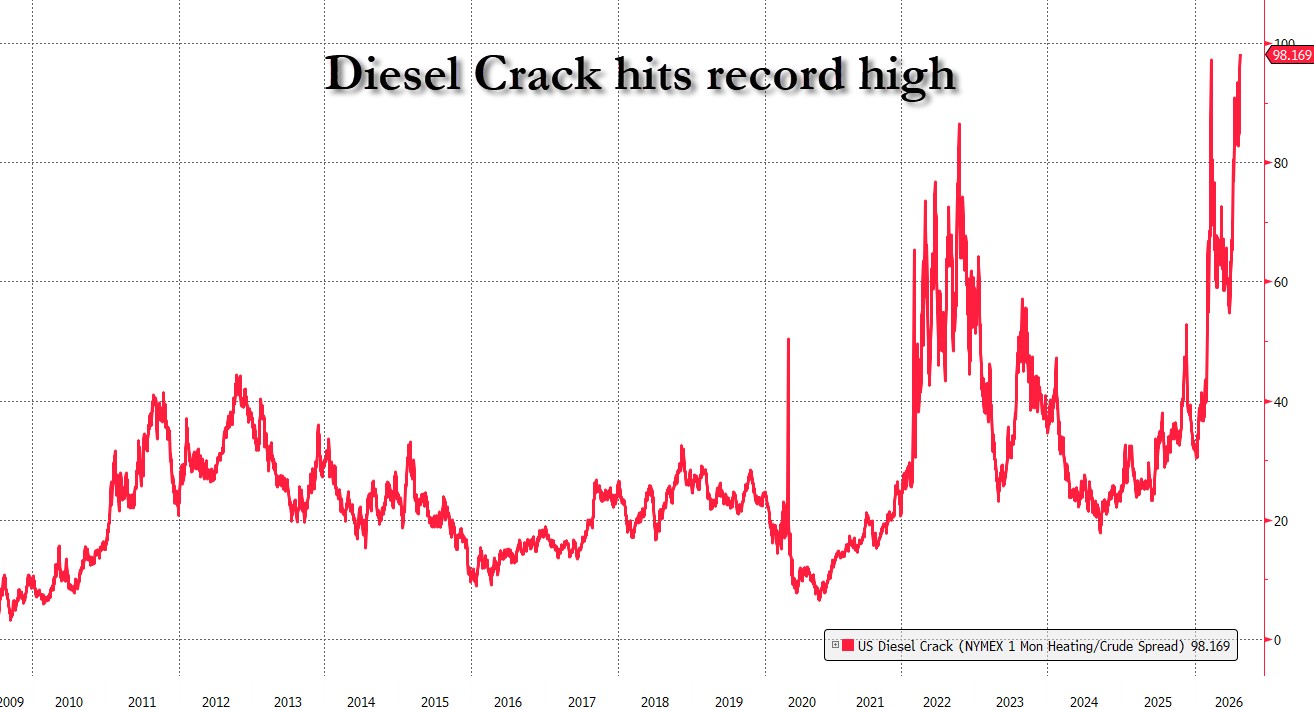
As the Strait of Hormuz crisis persists for five months, the true shock is erupting in the refined products market: U.S. diesel crack spreads surged past $97 per barrel intraday, nearing historical extremes; three of the world's four major refining hubs are stalled; Middle East exports have plummeted and Russia has banned sales, forcing the U.S. to single-handedly support global supply amid critically low inventories. Bank of America warns that unless supply sees a substantive recovery, the diesel market will remain tight, volatile, and expensive for a significant portion of next year
The Strait of Hormuz crisis has persisted for over five months. While the crude oil market appears relatively calm on the surface, the real impact is accumulating and erupting deep within the refined products market.
U.S. diesel crack spreads broke through $97 per barrel intraday on Thursday, approaching the $100 mark and hitting a record high. Top Wall Street institutions, including Goldman Sachs, Citigroup, Bank of America, and Jefferies, have successively issued warnings that global diesel supply is facing a "perfect storm." The latest forecast from the International Energy Agency (IEA) shows that the global oil supply deficit this quarter has reached 1.8 million barrels per day, more than double previous estimates.
Amid multiple overlapping supply shocks, three of the world's four major refining hubs have fallen into varying degrees of shutdown, with Europe, Asia, and other regions scrambling to buy U.S. fuel exports, further depleting America's already tight inventories. Francisco Blanch, Head of Commodities at Bank of America, warned, "Unless there is a substantive recovery in supply, the diesel market will remain tight, volatile, and characterized by high prices for a significant portion of next year."
Crack Spreads Explode: Crisis Lies in Refined Products, Not Crude Oil
Brent crude oscillated between $87 and $90 per barrel this week, with weekly gains approaching 5%. However, compared to the intense volatility in the refined products market, crude oil price performance has been relatively mild.
Sam Burwell, an analyst at Jefferies, succinctly described the current market structure in a research note released on Wednesday: "The tightness in the global oil market is being reflected through crack spreads rather than crude oil prices." He pointed out that wide crack spreads imply that refinery utilization rates will remain high, which supports crude oil demand.
On Thursday, the front-month U.S. diesel crack spread surpassed the previous high of $97 per barrel set in mid-March—a time when the U.S.-Iran conflict had erupted only three weeks prior. This signal indicates that the diesel market is in an extremely tight state.
Daan Struyven, a commodities expert at Goldman Sachs, told clients that since the outbreak of the Iran conflict, Goldman has believed that the Hormuz shock has damaged refined products, especially diesel, far more severely than crude oil. Citing Kpler data, he noted that diesel exports from the Persian Gulf have dropped by 80% year-on-year, while crude oil exports have fallen by 48% year-on-year, a significant disparity.
Three Major Refining Centers Simultaneously Damaged, Global Fuel Supply Chain Fractured
In a report titled "The Perfect Summer Storm for Diesel," Francisco Blanch of Bank of America pointed out that this industrial fuel has suffered "substantial disruptions" in three of the four major global regions.
Middle East: The closure of the Strait of Hormuz and surrounding military activities have significantly reduced Middle East fuel exports. The recent attack by Houthi forces on Saudi Arabia's Jazan refinery is the latest example. According to estimates by HSBC analysts, approximately 10 ships currently pass through the Strait of Hormuz daily, a sharp decline from the 30 to 40 before the escalation of conflict. The average daily flow of liquid cargo is about 4 million barrels, far below the publicly estimated 9 million barrels.
Russia: Continued drone attacks by Ukraine on Russian energy infrastructure have led to historic levels of disruption in Russian refining, removing a large volume of production from the global diesel supply pool. Furthermore, Moscow has announced a ban on diesel exports, further exacerbating the global supply contraction.
China: Due to concerns about domestic shortages, China has not yet resumed petroleum product exports to Asian regions. Jefferies data shows that Chinese crude oil imports plummeted by about 5 million barrels per day after the closure of the Strait of Hormuz. Although they rebounded slightly by about 1 million barrels per day month-on-month in July, there remains a gap of approximately 3 million barrels per day compared to the five-year average of about 11 million barrels per day.
U.S. Single-Handedly Supports Global Supply, Domestic Inventories in Emergency
Against the backdrop of damage to the three major refining centers mentioned above, the United States has become the only major refining hub operating normally, with Europe's reliance on U.S. exports rising to historical highs.
However, continuous exports are depleting America's already tight inventories. Anthony Yuen, Head of Energy Strategy at Citi Research, warned clients that global observable diesel inventories are now "below the five-year lowest level," noting that the last time inventories were at similar levels was in 2022, when global diesel crack spreads were about $20 per barrel lower than they are currently.
Meanwhile, U.S. crude oil inventory data showed a divergence—last week, crude oil inventories surged by 17.4 million barrels, the largest single-week increase since January 2023, due to weakening exports and increased imports from Saudi Arabia and Venezuela. This data briefly suppressed oil prices but did not change the tight landscape in the refined products market.
Although U.S. refinery utilization rates fell slightly from last week, they remain near seasonal highs for the past 20 years, indicating that refineries are striving to maximize capacity utilization under the incentive of high crack spreads.
Negotiation Stalemate Intensifies Uncertainty, Market Awaits Turning Point
The trajectory of the Hormuz crisis remains the market's biggest variable. Brent crude briefly fell below $80 per barrel early last week, as markets held expectations for an agreement mediated by Iran and Oman to reopen the waterway. However, as negotiations stalled again this week, oil prices rebounded to near $90.
Trump posted on Truth Social on Wednesday that the United States has "complete control" over the Strait of Hormuz and stated, "I think we will keep it that way," implying that the strategy of economic blockade will continue. U.S.-Iran negotiations are currently at an impasse, with the Trump administration maintaining the blockade on Iranian ports, while Tehran demands compensation for war losses. Pakistan, as a mediator, stated that broader peace negotiations have stalled.
Prediction market Polymarket shows that the probability of "extending the 60-day U.S.-Iran negotiation period" has plummeted from 80% a week ago to about 25%.
Charu Chanana, a strategist at Saxo Markets, stated that market volatility will remain high until the Strait of Hormuz reopens and production prospects become clear. Samantha Dart, Co-Head of Global Commodities Research at Goldman Sachs, previously told media that the global diesel supply shortage is a problem that "keeps her up at night."
The China Variable: Potential Demand Rebound Could Reshape Market Landscape
In the current supply crisis, China's moves are seen as the greatest uncertainty.
Sam Burwell pointed out that faced with such high crack spreads, the market cannot help but ask: When will China begin to increase crude oil imports to export more refined products, or replenish its own product and petrochemical inventories? Import data in the coming months will be a key indicator to test the elasticity of Chinese demand.
If Chinese crude oil imports return to the five-year average of about 11 million barrels per day, it would mean an incremental demand of about 3 million barrels per day, which would provide significant support for crude oil prices.
Burwell concluded that the current market landscape is generally bullish for crude oil prices. Wide crack spreads will drive refineries to maintain high operating rates, thereby supporting crude oil demand. However, until the situation in the Strait of Hormuz becomes clear, the refined products market—especially diesel—will continue to be the most sensitive barometer of this energy crisis.
