


Actions Speak Louder Than Words! Gallup Survey: Only 3% of Americans Trust AI for Financial Management, Yet 1 in 5 Uses It
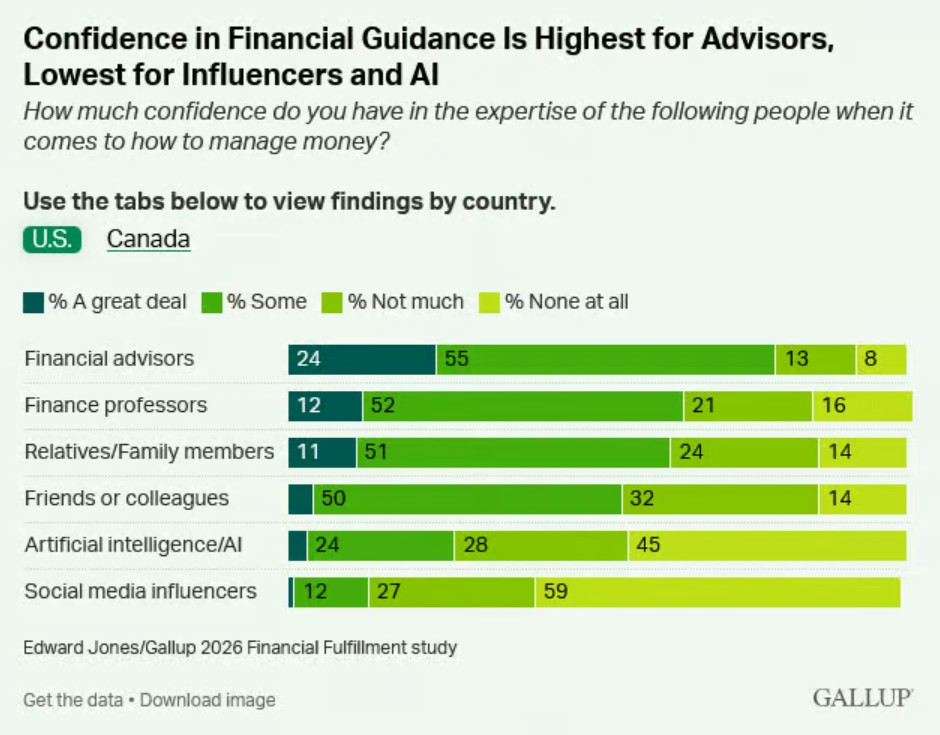
AI tools are quietly penetrating personal financial decision-making with their low-cost advantage. Although only 3% of Americans express being "very confident" in AI managing their personal finances, about one-fifth of those who sought financial advice in the past year have actually used AI tools
The rift between trust and behavior is becoming clearly evident in the realm of personal finance in the United States.
A recent Gallup survey reveals that only 3% of Americans say they are "very confident" in AI managing their personal finances, but among those who sought financial advice in the past year, about one in five has actually used AI tools. This data highlights an intriguing contradiction: while consumers verbally express high skepticism toward AI-driven financial management, their actual behavior tells a different story.
The survey, conducted jointly by Gallup and the brokerage firm Edward Jones, sampled 5,075 U.S. adults aged 21 and older between March 20 and April 6 this year. Notably, Edward Jones employs approximately 19,000 financial advisors, indicating a potential conflict of interest in the survey results.
For investors, this survey reflects deeper changes in the current financial advisory market—AI tools are quietly penetrating personal financial decision-making with their low-cost advantage, yet the lack of legal liability and information limitations still constitute significant risk exposures that cannot be ignored.
Low Trust, Yet Rising Adoption
The survey data presents a clear case of "saying one thing but doing another." Although only 3% of respondents are "very confident" in AI for financial management, even combining those who are "very confident" with those who have "some confidence," the total proportion is only about 30%.
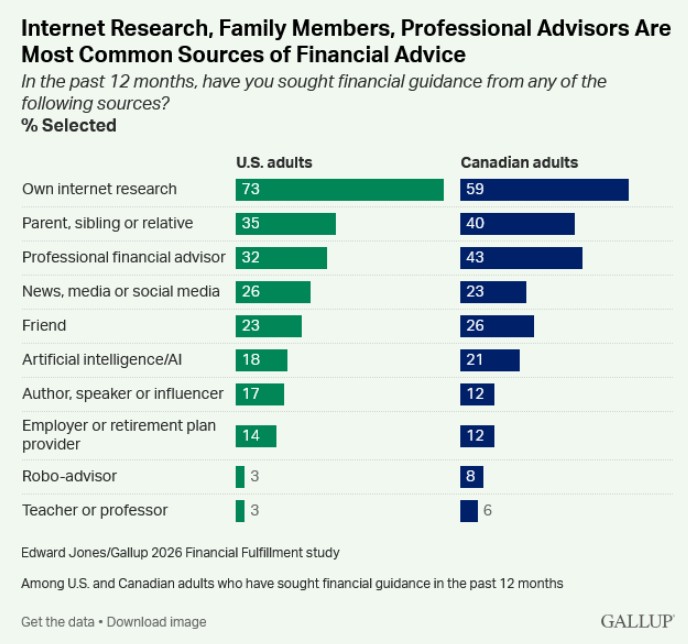
In contrast, trust in traditional financial advisors is far higher—about 80% of adults have at least "some confidence" in professional financial advisors. However, among those actually seeking advice, only about one-third consulted a professional advisor.
The most frequently used channel is independent online search, accounting for a substantial 73%. This is followed by consulting relatives (35%), news or social media (26%), and friends, authors, speakers, or influencers (about one in five). The usage rates for channels such as employers, retirement plan providers, robo-advisors, and teachers are relatively lower.
Generational Divide: Younger Embrace AI, Older Stick with Advisors
The use of AI financial tools shows significant generational differences. Among respondents who sought advice, about one-quarter of Gen Z and Millennials used AI, compared to 16% for Gen X and only 7% for Baby Boomers.
The usage of professional financial advisors shows the opposite trend: the consultation rate is as high as 55% for Baby Boomers, 34% for Gen X, 21% for Millennials, and only 14% for Gen Z.
Cost factors provide a direct logical explanation for this divergence. Online searches, family advice, and AI tools are nearly free, whereas hiring a professional advisor incurs costs. Younger generations, in the early stages of wealth accumulation, naturally tend to choose low-cost channels.
Experts Warn: AI Cannot Assume Fiduciary Duty
Despite the rising usage of AI tools, industry experts have issued clear warnings about their limitations.
Taha Choukhmane, an associate professor at the MIT Sloan School of Management, told the Associated Press that he recommends viewing AI as a starting point rather than the final authority. "I encourage people to use AI to explain and define concepts," he said, such as understanding what the stock market is or the difference between mutual funds and index funds. He also advised users to ask AI for reference sources so they can verify the information themselves.
Bobbi Rebell, a Certified Financial Planner at Financial Wellness Strategies, pointed out a key legal distinction: professional advisors typically bear fiduciary duty, meaning they are legally obligated to act in the best interests of their clients.
"No AI is a fiduciary," she told the Associated Press. "It doesn't truly know your life, nor will it ask you all the necessary questions."
Regardless of the source of advice chosen, the ultimate responsibility for financial decisions—and any resulting losses—remains with the individual.
