


AI Financing Concerns Intensify: Broadcom Plunges 7% Intraday as $370 Billion Potential Risk Raises Alarm
Bank of America estimates that Broadcom's chip financing projects could generate approximately $370 billion in senior debt by mid-2029 to fund 20GW of computing power, with about $150 billion in new debt potentially added in 2027 alone. While Bank of America has not negated Broadcom's operational fundamentals, the market is beginning to realize that if future AI computing demand relies on increasingly massive financing platforms to sustain itself, the valuation logic for the AI industry chain must also account for asset residual values, customer default rates, debt costs, and supplier guarantee liabilities
The narrative surrounding AI chip financing is shifting from "beneficial demand" to "credit risk," putting significant selling pressure on Nvidia's rival, Broadcom.
On Friday, August 14, Broadcom (AVGO) shares opened lower and continued to decline, dropping about 7% intraday as it hit a new daily low during midday trading, before closing down more than 5.9%. Media outlets pointed out that investors are reassessing the credit risks associated with the rapid expansion of AI infrastructure financing, with Broadcom's previously launched AI XPV financing platform becoming the focal point of market attention.
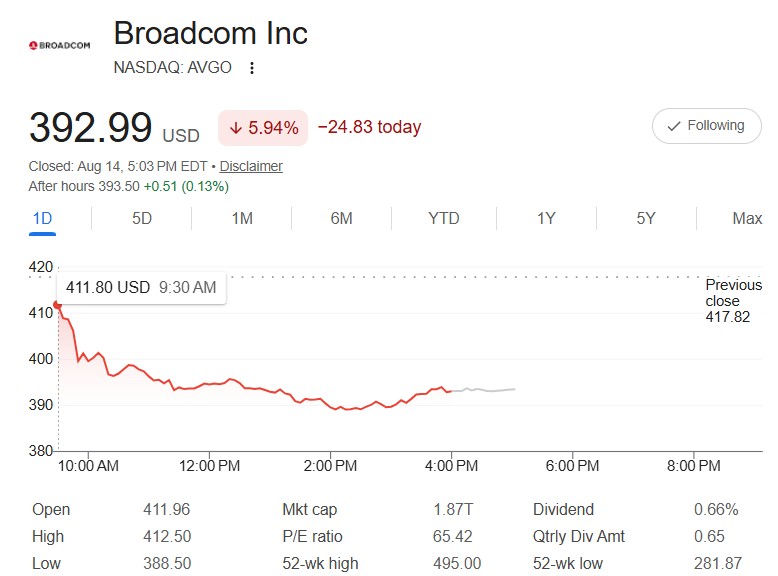
This sell-off was not driven by a sudden deterioration in Broadcom's latest earnings, but rather reflects a market repricing of its AI growth model. The core concern is that Broadcom is combining expensive AI chips and computing infrastructure with private credit through partnerships with institutions like Apollo and Blackstone to accelerate customer purchases via financing. As the platform scales, chip residual values, customers' debt-servicing capabilities, and Broadcom's potential guarantee liabilities could all become new sources of credit risk.
Notably, just as Broadcom faces pressure, Nvidia is also promoting a larger-scale AI financing platform. Reports indicate that Nvidia is collaborating with six Wall Street giants, including Apollo, Blackstone, BlackRock, and Goldman Sachs, to mobilize over $500 billion in third-party capital through a computing financing platform.
Commentators believe this model highlights the rapidly increasing reliance of AI infrastructure construction on external financing, prompting the market to ask: If AI computing demand requires ever-growing amounts of debt financing to sustain, how much of this AI capital expenditure boom is driven by real cash flow, and how much depends on financial leverage?
Broadcom's AI Financing Platform: From $35 Billion Deals to 20GW of Computing Power
Broadcom's AI XPV Platform was officially launched in June this year, established in partnership with Apollo and Blackstone. The initial capital scheme reached $35 billion, with the goal of supporting over 20GW of AI computing capacity by 2028.
The first transaction primarily serves Anthropic's plan to expand its computing power by over 1GW, utilizing Broadcom's custom XPU chips and networking solutions. At the time, Apollo stated that this deal was one of the largest private financings it had participated in.
The key to this model is transforming the large capital expenditures that AI companies and cloud computing firms would otherwise have to bear directly into infrastructure financing funded by the private credit market.
For Broadcom, the benefits are obvious: customers can reduce upfront capital expenditure pressure, while Broadcom can leverage financial institutions to expand XPU deployment scale, thereby further amplifying AI chip revenue.
However, the problem lies precisely here.
If AI chips themselves become important collateral in financing transactions, their future residual value will directly impact financing security. Unlike mature assets such as servers or aircraft, custom AI XPUs lack a mature secondary market. Once a customer defaults, there is significant uncertainty regarding whether these chips can quickly find other buyers and at what price they can be disposed of.
Bank of America analyst Tom Curcuruto pointed out that the lessee concentration on the XPV platform is currently high, with the first transaction relying mainly on Anthropic. Although OpenAI may become a future customer, other lessees have not yet been identified.
Bank of America Downgrades Broadcom's Credit Rating: The Real Concern Is Not the Present, But Platform Expansion
Market concerns regarding the XPV platform began to concentrate this week.
On Monday, Bank of America downgraded Broadcom's issuer and bond ratings from Overweight to Marketweight, citing the uncertainty of credit risks brought about by the expansion of the XPV platform.
Bank of America noted that since early June, the spread on Broadcom's bonds relative to similarly rated semiconductor companies has widened by approximately 20 to 30 basis points. Currently, the spread on Broadcom's bonds maturing in 2036 with a 4.95% coupon is about 105 basis points, and those maturing in 2056 with a 5.7% coupon have a spread of about 118 basis points, which is roughly 30 to 45 basis points higher than non-AI semiconductor companies like Texas Instruments and Qualcomm.
Notably, Bank of America has not turned bearish on Broadcom's fundamentals. On the contrary, the bank simultaneously raised its fiscal 2026 revenue and EBITDA forecasts for Broadcom by 10% and 13%, respectively.
This means the market is not trading on "Broadcom's AI business stalling," but rather on another layer of risk: the stronger the AI business and the faster the financing platform expands, the larger the potential credit exposure may become.
Bank of America believes the risks of the XPV platform mainly stem from two aspects: first, the lack of a mature secondary market for XPUs makes future residual values difficult to judge; second, high customer concentration. If investors begin to partially factor XPV risks into Broadcom's parent company credit risk, or even hedge by purchasing Broadcom CDS, it could further drive up its financing costs.
What Does $370 Billion Mean? Guarantee Exposure in Extreme Scenarios
What truly alerted the market was Bank of America's stress test of the XPV's future scale.
Broadcom does not provide full financing directly to customers but supports related debt through arrangements such as Residual Value Guarantees (RVG). For the initial $35 billion in XPU assets, Broadcom previously disclosed that under an extreme assumption of 100% default and zero recovery value of collateral, the maximum loss exposure for related senior debt would be $29 billion.
In a stricter stress test, Bank of America assumed chip prices would drop by 20% annually and suffer an additional 25% price shock upon default. The results showed that the peak RVG exposure for the first transaction would be about $26 billion, but the corresponding maximum actual loss would be approximately $2.9 billion.
What truly sparked concern is the expansion scenario.
If the XPV eventually expands to 20GW at a rate of 2GW per quarter, Bank of America estimates that by mid-2029, Broadcom's maximum RVG exposure could reach $370 billion; in an extreme case of 100% default, the corresponding maximum loss would be about $42 billion. If the default rate is 25%, the potential loss would be about $10.5 billion.
It is important to emphasize that $370 billion does not mean Broadcom has already incurred $370 billion in debt, nor is it Bank of America's prediction of actual losses. Rather, it is the maximum guarantee exposure calculated under an extreme stress scenario where the XPV expands to 20GW. Bank of America explicitly stated that a 100% default rate is an extreme and unrealistic assumption.
Moreover, even under this extreme scenario, Bank of America expects Broadcom's free cash flow after dividends in 2027 to still reach approximately $85 billion, demonstrating considerable loss-absorption capacity; the bank believes that the XPV alone is insufficient to shake Broadcom's credit foundation.
Therefore, the current market concern is not that "Broadcom will immediately face a solvency crisis," but rather that as the XPV continues to expand, some risks originally borne by customers and financial institutions may gradually transmit to Broadcom itself through guarantees, credit spreads, and investor risk premiums.
Nvidia's "$500 Billion Financing Plan" Further Exposes the Issue
Broadcom's stock drop on Friday also occurred amidst a broader market reassessment of the entire AI financing model.
According to reports on Monday, Nvidia partnered with Wall Street institutions such as Apollo, Blackstone, Goldman Sachs, and KKR to launch a "Computing Financing Platform," aiming to mobilize over $500 billion in third-party capital for AI infrastructure. Nvidia CEO Jensen Huang stated the following day that the company could choose to provide support of up to $125 billion for certain transactions, equivalent to 25% of the potential transaction scale.
Media outlets pointed out that behind this financing model lies an increasingly obvious reality: many AI customers require substantial computing power but may not possess balance sheets strong enough to independently bear the costs of data centers and chip purchases.
Thus, Wall Street is becoming an important source of funds connecting AI chip suppliers with AI infrastructure demanders.
From an industrial logic perspective, this may further release AI chip demand; however, from a financial market perspective, it also means that the AI boom is beginning to rely more heavily on private credit, asset securitization, and guarantee structures.
Reuters cited Bank of America data on Friday, stating that by mid-2029, Broadcom's chip financing projects could form approximately $370 billion in senior debt to fund 20GW of computing power, with about $150 billion in new debt potentially added in 2027 alone.
This also explains why the market is beginning to examine Broadcom's and Nvidia's financing plans together: AI infrastructure is gradually evolving from a "chip sales story" into a financialized story of "chips + data centers + private credit."
The Next Question for AI Capital Expenditure: Who Bears the Risk?
Over the past two years, the core question for investors in the AI industry chain was "is demand strong enough?" Now, as the investment scale of individual AI infrastructure projects often reaches tens of billions of dollars, the market is raising another question:
Who will ultimately pay for these investments?
If hyperscale cloud providers like Microsoft, Google, Meta, and Amazon bear the costs directly, the risk mainly manifests as pressure on capital expenditures, depreciation, and free cash flow; if AI startups bear them, the issue transforms into business models and financing capabilities; and when more projects are funded by the private credit market and supported by chip manufacturers through guarantee mechanisms, the risk begins to enter the credit market.
Broadcom's recent stock decline is a microcosm of this change.
In the short term, Broadcom's AI chip business remains on a high-growth trajectory, and Bank of America has not negated its operational fundamentals; but the capital market is beginning to realize that if future AI computing demand relies on increasingly massive financing platforms to sustain itself, then the valuation logic for the AI industry chain must also account for asset residual values, customer default rates, debt costs, and supplier guarantee liabilities.
For AI chip stocks already trading at high valuations, this narrative shift from "growth risk" to "credit risk" is often sufficient to bring about violent stock price fluctuations.
Broadcom's sharp drop on Friday may reflect exactly this rapid repricing of risk premiums.
