Fed rate hike expectations cool, AI sentiment rebounds, Nasdaq futures rise, memory chip stocks surge, gold climbs back above $4,400
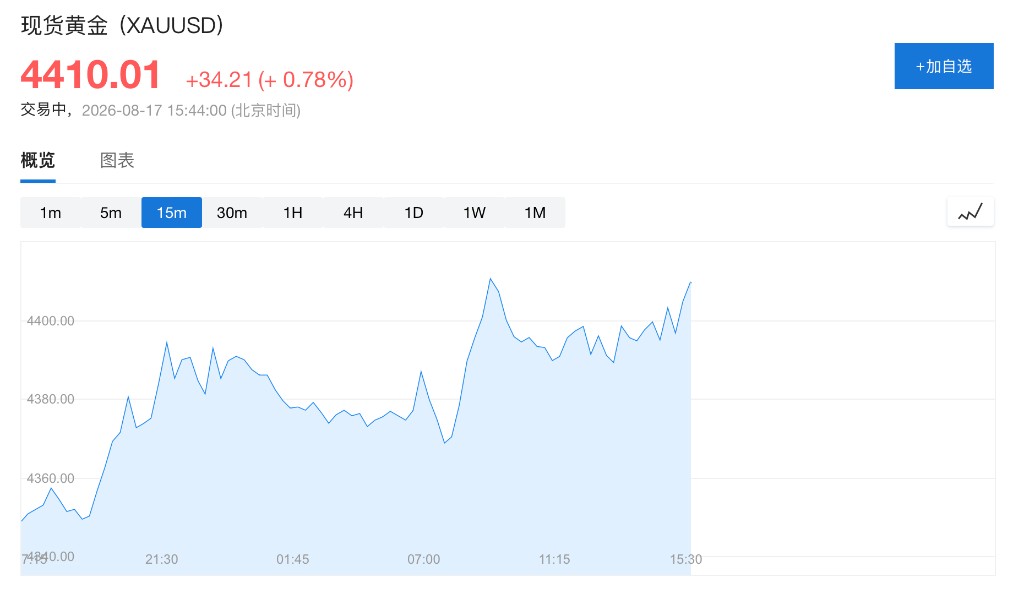
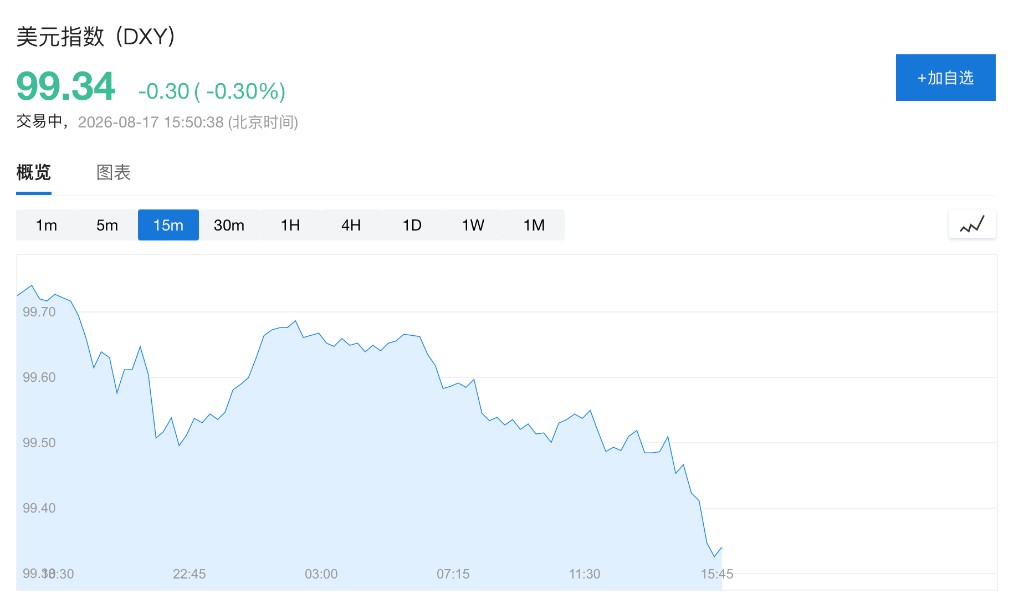
U.S. stock index futures traded mixed, with Dow Jones futures down 0.13% and Nasdaq 100 Index futures up 0.5%. U.S. July retail sales recorded their largest decline in over a year, compounded by continuously weakening economic data, causing market expectations for a Fed rate hike in September to drop to below 30%. The U.S. Dollar Index fell for the third consecutive day, approaching its lowest level since May. Spot gold rose 0.78% to $4,409 per ounce
The unexpected decline in U.S. July retail sales has further intensified concerns about a cooling U.S. economy, rapidly dampening market expectations for a Federal Reserve rate hike in September and keeping the U.S. dollar under pressure. Meanwhile, sentiment surrounding AI trades has recovered, leading to divergent pre-market movements in U.S. stocks, with Nasdaq futures rising.
On Monday, U.S. stock index futures traded mixed. Dow Jones futures fell 0.13%, while Nasdaq 100 Index futures rose 0.5%. In pre-market trading, memory chip stocks generally rose: SanDisk jumped approximately 6%, SK Hynix rose about 4%, Seagate Technology gained around 3%, Western Digital increased by roughly 4%, and Micron Technology rose about 3%.
The U.S. Dollar Index declined for the third consecutive day, nearing its lowest level since May. U.S. July retail sales posted their largest monthly drop in over a year, driving market expectations for a September Fed rate hike down to below 30%. At the same time, former President Trump's continued pressure on the Federal Reserve has further fueled market skepticism regarding the U.S. dollar's safe-haven status.
Regarding geopolitics, there are no immediate signs of further escalation in the Middle East, although risks have not dissipated. According to CCTV International News, in response to recent claims by former U.S. President Trump that he would "soon declare the Strait of Hormuz as U.S. territory after defeating Iran," Iranian Army Commander-in-Chief Hatami stated to the media on August 16 during a public event that such reckless remarks, even if intended as a joke, constitute a major error. Hatami also took a hardline stance, stating, "This is Iran, and the guardians will break the legs of aggressors." Oil prices edged lower, with WTI crude falling 0.6%.
Kyle Rodda, Senior Analyst at Capital.com, stated: "The biggest headwind facing the market remains geopolitical uncertainty, which continues to impact market sentiment. However, the relatively limited military activity in the Middle East recently has also reduced market volatility to some extent."
Key market movements are as follows:
U.S. stock index futures traded mixed: Dow Jones futures fell 0.13%, S&P 500 futures rose 0.1%, and Nasdaq 100 Index futures rose 0.4%.
European markets opened higher: Euro Stoxx 50 up 0.3%, Germany's DAX up 0.2%, UK's FTSE 100 up 0.3%, and France's CAC 40 up 0.04%.
Japan's Nikkei 225 closed up 0.6% at 6,922.05 points. Japan's TOPIX closed down 0.3% at 4,184.11 points.
The yield on the 2-year U.S. Treasury note fell 2 basis points to 4.15%. Yields on the 10-year and 30-year U.S. Treasury notes each dropped 1 basis point.
Japan's 10-year government bond yield rose to 2.91%, its highest level since 1996.
The U.S. Dollar Index fell 0.3% to 99.32.
The British pound rose 0.2% against the U.S. dollar to 1.3565, hitting a three-month high.
Spot gold rose 0.78% to $4,409 per ounce.
Crude oil declined: Brent crude fell more than 0.3%, and WTI crude dropped more than 0.6%.
Dow Futures Under Pressure, Nasdaq Futures Rise
U.S. stock index futures traded mixed, with Dow Jones futures down 0.13%, S&P 500 futures up 0.1%, and Nasdaq 100 Index futures up 0.5%. Following the S&P 500's consecutive record highs, the market remains focused on economic data and Federal Reserve policy developments.
In terms of economic data, investors will monitor the August New York State Manufacturing Index and the NAHB Housing Market Index to further gauge the health of the U.S. economy. Regarding the Federal Reserve, the market awaits the release of the July meeting minutes on Wednesday, looking for more clues on the interest rate path and policy divergences.
On the earnings front, retail companies will densely report results this week. Home Depot and Lowe's will announce earnings on Tuesday and Wednesday respectively, while Walmart is scheduled to release its results on Thursday. Retail consumption performance will serve as an important window for observing the resilience of the U.S. economy.

Dollar Falls for Third Consecutive Day, Nearing May Lows; Concerns Over Fed Independence Intensify
The U.S. Dollar Index declined for the third straight day, approaching its lowest level since May. Weak U.S. economic data has diminished market expectations for further monetary tightening by the Federal Reserve, eroding the interest rate support previously bolstering the dollar.
Richard Vranovic, Chief FX Strategist at Westpac Banking Corp in Sydney, noted that regular dialogues between Trump and Federal Reserve Chair Kevin Warsh, along with Trump's renewed attempts to remove Fed Governor Lisa Cook, are also exerting pressure on the dollar.
He pointed out that frequent communications between Trump and Warsh, the renewed attempt to dismiss Cook, and uncertainty regarding the Federal Reserve's future response mechanisms are exacerbating market doubts about the dollar's safe-haven attributes. Additionally, the trend of de-dollarization is garnering renewed attention, while the recent surge in long-term U.S. Treasury yields has further reinforced this factor.
Fed Rate Hike Expectations Cool, Gold Prices Rise
Spot gold rose 0.78% to $4,409 per ounce. A weaker dollar combined with soft U.S. economic data has alleviated concerns about further policy tightening by the Federal Reserve, providing support for gold prices.
Recent data shows that the U.S. Consumer Confidence Index declined for the first time in three months, while retail sales recorded their largest single-month drop in over a year. This has further intensified concerns about slowing economic growth and cooled expectations for Fed rate hikes.
Meanwhile, recovering investor demand and continuous gold purchases by global central banks have provided additional support for gold prices. Last week, gold prices broke above the 100-day moving average for the first time since April and currently remain near this level.
Data from ANZ Bank shows that in the first quarter of 2026, global central banks collectively purchased 244 tons of gold, marking the strongest quarterly buying volume since the fourth quarter of 2024.