


Amazon AWS: The Path to $1 Trillion in Revenue
Morgan Stanley projects that AWS computing capacity will expand from 14 GW in 2025 to 120 GW in 2035. If monetization efficiency reaches $12 per watt, AWS revenue is expected to surpass $1 trillion. As the business scales, its AI profit margins may follow the expansion trajectory of the core cloud business, with long-term EBIT margins potentially reaching approximately 30%
The long-term growth potential of Amazon Web Services (AWS) is becoming a key variable in reassessing Amazon's investment value.
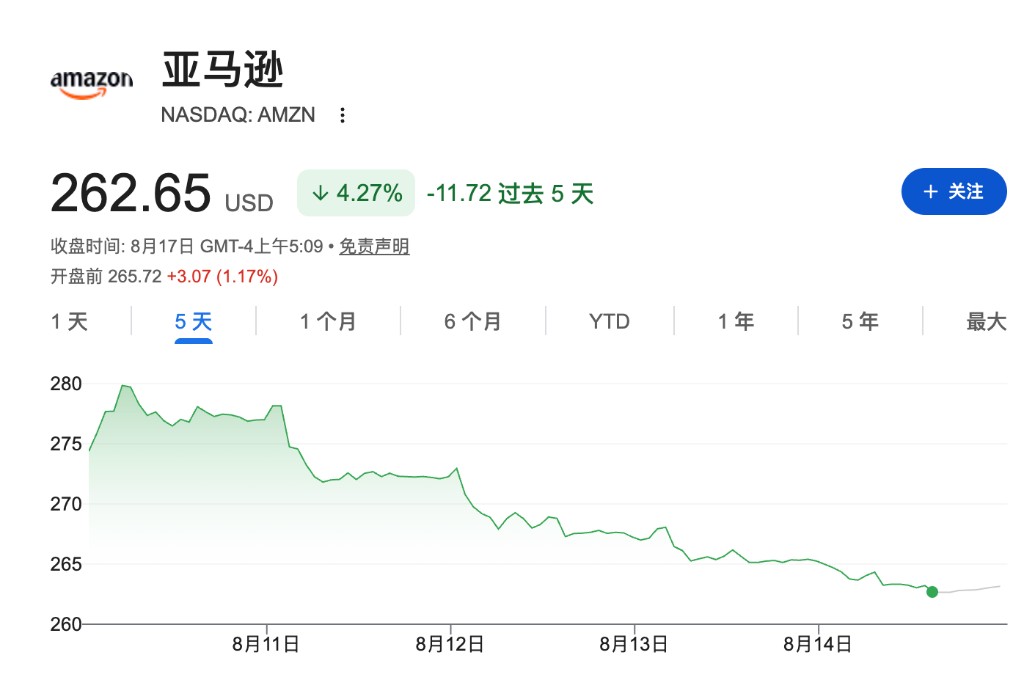
In a report released on August 16, Morgan Stanley analyst Brian Nowak maintained an "Overweight" rating on Amazon, with a base target price of $335, representing approximately 27% upside from the current share price of around $262. Furthermore, if AWS continues to grow along the expected trajectory, Amazon's share price could reach $500 by the end of 2027.
During the earnings call, Amazon management stated, "We have long believed that AWS could become a tens-of-billions-of-dollars revenue business. Now we believe this scale will at least double, with a high probability of becoming an annual revenue business worth $1 trillion, accompanied by highly attractive free cash flow and return on invested capital."
The report suggests that against the backdrop of continuous computing power expansion, the key variable determining when AWS will reach $1 trillion in revenue is the monetization efficiency per incremental watt. AWS's current monetization level is approximately $8 per incremental watt, based on estimates for the full year 2026. Morgan Stanley expects this efficiency to continue improving as product innovation evolves and supply-demand dynamics shift.
AWS's Path to $1 Trillion in Revenue: Computing Power Expansion is the Core Variable
Morgan Stanley's analytical framework centers on computing capacity expansion and improved monetization efficiency. The report forecasts that Amazon will add 6 to 8 gigawatts (GW) of computing capacity between 2026 and 2027, subsequently expanding at a pace of approximately 8 GW per year. This would drive AWS's total computing capacity from about 14 GW in 2025 to roughly 120 GW in 2035.
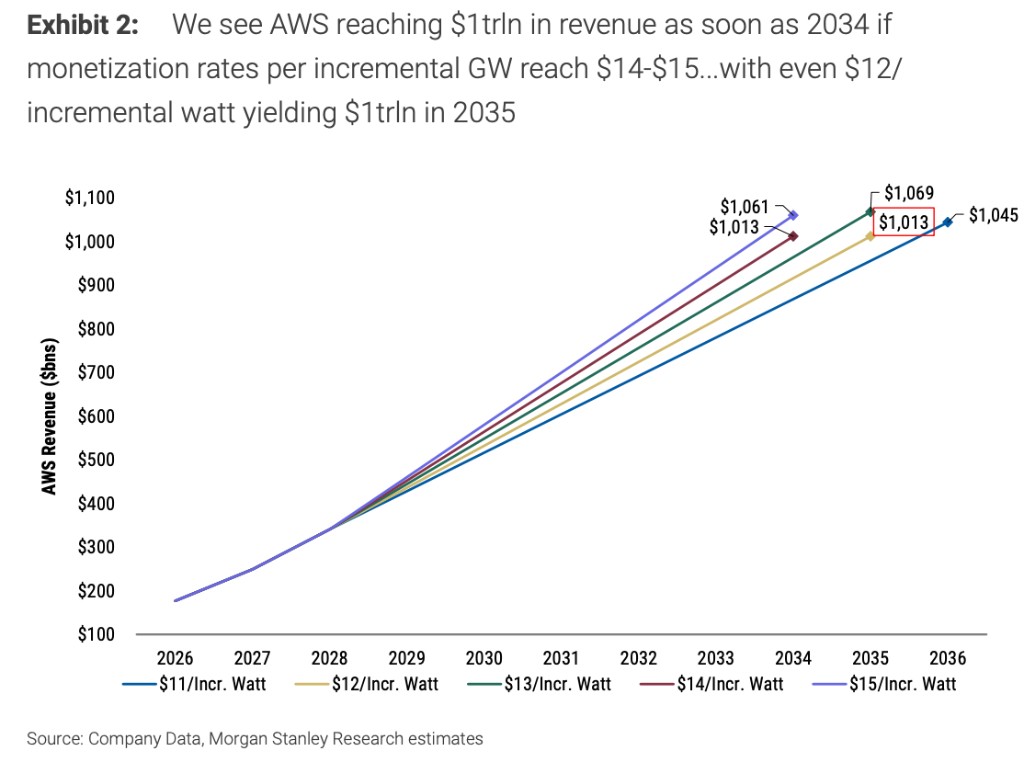
On this basis, the key to AWS's revenue growth lies in the monetization efficiency of its computing power. Morgan Stanley calculates that if the annual revenue generated per additional watt of computing power rises to $12, AWS revenue could exceed $1 trillion by 2035. If monetization efficiency further increases to $14–$15, this milestone could be achieved as early as 2034.
Under the base case scenario, assuming AWS adds approximately 8 GW of computing power annually and monetization efficiency gradually rises to $12 per incremental watt, Morgan Stanley expects AWS revenue to grow from about $176.9 billion in 2026 to approximately $249.2 billion in 2027, a year-over-year increase of about 41%. This implies that the simultaneous expansion of computing power and improvement in monetization efficiency per unit of computing power will be the core drivers propelling AWS toward $1 trillion in revenue.
Profit Margin Assumptions: AI Business Poised to Replicate Historical Trajectory of Core Cloud Business
Regarding profit margins, Morgan Stanley cited Amazon management's comments that the profit margin and return trends of the AI business are "highly similar, even slightly ahead," of the early stages of the core cloud business. Consequently, the firm set its long-term EBIT margin assumption for AWS at approximately 30%.
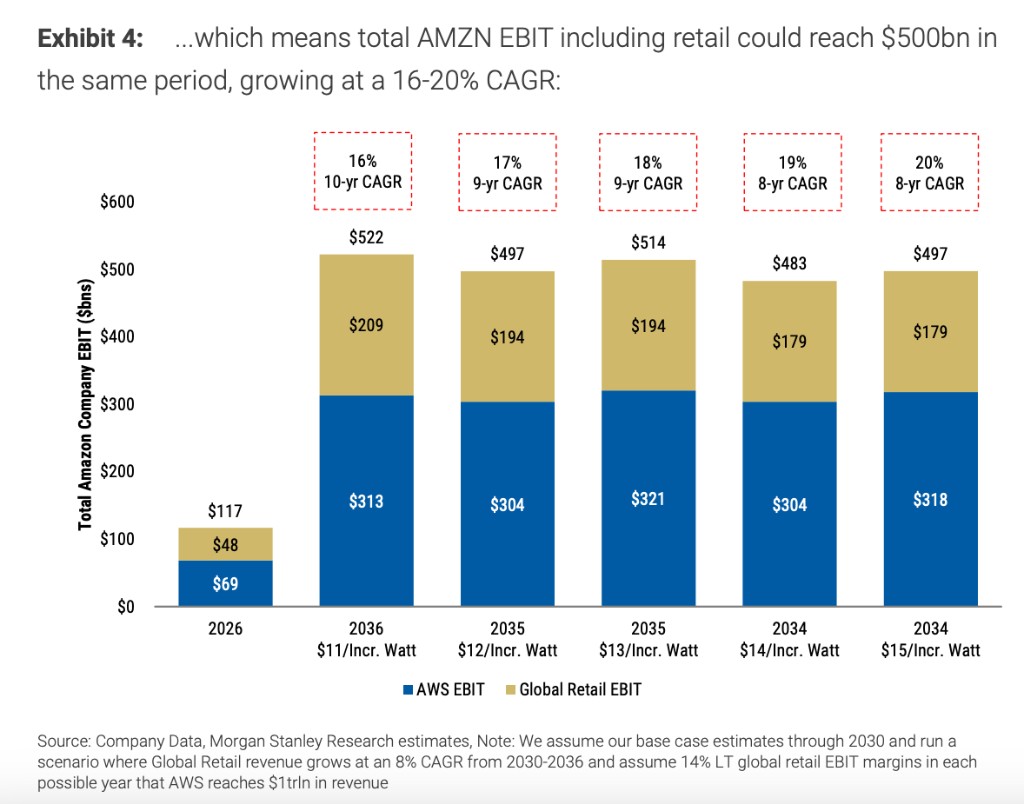
Based on this assumption, if AWS revenue reaches $1 trillion, the corresponding EBIT would amount to approximately $300 billion. After adding reasonable profit contributions from the retail business, Morgan Stanley expects Amazon's consolidated EBIT to reach about $500 billion between 2034 and 2036, implying a compound annual growth rate (CAGR) of approximately 16% to 20%.
Specifically, in a scenario where each incremental watt generates $14, AWS EBIT is projected to reach about $304 billion by 2034, with consolidated EBIT at approximately $483 billion, representing a CAGR of about 19%. If each incremental watt reaches $15, AWS EBIT and consolidated EBIT would be approximately $318 billion and $497 billion, respectively, corresponding to a CAGR of about 20%.
Valuation Restructuring: Current Share Price Reflects a ~50% Discount Relative to Peers
Morgan Stanley believes that Amazon's current share price does not fully reflect the aforementioned long-term earnings potential. The report points out that discounting the long-term EBIT of approximately $500 billion back to 2028 using a 10% weighted average cost of capital (WACC), and then capitalizing it at an EV/EBIT multiple of approximately 21x, yields an implied share price of about $500 for Amazon by the end of 2027. This valuation multiple is still about 10% lower than the peer average of approximately 23x.
From another perspective, Amazon's current valuation is equivalent to approximately 11 times its expected 2035 EBIT (about $265 billion), discounted to 2028 at a 10% WACC. This is about 50% lower than the average valuation level of approximately 23x for hyperscale cloud computing and retail peers—including Alphabet, Microsoft, Meta, Walmart, Costco, and Netflix.
Morgan Stanley noted that this valuation discount itself indicates further upside potential for Amazon. The report suggests that faster-than-expected AWS revenue growth, continued margin expansion, and the leverage effect from retail business growth and improved logistics fulfillment costs could further open up upside potential.
