


NVIDIA Earnings Next Week: Likely Another 'Beat & Raise,' But Market May Not Be Satisfied
Morgan Stanley expects NVIDIA's revenue for the quarter ending in July to reach $91.1 billion, with strong Blackwell demand and improved supply potentially driving another "earnings beat + guidance raise." However, stock price declines on the day following earnings for four consecutive quarters indicate that the market's threshold for beating expectations has risen significantly. Whether the stock can sustain its upward momentum will depend more on Rubin ramp-up, margin improvement, and changes in market share
NVIDIA faces its quarterly earnings "major test" next Thursday. Against a backdrop of sustained strong demand and continuous improvements on the supply side, Morgan Stanley expects the company is highly likely to deliver another "beat and raise" performance. However, unlike before, simply beating earnings expectations may no longer be sufficient to drive the stock price higher.
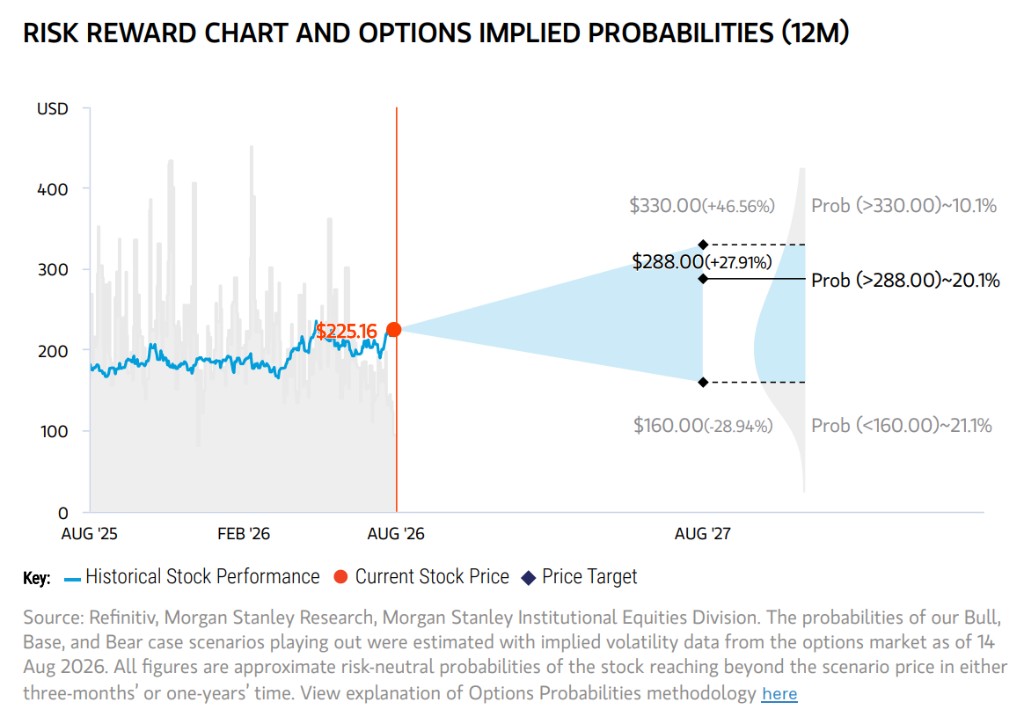
Morgan Stanley maintains an "Overweight" rating on NVIDIA with a target price of $288, continuing to list it as a "top pick." The firm expects NVIDIA's revenue for the quarter ending in July to reach $91.1 billion, rising further to $102.3 billion for the quarter ending in October. It also believes that wafer starts for Blackwell's 4nm process have improved, suggesting there is still upside potential to current performance forecasts.
However, the stronger the earnings, the higher the market's demands. NVIDIA's stock fell on the day following earnings for four consecutive quarters, reflecting a shift in investor focus from "can it still beat expectations" to "can the outperformance be sustained." Morgan Stanley believes that medium- to long-term variables such as market share, gross margins, the circular financing model, and the Rubin ramp-up are key to determining whether NVIDIA's valuation can expand further, and these questions are difficult to answer definitively with a single quarterly report.
Blackwell Demand Remains Strong
Morgan Stanley expects NVIDIA's revenue for the July quarter (F2Q27) to be $91.1 billion and for the October quarter (F3Q27) to be $102.3 billion; corresponding earnings per share (EPS) are projected at $2.07 and $2.34, respectively, broadly in line with market consensus estimates of $2.08 and $2.36.
On the surface, Morgan Stanley's earnings forecasts are not significantly above market expectations. The firm believes that the truly noteworthy aspect is the signal from the supply side.
During June research trips in Asia, Morgan Stanley observed that wafer starts for the 4nm process required for NVIDIA's Blackwell chips had increased, implying that supply assumptions in current models may still be conservative. In other words, while the market sees that "demand remains robust," how much NVIDIA can actually deliver may become a source of future upward revisions to performance.
Consequently, Morgan Stanley expects NVIDIA to likely continue its past "Beat & Raise" pattern. However, since the market has already raised expectations for the October quarter based on recent supply-side signals, the largest short-term upside to performance may not lie in the next quarter, but rather in the January quarter of next year.
At that time, Rubin will begin shipping on a larger scale.
Rubin Starts Shipping, Real Impact May Come Next Year
The Rubin product line is currently progressing as expected. NVIDIA has confirmed that Rubin will start shipping in the third quarter. Morgan Stanley estimates shipments of approximately 150,000 units in Q3, corresponding to about $9 billion in revenue, with an average selling price of roughly $60,000 per unit.
Recently, KYEC, a major testing partner of NVIDIA, lowered its full-year guidance and pushed more AI-related revenue into Q4 2026 and 2027, sparking market concerns about the pacing of Rubin shipments.
However, Charlie Chan, Morgan Stanley's Asia Semiconductor Analyst, believes that this change reflects an extended testing cycle rather than a decline in shipment volumes. The bank's updated model maintains the full-year Rubin testing volume unchanged, merely shifting more weight from Q3 to Q4.
More importantly, even if Q3 Rubin shipments fall short of expectations, the impact on NVIDIA's overall performance would be relatively limited. Morgan Stanley's current estimate of 150,000 units is already significantly lower than revised industry estimates, so short-term changes in testing pace are insufficient to alter NVIDIA's overall revenue trend.
Three Key Questions Determine Post-Earnings Stock Movement
For NVIDIA, the real challenge has shifted from "can performance beat expectations" to "can valuation find new upward logic." Morgan Stanley believes that profit margins, circular financing, and market share are the three most contentious issues among investors, and this earnings call may still struggle to provide definitive answers.
First is profit margins. Morgan Stanley expects management to reiterate guidance for FY2027 gross margins to remain in the "mid-70%" range. However, the firm remains reserved about the market consensus expectation that gross margins will rebound in the second half of FY2028.
Cost pressures from DRAM, front-end wafers, packaging, and substrates may persist, meaning there is a risk of further pressure on margins. If NVIDIA lowers its margin expectations, it will undoubtedly put pressure on the stock price in the short term; however, from a valuation perspective, a downward revision in margin expectations could also serve as a clearing event for market sentiment.
Second is the circular financing model. Jensen Huang previously explained the logic behind NVIDIA's $500 billion cooperation framework with partners via a blog post. Morgan Stanley expects that management's comments on this topic during the earnings call will not change significantly.
Third is market share. As ASIC competition heats up and AMD continues to advance its AI chip business, the market is beginning to focus on whether NVIDIA can maintain its current leading position. Morgan Stanley expects management to emphasize the significant improvement in AI factory economics offered by Rubin compared to Blackwell.
However, since Rubin is still in the early stages of mass production, the market needs more shipment data and customer feedback to judge its true competitiveness relative to ASICs and AMD.
Market May Still Underestimate 2027
If the short-term earnings lack a sufficiently strong catalyst, longer-term growth expectations may be the key to the continued expansion of NVIDIA's valuation.
Morgan Stanley believes that market expectations for NVIDIA in 2027 are still too low. The firm expects NVIDIA's FY2027 revenue to reach $393 billion, increasing further to $598.8 billion in FY2028, significantly higher than the market consensus of $562.4 billion.
Jensen Huang previously stated at the GTC conference that the company has visibility into $1 trillion in combined demand for Blackwell and Rubin from 2025 to 2027. This figure includes networking business but excludes Groq, standalone CPUs, RTX, and software businesses.
Morgan Stanley points out that the current market consensus implies total data center revenue of approximately $1.054 trillion, while the bank's forecast is $1.09 trillion. Considering that the 2025 data already includes about $30 billion in Hopper and related networking revenue, the bank believes this forecast does not set an exceptionally high bar.
Meanwhile, inference demand is accelerating, with growing demand from frontier labs, enterprises, and sovereign clients. Coupled with the ramp-up of new products like Rubin and potential incremental revenue sharing, Morgan Stanley believes that NVIDIA's actual business scale in 2027 could be significantly higher than current market expectations.
Even With Strong Earnings, The Stock May Not Immediately Respond Positively
Therefore, next week's NVIDIA earnings report may present a familiar scenario: performance beats expectations again, guidance is raised again, but the stock price may not surge as a result.
The consecutive stock price declines on the day following earnings for the past four quarters indicate that the market's pricing logic for NVIDIA is changing. As the performance base continues to rise, "Beat & Raise" is transforming from a stock price catalyst into a basic market requirement.
Morgan Stanley remains bullish on NVIDIA's long-term fundamentals, believing that Blackwell demand, the Rubin ramp-up, and growth in inference demand will continue to support performance. However, regarding the short-term stock price, what the market is truly waiting for is whether market share can be maintained, whether margins can stabilize, and whether Rubin can prove NVIDIA's leading advantage in the next round of AI infrastructure competition.
In other words, the highlight of next week's earnings may not be whether NVIDIA can once again deliver a beautiful report card, but whether that report card is impressive enough to make investors willing to pay for a higher valuation again.
