


The Value Depression in China's AI Infrastructure: 85% of Global Compute Traffic, Only 10% of Market Revenue
Chinese AI models have quietly shouldered 85% to 89% of global agent and code generation traffic, yet their monetization revenue accounts for only 10% to 16%—this is currently the most undervalued arbitrage. The combined market capitalization of US AI compute assets stands at $175 billion, while comparable Chinese assets are valued at only around $20 billion; the market cap of CoreWeave alone is nearly four times that of China's top three compute companies. GDS's record-breaking bookings have already validated a fundamental inflection point, with valuation gaps and catalysts emerging simultaneously
Chinese AI models have quietly come to dominate global compute consumption, yet the market valuation of their infrastructure severely diverges from this scale—this may be the most overlooked arbitrage in the current AI investment landscape.
According to a Tuesday report by zerohedge, data from OpenRouter shows that Chinese open-source models handle 85% to 89% of global agent and code generation token traffic, but the corresponding share of compute consumption revenue is only 10% to 16%. In other words, the market is currently pricing in a 10% monetization story, while the underlying reality is supported by 85% of the traffic.
Meanwhile, the enterprise value of US AI compute infrastructure totals approximately $175 billion, whereas comparable Chinese assets amount to only about $20 billion—the market capitalization of CoreWeave alone is sufficient to buy nearly four times the value of China's top three compute giants.
Fundamentals are showing an inflection point. GDS (GDS) just recorded a record 470 MW in new signed bookings for the first half of the year, raised its full-year performance guidance, and returned to profitability; VNET (VNET) will release its earnings report on August 18. The valuation depression is already present, and the upward inflection in fundamentals is becoming a catalyst.
Leading Traffic, Lagging Monetization
The dominance of Chinese open-source models in global AI usage has exceeded the expectations of most investors.
On the OpenRouter platform—currently the most representative public data source tracking open-source model usage—Chinese models handle 85% to 89% of global agent tasks and code generation token traffic, but the corresponding revenue share is only 10% to 16%. This divergence reveals a structural misalignment: market pricing reflects current monetization capabilities rather than the underlying scale of traffic.
Data from the distribution end further confirms this trend. Alibaba's Qwen model has surpassed 3 billion cumulative downloads in the past six months, exceeding the combined downloads of Meta and Google during the same period.
The evolution path of this logic is clear: first win traffic through scale, then drive monetization through traffic.
Frontier Performance, Fractional Pricing
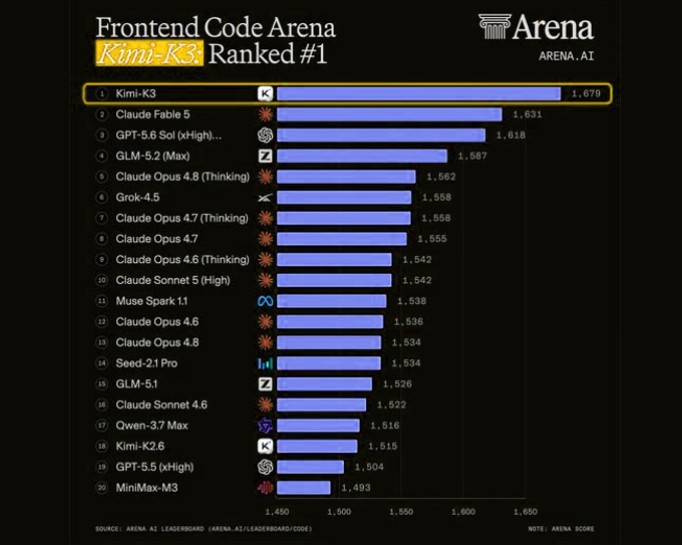
High traffic does not stem from the accumulation of low-quality models. Chinese open-source models have entered the top ranks of global coding capability leaderboards, with Kimi K3 currently topping the Arena Frontend Code ranking, followed closely by Qwen 3.8 Max.
However, in terms of pricing, API call fees for Chinese frontier models range from approximately $0.20 to $2.30 per million tokens, while corresponding prices for leading US models are $4 to $8.
This price gap is narrowing. Zhipu AI (Zhipu) has raised prices by approximately 110% year-to-date and guides Annual Recurring Revenue (ARR) to grow from $250 million to around $1 billion by year-end.
The logic behind the pricing strategy aligns with the traffic strategy: first lock in users with low prices, then gradually increase the monetization rate.
The Direction of Compute Constraints Is Reversing
The core logic for previously being bearish on Chinese AI was the lack of top-tier chips, making it impossible to participate in the frontier model race. This constraint is loosening.
Meituan's LongCat 2.0 has completed end-to-end training entirely based on 50,000 Huawei Atlas 950 chips. According to Goldman Sachs forecasts, China's self-sufficiency rate for AI chips will rise from the current 42% to approximately 70% by 2030.
At the same time, the constraint direction in the United States is exactly the opposite. Goldman Sachs expects that available excess power capacity in the US will shrink to approximately 130 gigawatts by 2030, while China's will expand to approximately 400 gigawatts during the same period.
The chip gap is narrowing, while the power gap is widening.
Valuation Misalignment: One CoreWeave Buys Four Times China
The valuation gap is more intuitive when looking at specific numbers.
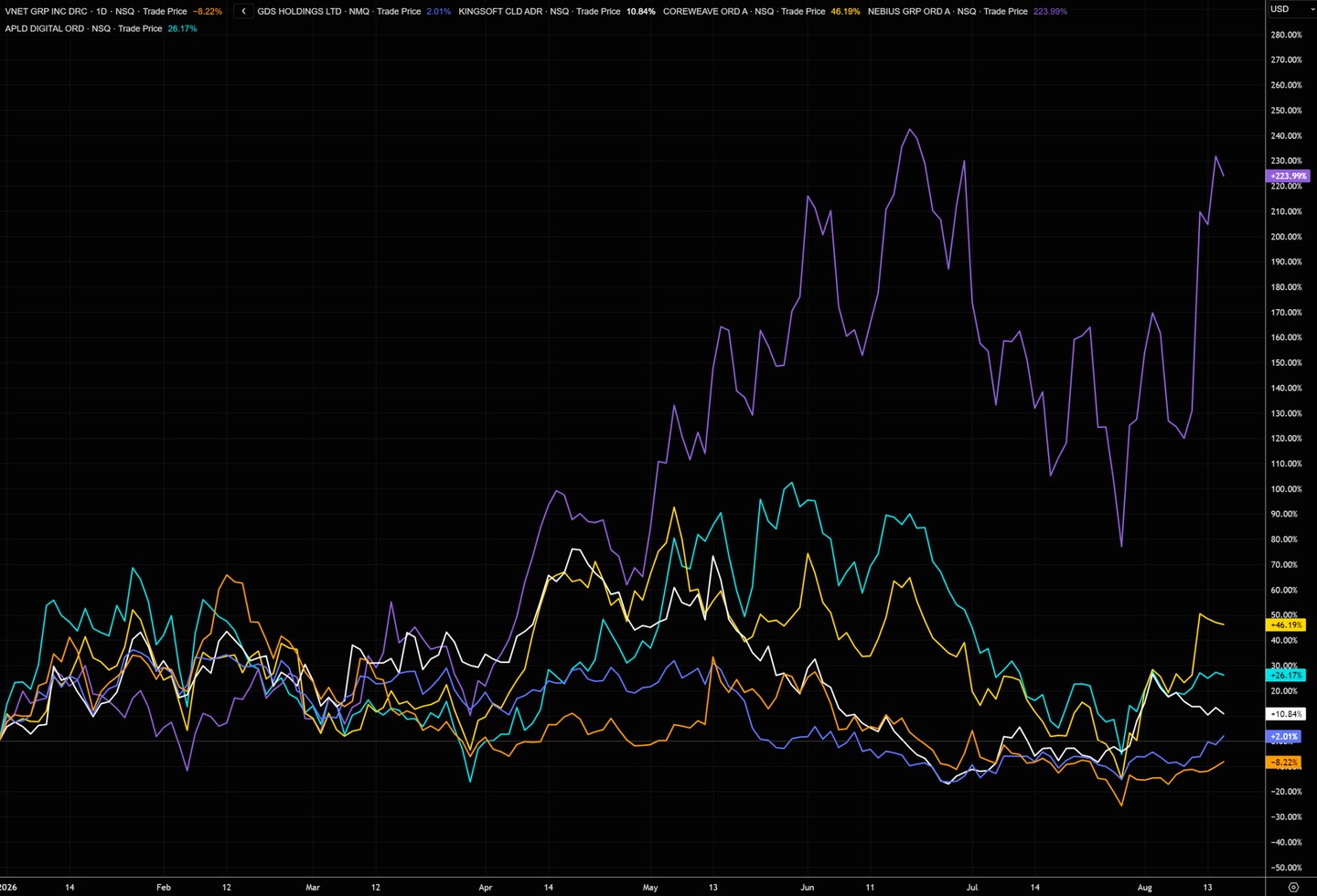
The market capitalization range for US AI compute enterprises is approximately $9 billion to $75 billion, while for comparable Chinese enterprises it is only $2 billion to $7 billion. In terms of enterprise value, the US totals approximately $175 billion, while China totals approximately $20 billion.
With the market capitalization of CoreWeave alone, one could buy nearly four times the value of China's top three compute companies.
The comparison at the revenue level is equally intriguing. Applied Digital (APLD) has an annual revenue of only a few hundred million dollars, yet its market capitalization is higher than that of GDS, which guides annual revenue of approximately $1.7 billion.
Both are in the AI infrastructure construction cycle, yet the pricing is vastly different.
Buy Infrastructure, Not the Models Themselves
This misalignment also exists one layer up in the industry chain, and the direction is even more extreme.
Investors are willing to pay a valuation of approximately 177 times recurring revenue for Chinese model labs such as Zhipu AI, while the infrastructure layer hosting these models, including Alibaba and Tencent, trades at a P/E ratio of only about 15 to 17 times.
Every incremental token ultimately requires compute power to support it.
Rather than buying models at 177 times earnings, it is better to hold the infrastructure layer that collects "rent" from all models at 15 times earnings.
Cheapness alone does not constitute an investment thesis; it requires fundamental support. GDS just announced a record 470 MW in new signed bookings for the first half of the year, with another 600 MW in reserved status, while raising performance guidance and returning to profitability. VNET will release its earnings report on August 18, which will provide further fundamental validation.
