


AI Hidden Risk! US Tech Giants' Off-Balance-Sheet Liabilities Swell to $3 Trillion, Approximately 5 Times Annual Capital Expenditure
According to The Wall Street Journal, nine US tech giants, including Alphabet and Microsoft, have accumulated approximately $3 trillion in off-balance-sheet commitments, primarily related to AI infrastructure construction. This figure is about five times their annual capital expenditure and has grown by 50% within two months. The core components include $1.2 trillion in uncommenced leases and $1.9 trillion in purchase obligations, which are not required to be recorded on the Balance Sheet under current accounting standards. Additionally, new off-balance-sheet guarantee structures amount to $70 billion. As some companies experience negative free cash flow, market concerns are rising that these hidden liabilities could severely impact the financial health of tech companies if triggered
The true financial commitments of US tech giants in AI infrastructure are far more alarming than publicly disclosed figures suggest.
According to a report by The Wall Street Journal on August 18, nine top technology companies—Alphabet (Google's parent company), Meta, Microsoft, Amazon, Oracle, Nvidia, Broadcom, SpaceX, and AMD—disclosed total off-balance-sheet commitments of approximately $3 trillion in the notes to their recent securities filings, with the vast majority directly related to AI infrastructure construction.
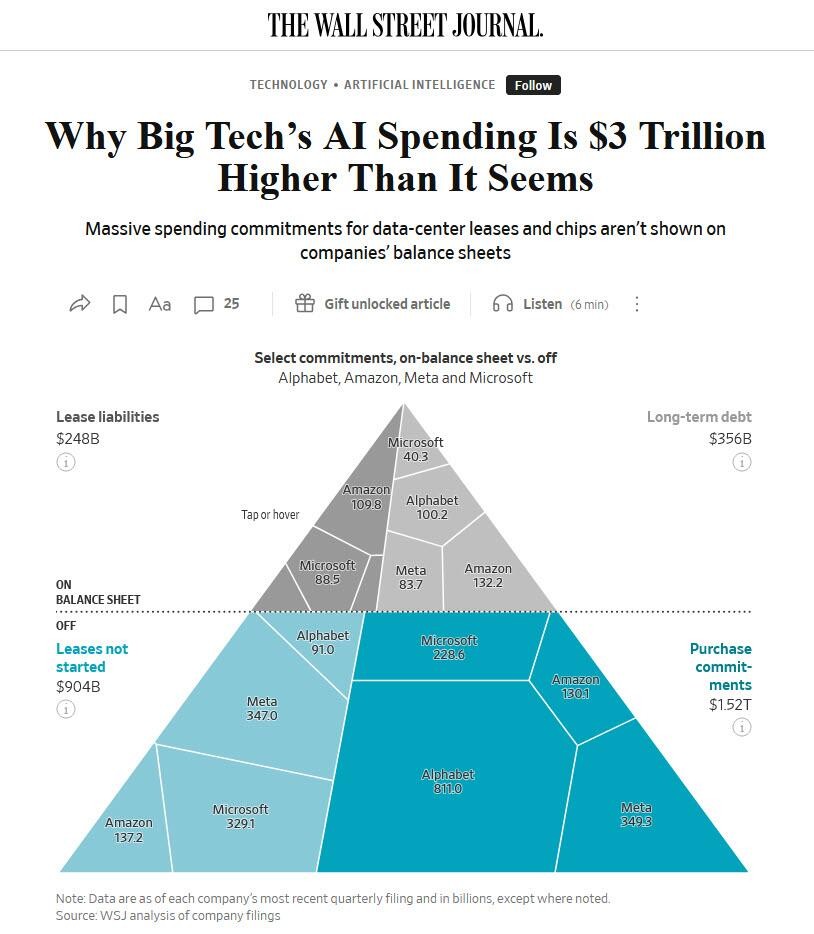
This figure is approximately five times the combined capital expenditure of $600 billion incurred by these companies over the past year, and about three times their outstanding lease obligations and long-term debt balances. More alarmingly, this scale has increased by approximately 50% from the previous $1.8 trillion in just two months.
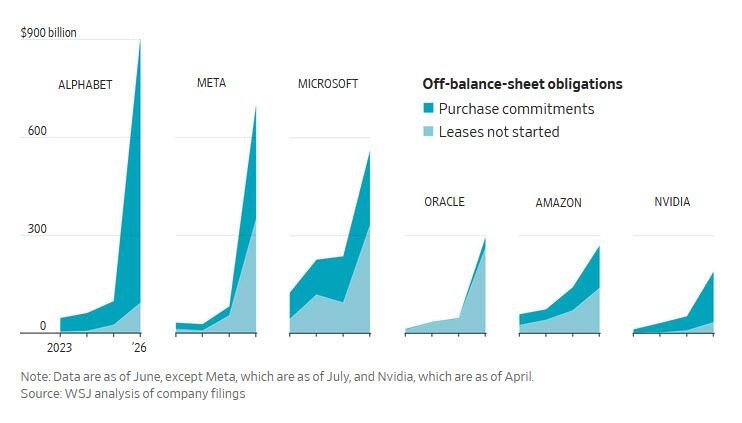
The core components of these hidden liabilities are approximately $1.2 trillion in "uncommenced leases" and approximately $1.9 trillion in "purchase obligations." Under current accounting standards, these two types of expenditure obligations do not need to be recorded on the Balance Sheet until delivery or rental payments begin, allowing them to legally remain off the balance sheet.
Meanwhile, as previously noted in Wall Street News articles, Bloomberg reported on August 15 that the scale of new off-balance-sheet guarantee structures based on "Residual Value Guarantees" (RVG) has reached approximately $70 billion. Chip giants like Nvidia and Broadcom are endorsing customer financing with their own credit. These contingent liabilities have not been fully priced in by the market, causing increasing unease among bond investors.
Alphabet and Amazon have recently seen their free cash flow turn negative—capital expenditures have exceeded operating cash inflows. This means that hyperscalers will continue to rely on capital market financing in the foreseeable future. Once the $3 trillion in off-balance-sheet commitments are triggered, they will have a profound impact on tech companies whose balance sheets were previously considered "fortress-like."
$3 Trillion in Off-Balance-Sheet Commitments: How Accounting Rules Make Huge Debts "Disappear"
Analysis by The Wall Street Journal reveals that the ability of nine top tech companies to legally bypass the Balance Sheet with their off-balance-sheet commitments stems from two mainstream accounting treatments.
The first category is "uncommenced leases."
Take Meta's "Hyperion" data center project in Louisiana as an example—covering an area equivalent to about 1,700 football fields. Meta initially signed a four-year lease starting in 2029, renewable for up to 20 years, and committed to making up any shortfall to bondholders if it terminated the lease early.
Since Meta deemed the probability of actually paying this guarantee amount to be low, it did not record any liability on its Balance Sheet. According to accounting standards, the lease obligation can remain off-balance-sheet until rental payments officially begin. Meta disclosed total commitments for such "uncommenced leases" of approximately $347 billion.
The Wall Street Journal statistics show that the total uncommenced leases for all analyzed companies have reached approximately $1.2 trillion in off-balance-sheet obligations, an increase of about four times compared to the figures disclosed a year ago.
The second category is "purchase obligations."
Data centers require massive amounts of hardware, including Nvidia chips and memory chips for training and running models. To lock in supplier capacity, tech companies commonly sign long-term purchase contracts in advance. Under accounting rules, purchase obligations also do not need to be recorded on the Balance Sheet before products or services are delivered. The purchase obligations for the analyzed companies total approximately $1.9 trillion.
These two categories combined constitute the bulk of this approximately $3 trillion "time bomb." Even if revenue fails to materialize as expected, signed purchase contracts and leases generally cannot be unilaterally canceled.
"Residual Value Guarantees": $70 Billion in Off-Balance-Sheet Contingent Liabilities Quietly Accumulating
As noted in Wall Street News articles, beyond the large-scale off-balance-sheet leases and purchase obligations mentioned above, a new structural arrangement called "Residual Value Guarantee" (RVG) is rapidly expanding in the AI financing ecosystem. Its scale has reached approximately $70 billion, becoming another layer of little-known hidden risk.
This structure operates in three layers: A Special Purpose Vehicle (SPV) borrows money to purchase chips, with the loan supported by cash flows from the AI company's usage contracts; if the AI company stops paying, the chips are subleased or sold to repay the debt; if there is still a shortfall, the guarantor—usually the chip manufacturer—makes up the difference.
Chip giants like Nvidia and Broadcom thus act as the ultimate backstop, but the related guarantee obligations are typically not recorded on their balance sheets. Meta's statement in relevant documents confirms this logic: "The probability of the RVG guarantor making payments is low, so no liabilities have been recorded to date."
Broadcom has extended this logic to its "Big Sky" project—Broadcom provides guarantees for a $35 billion debt transaction, while investors such as Apollo Global Management and Blackstone Group fund the purchase of custom AI chips, which are then leased to Anthropic. This allows senior debt to obtain investment-grade ratings, thereby lowering financing costs.
Bank of America strategists estimate that Broadcom's AI XPV platform could accumulate $370 billion in senior debt by mid-2029.
Nvidia CEO Jensen Huang stated that the company might provide residual value support mechanisms of up to 25% for relevant opportunities, assessing them on a "case-by-case basis," with the goal of "helping to unlock a large pool of independent capital while maintaining disciplined risk exposure."
Nvidia announced last week that it had reached a $500 billion financing partnership with six US investment institutions, including BlackRock and Goldman Sachs. Part of the reason was to introduce external capital to alleviate the dilemma of the "circular financing" loop where AI companies fund each other by purchasing each other's products.
Rating Agencies Issue Warnings, Bond Market Struggles to Price Risks
Wall Street News articles also noted that rating agencies have publicly expressed concern about the rapid expansion of the RVG structure.
Moody's pointed out in a report that "the main risk lies in the dense occurrence of such transactions in the short term," warning that a significant increase in Broadcom's contingent obligations, "even if its existing debt leverage remains at a low level, will limit Broadcom's financial flexibility and may exert pressure on the company's credit profile."
S&P Global Ratings characterized the residual value support provided by Broadcom as a "contingent debt-like obligation" and explicitly stated that this portion would be included in adjusted debt calculations.
The core anxiety of bond investors is: When will these off-balance-sheet contingent liabilities transform into real losses on the balance sheet? Mariya Entina, portfolio manager at DoubleLine, stated bluntly:
"It's like gaming the system, trying to get preferential treatment from rating agencies to achieve the highest possible ratings... We are entering an era of financial engineering. When you engage in financial engineering, you are obscuring financial reality."
CreditSights analysts compared Nvidia's residual value support to "selling a put option," noting that "it is pro-cyclical, costing almost nothing during boom phases, but becoming most critical during severe downturns when customers default and the market value of hardware declines."
Brian Gelfand, Co-Head of Global Credit at TCW, stated:
"This is not ordinary investment-grade credit underwriting; it is far more complex. Given the off-balance-sheet nature, tail risks are elevated."
Some market participants hold a relatively optimistic view. John Lloyd, Global Multi-Sector and Corporate Credit Head at Janus Henderson Investors, believes that triggering residual value support requires extreme conditions.
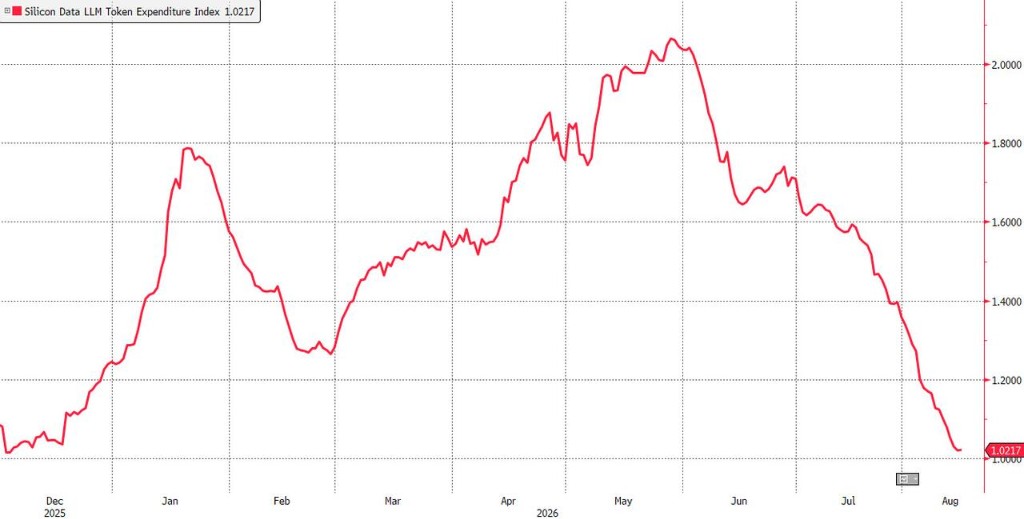
"You would have to see a cliff-like drop in the growth rate of token usage, which is not what we are seeing at all," emphasizing that these companies are "not trying to hide contingent liabilities, but rather trying to finance them."
Divergent Views: Sustained Demand or "Boom-Bust" Cycle?
There is significant divergence in the market regarding whether these off-balance-sheet liabilities constitute a systemic risk.
Optimists believe that the continuously soaring demand for AI tools has pushed up stock prices and caused shortages of core hardware, which itself is strong evidence of robust demand in the coming years. They argue that tech companies will have sufficient cash flow to cover all bills.
Pessimists focus on two main risks:
First, the vast majority of purchase obligations and signed leases are irrevocable; bills must be paid regardless of whether revenue materializes;
Second, Chinese open-source models are offering performance close to frontier models at significantly lower prices. If enterprises and consumers shift en masse to these cheap alternatives, the profits of hyperscalers will face systemic compression, while infrastructure bills cannot be reversed.
It is reported that relevant token prices have cumulatively fallen by more than 50% in the past few weeks.
From a structural perspective, the current danger lies in the combination of timing mismatches and information opacity: Capital expenditure commitments have preceded the arrival of revenue and free cash flow; a large amount of depreciation costs are still deferred, and once construction in progress is gradually transferred to fixed assets, it will create concentrated profit pressure; furthermore, due to inconsistent standards in the classification and disclosure of off-balance-sheet liabilities across companies, any cross-company comparison of true leverage faces inherent uncertainty, making it difficult for investors to fully assess overall risk exposure.
As analysts have pointed out, these liabilities do not currently constitute an imminent solvency crisis, but they represent a mismatch in timing and disclosure—a wall of deferred depreciation and a bill whose bottom has not yet been seen.
Risk Warning and Disclaimer
The market involves risks, and investment should be approached with caution. This article does not constitute personal investment advice, nor does it take into account the specific investment objectives, financial status, or needs of individual users. Users should consider whether any opinions, views, or conclusions in this article align with their specific circumstances. Investment decisions made based on this content are the sole responsibility of the investor.
