Morgan Stanley: In the AI era, AWS's trillion-dollar revenue is expected, with Amazon targeting $500
Morgan Stanley maintains an "Overweight" rating on Amazon, raising the target price to $335. The research report points out that if AWS cloud business achieves annual revenue of $1 trillion in the AI era while maintaining high profit margins, Amazon's stock price is expected to reach $500 by the end of 2027. This prediction is based on Amazon's management's optimistic expectations for AWS's long-term growth and profit margins, as well as the recent acceleration in AWS's growth
According to the Zhitong Finance APP, Morgan Stanley has released a research report maintaining an "overweight" rating on Amazon (AMZN.US) and raised the target price from $330 to $335, which is 28% higher than the latest closing price. However, the focus of this report is not on short-term forecasts but rather on a longer-term valuation scenario. Morgan Stanley analyst Brian Novak pointed out in the report that if AWS's annual revenue can reach $1 trillion and maintain profit margins consistent with historical levels in the cloud business, Amazon's stock price is expected to reach $500 per share by the end of 2027.
This optimistic scenario stems from significant upward revisions in expectations by Amazon's management during the recent earnings call. For years, Amazon has claimed that AWS's revenue could reach hundreds of billions of dollars, but now management has revised that figure to $1 trillion.
Novak attempts to address the core question raised by this target in the report: How long will it take for AWS to reach a trillion-dollar scale? If this goal is truly achieved, what does it mean for Amazon's stock price?
AWS's Trillion-Dollar Revenue Vision: AI Era Profit Margins Leading Historical Levels, or Transforming into a Strong Profit Engine
The trigger for this report was Amazon's management's statements during the Q2 earnings call.
Amazon's management stated, "We have always believed that AWS could become a business with hundreds of billions in revenue, and now we believe it will at least double, and it is very likely to ultimately become a business with annual revenue of $1 trillion, accompanied by highly attractive free cash flow and return on invested capital."
Management also directly addressed the profit margin issue: "We have achieved this in the first phase of cloud computing, but at that time, demand was accumulated over a longer time frame, unlike the rapid pace of the AI era. However, we see that the profit margins and returns in the AI field are comparable to the levels when core cloud computing was at the same development stage—actually slightly ahead."
These comments form the cornerstone of Morgan Stanley's model. Data shows that AWS's revenue grew by 37% year-over-year in Q2, marking the fastest growth rate in 18 quarters, with significant increases in annualized revenue from AI and custom chip businesses. If the profit margins in the AI era are indeed as Amazon's management claims, consistent with historical levels in the cloud business, then the $1 trillion AWS will become a massive profit engine.
Amazon's Capital Expenditure Soars to $220 Billion; Capacity is the Key Constraint
Morgan Stanley's report clearly states that the real factor determining when AWS can reach $1 trillion in revenue is not demand. Although demand appears strong, the constraint lies in whether Amazon can quickly deploy enough computing capacity to meet that demand.
The report outlines a timeline for capacity expansion: 6 gigawatts (GW) of new capacity this year, 8 GW next year, and then a continuous addition of 8 GW each year thereafter.
Amazon has raised its 2026 capital expenditure guidance from $200 billion to $220 billion, with most of the new capital expenditure allocated for building AI infrastructure.
The report acknowledges that the outlook for next year will become uncertain—electricity, construction, servers, labor, any link could become a bottleneck. However, Morgan Stanley believes that based on Amazon's current execution, the annual expansion pace set by its model is achievable
Monetization Rate Per Watt Determines Timing: $1 Trillion Revenue Achievable by 2034 at the Earliest
Having capacity alone is not enough; the key lies in how much revenue each watt of capacity can generate. The report indicates that currently, AWS generates approximately $8 in revenue for every additional watt of computing power. This figure needs to continue to improve—Morgan Stanley predicts that revenue per watt will increase driven by higher-value AI workloads and more reasonable computing pricing.
Under higher monetization rate assumptions, the model shows that AWS could achieve $1 trillion in annual revenue as early as 2034; under baseline assumptions, this milestone is expected around 2035. The report anticipates that AWS revenue will continue to grow robustly before the end of this decade, gradually slowing down as the base expands.
If AWS's profit margins in the AI era remain consistent with past cloud business, then $1 trillion in revenue could yield hundreds of billions in operating profit. Coupled with its retail business, Amazon is expected to rank among the most profitable companies globally.
Risks and Opportunities Coexist: Free Cash Flow Under Pressure, but Long-Term Logic Remains Unchanged
AWS is already the largest cloud business globally, growing at the fastest pace in 18 quarters, while the AI infrastructure cycle is still in its early stages. However, risks are also very real.
Morgan Stanley issued a warning in the report regarding pressure on free cash flow: Amazon's AI infrastructure spending has been eroding free cash flow. As of the last 12 months ending in the second quarter, free cash flow has turned into a net outflow due to a significant year-on-year increase in property and equipment purchases.
Other risk factors include: monetization rate improvements falling short of expectations, competitors potentially lowering cloud service prices, and regulations possibly delaying data center construction.
If many favorable trends continue, Amazon's stock price could reach $500; if these trends develop normally, the baseline target price is $335. For investors, the core message conveyed by Morgan Stanley is that, in either scenario, Amazon's greatest growth opportunity may no longer be selling more online goods, but rather the astonishing profit potential that AWS can unleash in the AI era.
Massive AI Investments Begin to Yield Returns as Wall Street Analysts Turn Bullish
On July 30 local time, Amazon released a strong second-quarter earnings report: revenue surpassed $200 billion for the first time, operating profit surged 43.2% year-on-year to $27.461 billion, and operating profit margin climbed to 13.7%, setting a record high since the company's IPO. More importantly, AWS achieved revenue of $42.23 billion, a year-on-year increase of 36.7%, far exceeding Wall Street's expectation of 31%, marking the fastest growth in 18 quarters since 2021 and the fifth consecutive quarter of accelerated growth. The massive AI investments are beginning to yield returns.
Following the earnings report, several Wall Street firms raised their target prices for Amazon.
Goldman Sachs may be the most optimistic among them, believing that the tech giant deserves a more significant valuation reassessment. The firm raised Amazon's target price from $335 to $375, maintaining a "buy" rating. The acceleration of AWS growth, strong AI demand, and positive momentum in the advertising business are all factors that have collectively boosted Amazon's profit outlook Bank of America raised its price target for Amazon from $310 to $320, maintaining a "Buy" rating, citing that Amazon's cloud business performance easily exceeded market expectations. However, the bank also cautioned that more substantial evidence is needed to prove that Amazon can effectively convert its massive AI spending into strong and sustainable free cash flow.
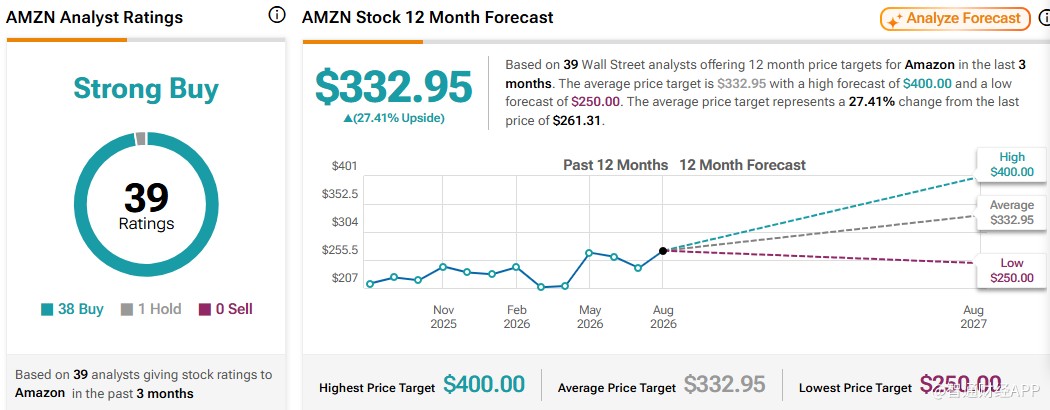
Overall, most Wall Street analysts remain optimistic about Amazon, with a consensus rating of "Strong Buy" and an average price target of $332.95, which is 27% higher than the current stock price level.