


Is the Plunge in U.S. Treasuries Over? Three Major Concerns Loom: Institutions Warn Sell-Off Could Worsen
The yield on 30-year U.S. Treasuries has surged to near 20-year highs, with institutions warning that the sell-off may worsen. Major holders—the UK, China, and Japan—all reduced their U.S. Treasury holdings in June. Fundstrat predicts yields could rise to the 5.6%-5.7% range. Long-term U.S. Treasuries remain under pressure from the triple risks of global yield linkage, potential Federal Reserve rate hikes, and supply-side inflation pressures. Even with weaker U.S. economic data, the repricing of borrowing costs continues to exert upward pressure
The yield on 30-year U.S. Treasuries has surged to near 20-year highs, while multiple strategists warn that this sell-off is far from over.
On Monday, the yield on 30-year U.S. Treasuries rose by more than 4 basis points to 5.311%, reaching its highest level since June 2007. Meanwhile, data released by the U.S. Department of the Treasury showed that major holders of U.S. debt—the United Kingdom, China, and Japan—all reduced their U.S. Treasury holdings in June. Mark Newton, a technical strategist at Fundstrat, warned that the 30-year yield could climb further into the 5.60% to 5.70% range, potentially at a faster pace than usual.
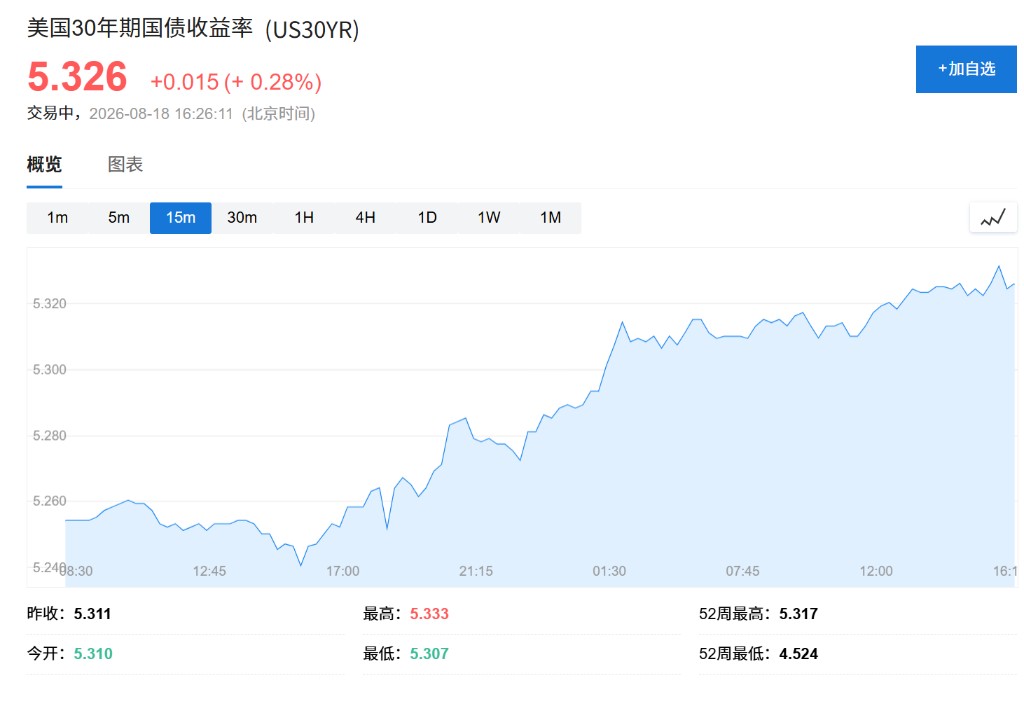
Notably, this trend has emerged against a backdrop of weak U.S. economic data—July retail sales were the worst since May 2025, and the labor market also showed signs of cooling. However, long-term U.S. Treasuries remain under continuous pressure due to the confluence of three risks: the linked upward movement of global yields, the potential path of Federal Reserve rate hikes, and supply and inflation pressures.
Global Yield Linkage: U.S. Treasury Sell-Off Extends Beyond Domestic Borders
The sharp rise in 30-year U.S. Treasury yields was not entirely triggered by domestic factors.
Mark Newton pointed out that Japan released economic growth data that fell short of expectations, yet the GDP deflator rose higher than expected. "Yields on 10-year and 20-year Japanese government bonds subsequently rose and quickly spilled over into the U.S. market, pushing long-term U.S. Treasury yields to multi-year highs," he said.
Strategists at BMO also cited fiscal concerns in the United States, Japan, the United Kingdom, and several European countries as one of the potential reasons for the recent weakness in long-term bonds. BMO believes that even if U.S. economic data softens further, the overall repricing of global long-term borrowing costs may continue to exert upward pressure on U.S. Treasury yields.
Federal Reserve Rate Hike Risk: Strong Economy Could Force Further Tightening
Another risk is that the U.S. economy may remain too strong, making it difficult for interest rates to decline significantly.
In a research note released on Monday evening, Deutsche Bank noted that the market is currently pricing in a rare benign combination—economic resilience coexisting with record-high stock markets, constrained only by limited further tightening from central banks and manageable commodity supply shocks. Henry Allen, a macro strategist at Deutsche Bank, believes this combination is unsustainable:
"By definition, strong growth and active risk assets imply that financial conditions will remain loose, thereby boosting demand and forcing central banks to accelerate the pace of rate hikes."
The bank also pointed out that inflation remains above target levels. Its analysis shows that historically, a CPI above 3% has often corresponded to tightening exceeding 100 basis points during the first year of the Federal Reserve's rate-hiking cycle.
There is precedent for drastic repricing in the bond market without a recession. In early 2024, driven by stronger growth and inflation, the 10-year U.S. Treasury yield climbed from 3.88% at the end of 2023 to a peak of 4.70% by the end of April that year, causing market expectations for rapid Federal Reserve rate cuts to unravel.
Supply and Term Premium: Long-Term U.S. Treasuries Face Unique Pressures
The third risk focuses on long-dated bonds themselves: investors may demand higher returns to compensate for the risks associated with financing the U.S. government over decades.
Large-scale Treasury issuance is a significant pressure point. BMO noted that the winning yield at the latest 30-year Treasury auction was the highest since 2001; furthermore, five of the previous seven 20-year Treasury auctions resulted in a "tail" (where the auction yield was higher than secondary market levels), indicating that demand for ultra-long-term bonds is not robust.
Inflation could bring additional pressure. BMO stated that energy prices remain a potential headwind for U.S. Treasuries, especially since yields have shown little willingness to decline even as economic data softens. Deutsche Bank further warned that if commodity prices suffer another shock, "the combination of negative hits to both growth and inflation could put simultaneous pressure on stocks and bonds."
In summary, long-term U.S. Treasuries are currently facing pressure from multiple directions: the overall upward trend in global yields, the possibility that U.S. economic resilience may exceed expectations, and lingering concerns regarding inflation and debt supply.
Risk Disclosure and Disclaimer
Investing involves risks; please proceed with caution. This article does not constitute personal investment advice, nor does it take into account the specific investment objectives, financial status, or needs of individual users. Users should consider whether any opinions, views, or conclusions in this article align with their specific circumstances. Investors assume full responsibility for their own investment decisions.
