


KUAISHOU-W Q2 Revenue of RMB 35.54 Billion Meets Expectations; Kling AI Revenue Surges Over 200%; MAU Significantly Exceeds Estimates | Financial Report Insights
More updates to follow
Kuaishou Technology's second-quarter performance generally met market expectations. However, the strong performance of its AI business and the better-than-expected growth in user scale became the highlights of this quarter's financial report, indicating the platform's continuous expansion in user base.
According to Kuaishou's announcement, for the three months ended June 30, 2026, the company's total revenue increased by 1.4% year-on-year to RMB 35.54 billion, basically in line with the Bloomberg consensus estimate of RMB 35.51 billion. Net profit was RMB 3.15 billion, and adjusted net profit was RMB 3.91 billion, both slightly exceeding market estimates.
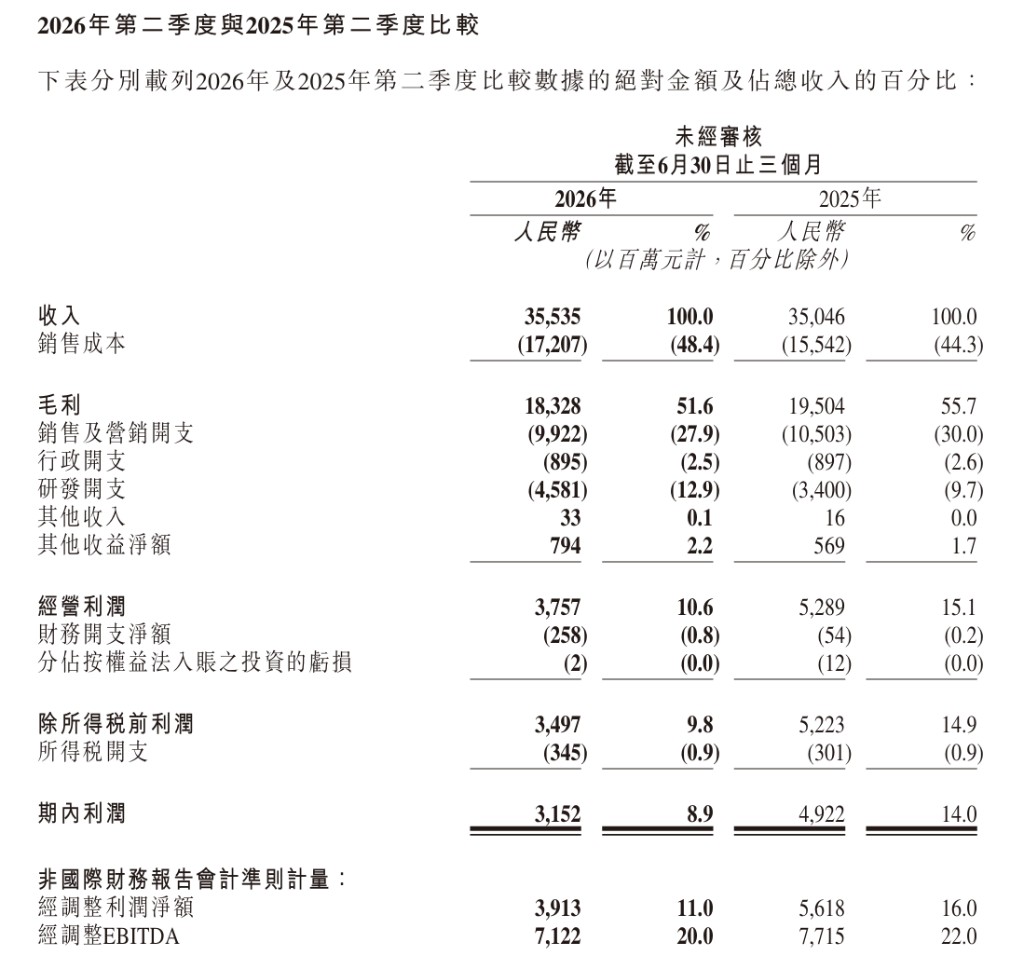
Kling AI's operating revenue in the second quarter exceeded RMB 850 million, a year-on-year increase of over 200%, with a significant acceleration compared to the first quarter. Kuaishou attributed this to the dual drivers of model capability iteration and the expansion of commercialization scenarios. Kuaishou's average monthly active users (MAU) reached 800 million, far exceeding the market estimate of 740 million, marking a significant increase.
Meanwhile, Kuaishou's continued investment in AI is reshaping its cost structure. R&D expenses in the second quarter surged by 34.7% year-on-year to RMB 4.58 billion, far exceeding the market estimate of RMB 4.07 billion; gross margin decreased from 55.7% in the same period last year to 51.6%, and operating profit declined by 29% year-on-year to RMB 3.76 billion. Company management stated that in the face of a complex macroeconomic environment, they will maintain a prudent attitude towards short-term business prospects, but remain committed to the long-term strategic direction of deepening AI investments.
Impressive Growth in Kling AI Becomes the Strongest Growth Engine
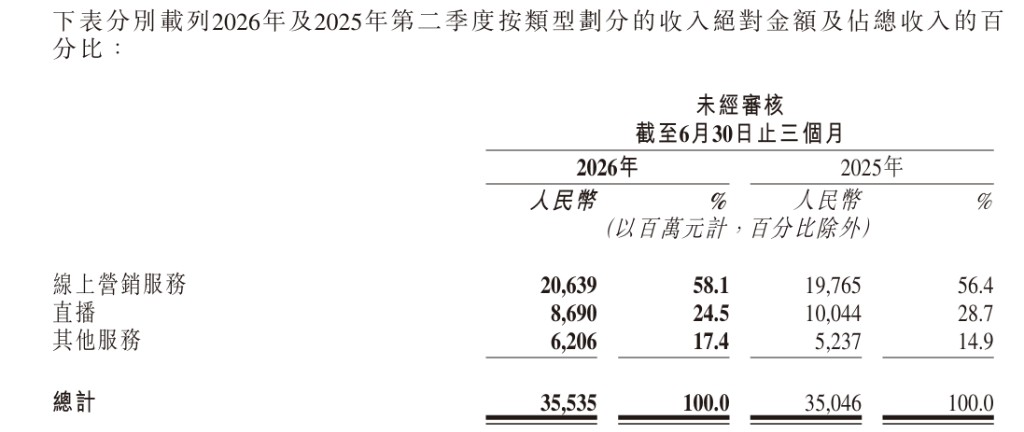
The commercialization progress of Kling AI was the most watched highlight of this quarter's financial report. Kling AI's operating revenue in the second quarter exceeded RMB 850 million, a year-on-year increase of over 200%, driving "other services" revenue to grow by 18.5% year-on-year to RMB 6.21 billion, higher than the market estimate of RMB 5.83 billion. In comparison, this segment has become the fastest-growing source among the three major businesses.
From a product perspective, Kuaishou launched the industry's first video generation model supporting native 4K output in the Kling AI 3.0 series this quarter, and introduced the Kling 3.0 Turbo model, focusing on the simultaneous optimization of creation efficiency and cost. Kling AI also launched MCP and CLI interfaces to support batch creation by AI agents, further expanding applications in workflow automation scenarios. In terms of recognition in the creative industry, two advertisement films generated by Kling AI won one Silver Lion and two Bronze Lions at the 2026 Cannes Lions International Festival of Creativity.
According to Kuaishou's financial report, Beijing Kling Intelligent Technology Co., Ltd. signed a capital increase agreement with several investors on July 2, 2026, intending to obtain external funding totaling no more than USD 3 billion. Upon completion of the involved restructuring, Beijing Kling's financial results will continue to be consolidated into the group's consolidated financial statements.
Moderate Growth in Marketing Revenue, Continued Contraction in Live Streaming Business
Online marketing services revenue increased by 4.4% year-on-year to RMB 20.64 billion, slightly lower than the estimated RMB 21.01 billion. Content consumption, local life services, and the AI application industry were the main drivers of non-e-commerce marketing growth this quarter. Among them, spending on short drama marketing placements increased by over 100% year-on-year, and spending on AIGC short video marketing materials generated by AI increased by over 70% year-on-year.
In terms of e-commerce marketing, the T2000 brand special plan showed initial results, with the growth rate of brand merchants' marketing placements exceeding the overall market; the customer penetration rate of net transaction ROI products increased from 45% in the first quarter to 55%, helping merchants reduce return rates.
Live streaming business revenue declined by 13.5% year-on-year to RMB 8.69 billion, basically meeting expectations. Kuaishou attributed this to the continuous promotion of healthy development in the live streaming ecosystem, with adjustments to the previously high-income anchor structure continuing to bring pressure. This quarter, the total number of AI gifts sent by users exceeded 6 million, and the application of AI technology in live streaming recommendation and interaction scenarios further deepened.
User Scale Exceeds Expectations, Core Commercialization Indicators Remain Robust
Kuaishou's user data this quarter was more impressive than expected. Kuaishou App's average daily active users (DAU) reached 412.3 million, and average monthly active users (MAU) reached 797.3 million, both increasing from 408.9 million and 714.8 million in the same period last year, respectively. MAU was about 8% higher than the Bloomberg consensus estimate of 740 million, indicating that the platform still possesses strong user stickiness in an environment of intensified competition for existing users.
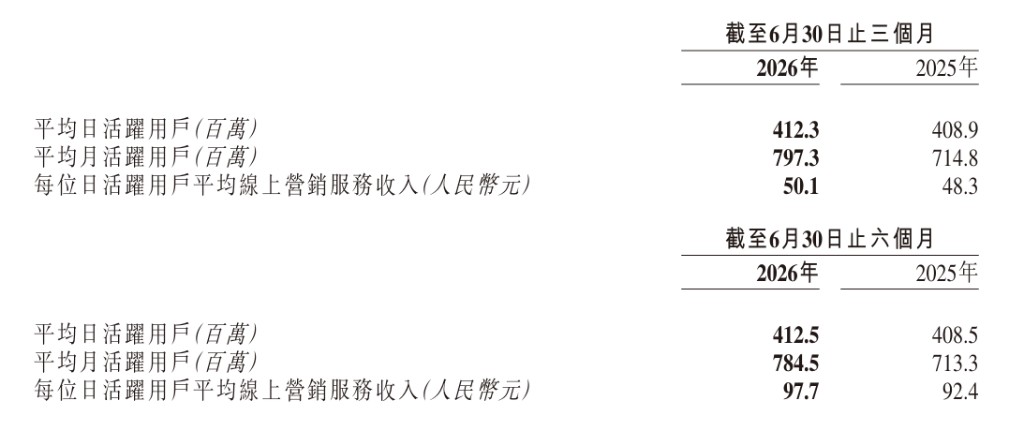
From the perspective of commercialization efficiency, the average online marketing services revenue per DAU increased from RMB 48.3 in the same period last year to RMB 50.1, reflecting a steady improvement in user monetization capabilities. Core commercial revenue, including online marketing services and other services mainly driven by e-commerce and Kling AI, increased by 7.4% year-on-year, significantly faster than the 1.4% growth in total revenue, indicating that high-value businesses are accounting for a larger proportion.
AI Investment Pushes Up Costs, Profit Margin Under Temporary Pressure
Kuaishou's profit this quarter was under pressure, mainly due to the rapid expansion of AI-related investments. R&D expenses increased significantly from RMB 3.4 billion in the same period last year to RMB 4.58 billion, and cost of sales increased by 10.7% year-on-year to RMB 17.2 billion, with the increase in revenue sharing costs being the main driver. Gross profit therefore decreased by 6% year-on-year to RMB 18.3 billion, and gross margin narrowed by 4.1 percentage points to 51.6%.
Operating profit decreased by 29% year-on-year to RMB 3.76 billion, with the domestic segment's operating profit dropping from RMB 5.4 billion to RMB 3.73 billion; the overseas segment turned from profit to loss, recording an operating loss of RMB 25 million, with revenue declining by 9.3% year-on-year. Net profit decreased by 36% year-on-year to RMB 3.15 billion, and adjusted EBITDA decreased by 7.7% year-on-year to RMB 7.12 billion, but was better than the estimated RMB 6.79 billion.
As of June 30, 2026, Kuaishou's total available funds (including cash, time deposits, and financial assets) amounted to RMB 121.3 billion, an increase from RMB 117.7 billion at the end of the previous quarter, maintaining a robust balance sheet.
Prudent Outlook, Commitment to Long-term AI Investment
Regarding business outlook, Kuaishou's management clearly stated that they would remain prudent about the short-term prospects for the second half of the year, citing a complex and challenging macroeconomic environment. The company also emphasized that it will continue to expand Kling AI's model capabilities, deepen its commercial applications in professional creative scenarios, and promote the implementation of large model technology in broader scenarios to assist merchants and marketing clients in improving operational efficiency.
In terms of shareholder returns, as of the last practicable date, Kuaishou had cumulatively repurchased 43.3 million Class B shares, costing approximately HKD 1.97 billion. The Board of Directors resolved not to distribute an interim dividend for this period. In the second quarter of 2026, the AI code contribution rate reached 60%, and the proportion of employees using self-developed AI agent products exceeded 92%, indicating that AI has deeply penetrated the company's internal operational system.
More updates to follow...
