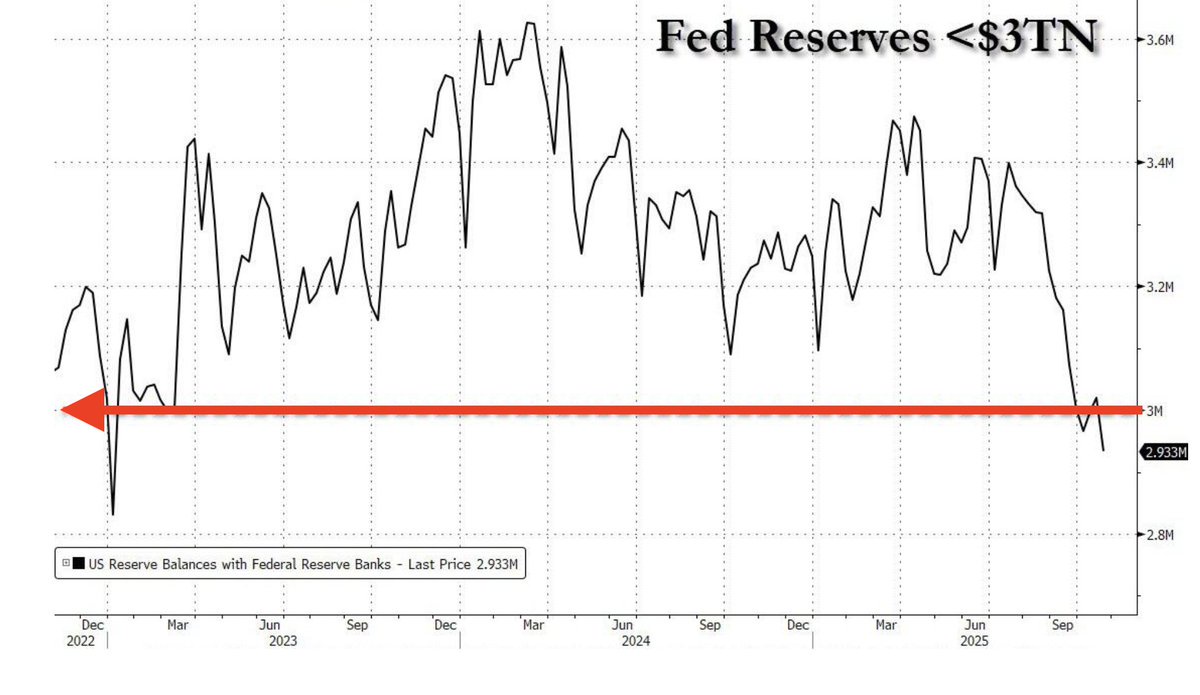
Fed reserves just slipped under $3 trillion again, sitting at $2.933 trillion for the week ending October 22, down another $59 billion.
That’s the second week in a row below the $3T mark, and the decline is accelerating. Earlier this month, we had eight straight weeks of bleeding reserves before a small pause, but now the slide’s picking up speed and this latest drop is bigger than the typical $20–45 billion moves we were seeing before.So what’s going on? The U.S. Treasury has been rebuilding its cash pile back to over $800 billion since the debt ceiling was lifted in July. To do that, they’ve been flooding the market with short-term Treasury bills. But every time the Treasury issues new bills and collects money, that cash leaves the banking system moving from private bank deposits to the Treasury’s account at the Fed. When those settlements hit, banks and dealers have to deliver cash, which directly drains reserves.Here’s where it gets messy: the Overnight Reverse Repo Facility (RRP) once a $2.5 trillion cushion for liquidity swings is basically empty now, sitting around just a few billions. Back when QT and Treasury issuance were draining cash, the RRP absorbed the shock. Now that buffer’s gone, so every dollar drained hits the banks directly.You can already see this tension spilling into money markets. On October 15, repo rates spiked to 4.36%, which is unusually high for a normal day. Banks have started tapping the Fed’s Standing Repo Facility (SRF), an emergency backstop we haven’t seen used this heavily since the COVID liquidity crunch. SOFR spreads are widening, the effective fed funds rate is inching higher, and funding costs are tightening across the board.That’s why everyone’s watching next week’s FOMC meeting (Oct 28–29). JPMorgan and Bank of America both expect the Fed to end QT soon. Powell hinted as much in his October 14 speech saying we’re “approaching ample reserves” and acknowledging that repo rates are getting firm. The Fed’s playbook is clear: stop QT before another funding crisis hits, like in September 2019 when repo rates exploded to 10%.If the Fed does announce an end to QT, liquidity should loosen quickly. Treasury yields would likely fall, risk assets would rally, and money market stress would ease. But until then, we’re in a fragile stretch. More Treasury settlements are coming, month end pressures are near, and reserves are skating dangerously low.Source: StockMarket.News
The copyright of this article belongs to the original author/organization.
The views expressed herein are solely those of the author and do not reflect the stance of the platform. The content is intended for investment reference purposes only and shall not be considered as investment advice. Please contact us if you have any questions or suggestions regarding the content services provided by the platform.