


Morgan Stanley: Semiconductor Capital Equipment
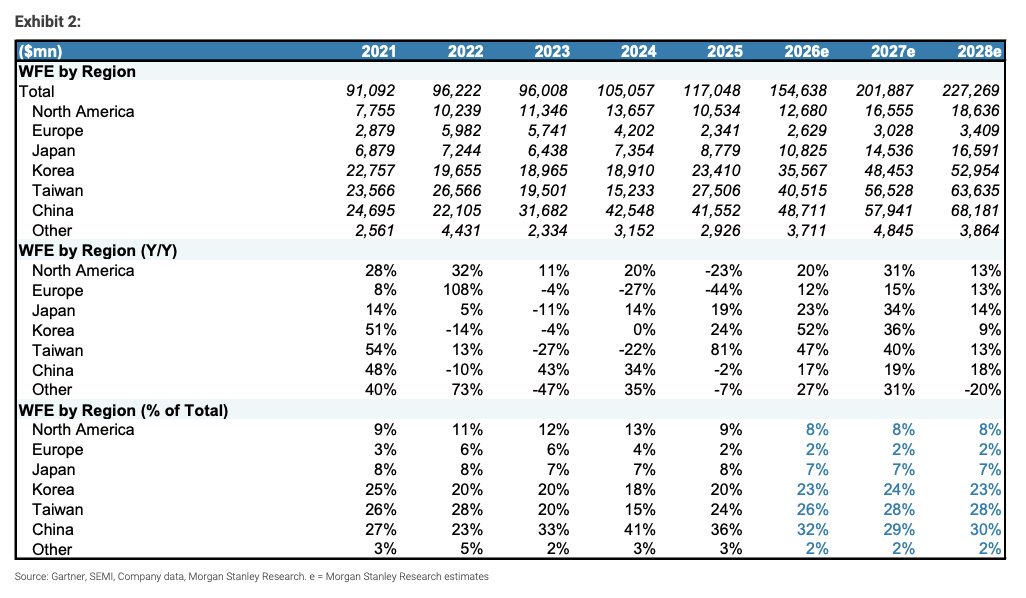
> Total WFE Acceleration: Wafer Fab Equipment (WFE) revenue is projected to grow dramatically, breaking out from $117.0bn in 2025 to $154.6bn in 2026e (+32%), $201.9bn in 2027e (+31%), and ultimately reaching $227.3bn by 2028e (+13%).> Capital Intensity Shift: WFE is consuming a much larger slice of total semiconductor industry capital expenditure. WFE as a percentage of total capex rises from 54% in 2025 to 65% by 2028e, showing that hardware and tooling complexity are outstripping physical facility costs.> Foundry/Logic Dominance: Foundry/Logic remains the absolute largest segment, growing steadily from $75.3bn in 2025 to $133.7bn by 2028e. Its growth peaks in 2027e at +28% y/y before normalizing to +17% in 2028e.> The Memory Cycle Peak (2026–2027): Memory WFE experiences an enormous surge, growing +56% in 2026e ($64.3bn) and another +35% in 2027e ($86.4bn). However, it hits a sharp deceleration wall in 2028e, growing just +7% ($92.2bn), indicating that the bulk of the capacity build-out happens in the next 24 months.> DRAM Leads the Charge: DRAM accounts for the vast majority of memory spend (70% to 76% of total memory WFE from 2024 to 2028e), growing by 56% in 2026e and 28% in 2027e, before slowing to a crawl (+3%) in 2028e.> NAND's Delayed Catch-Up: NAND spending is back-half loaded. While DRAM flattens out by 2028e (+3%), NAND continues to grow at +17% in 2028e ($28.1bn) following strong 2026e (+56%) and 2027e (+54%) cycles.> China’s Share Retrenches: China dominated global WFE market share, peaking at 41% of total global spend in 2024 ($42.5bn). While absolute dollar spending in China continues to grow through 2028e ($68.2bn), its global market share structurally drops and stabilizes at 29% to 30% between 2027e and 2028e.> The Memory Threat: They question whether the industry can digest over $110bn in combined DRAM and NAND WFE by 2028 without inducing severe bit oversupply issues.> The ASML Supply Wall: They doubt ASML can physically build and deliver the roughly 130 Extreme Ultraviolet (EUV) lithography systems required to support that kind of equipment spend.> The Next-Gen Foundry Mirage: The hyper-cycle relies on new logic players like Rapidus and TeraFab successfully contributing over $10bn in equipment spending, which remains an unproven execution risk.$Micron Tech(MU.US) $ASML(ASML.US) $Applied Materials(AMAT.US) $Lam Research(LRCX.US) $MKS $Camtek(CAMT.US) $Nova(NVMI.US) $KLA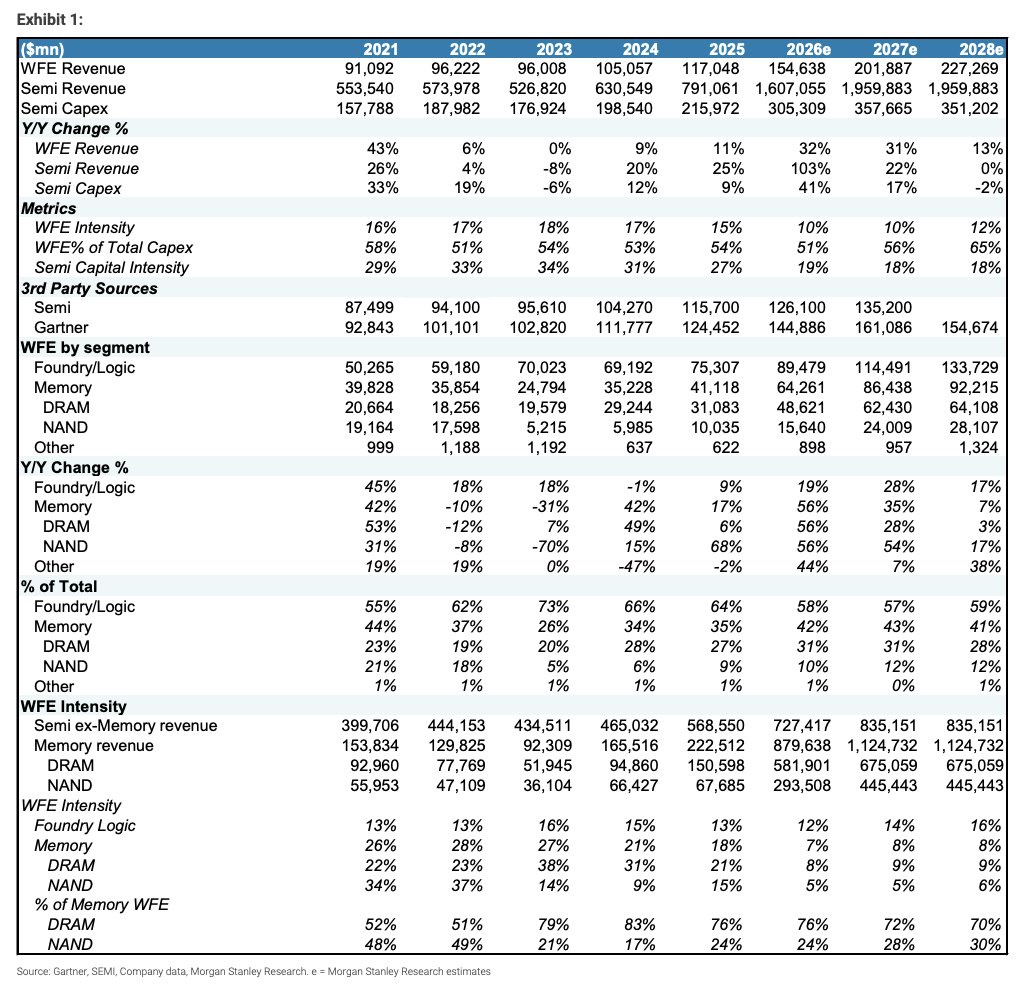
The copyright of this article belongs to the original author/organization.
The views expressed herein are solely those of the author and do not reflect the stance of the platform. The content is intended for investment reference purposes only and shall not be considered as investment advice. Please contact us if you have any questions or suggestions regarding the content services provided by the platform.
Post your comment

No Comments