



Joining hands with Nio to increase investment, can the "home appliance giant" Midea tell a good new story?

On April 10, $NIO-SW(09866.HK) founder Li Bin announced a strategic cooperation agreement with $Midea Group(000333.SZ) in his hometown Anqing.
According to the agreement, Midea and NIO will deepen cooperation in the field of automotive components and new technology R&D, jointly developing products including but not limited to air conditioning compressors, electric drives, thermal management integration, and car refrigerators.
In the industrial sector, the two parties will also collaborate in areas such as industrial robots, automotive and general industrial automation solutions, motion control systems, digital management systems, and smart logistics to promote mutual progress in intelligent manufacturing and smart transportation.
For the "home appliance giant" Midea Group, this is clearly another step forward in diversified development.
Doubling Down
In fact, this is not Midea Group's first foray into the automotive components sector. On the contrary, it has been investing in R&D in this field for over 10 years, including its presence in Anqing.
In January 2022, Anqing Welling Automotive Components Co., Ltd. was officially established, focusing on incremental components in three key areas for new energy vehicles: "thermal management, electric drives, and chassis execution systems." The company is wholly owned by Guangdong Welling Automotive Components Co., Ltd., which in turn is jointly held by Midea Group and Foshan Midea Air-Conditioning Industry Investment Co., Ltd.
The following month, the signing and groundbreaking ceremony for Welling Automotive Components' new energy vehicle components strategic base in Anqing took place. With a total investment of approximately 11 billion yuan, this project is one of Midea Group's largest investments to date.
A year later, the first phase of Welling Automotive Components' new energy vehicle components strategic base in Anqing, under Midea Industrial Technology, officially began production, showcasing "Midea speed."
On the same day Midea and NIO signed their agreement, Welling Automotive Components also announced the launch of its "next-generation 900V round-wire stator," further enriching its product lineup in the electric drive sector.
It is reported that the automation level of Welling's next-generation 900V round-wire stator production line reaches 93%, significantly improving production efficiency and product quality while featuring flexible production, traceability, and high automation.
Moreover, Midea Group has been expanding its market presence through collaborations with both established and emerging automakers such as XPeng, Li Auto, and JAC Motors.
Midea Group stated that Welling Automotive shipped 750,000 units last year, a 400% year-on-year increase. Its automotive electric compressor products now cover the full range of models from several mainstream automakers, and it has secured its first customer project for integrated thermal management modules.
NIO and Midea began collaborating as early as 2021. This further extension of their partnership will solidify their positions in the automotive components market and foster mutual development.
Significant Results from Midea's Diversified Strategy?
Before entering the automotive components sector, Midea Group had already extended its reach into the industrial robotics market.
In 2015, Midea Group's wholly-owned subsidiary MECCA began acquiring shares in Germany's KUKA. By 2021, Midea Group had fully acquired and privatized KUKA Aktiengesellschaft, a Frankfurt-listed company, through its wholly-owned subsidiary.
KUKA, a leading robotics manufacturer, is one of the "Big Four" in the global robotics industry alongside ABB, Fanuc, and Yaskawa, holding a prominent position in the field.
However, KUKA's performance began to decline sharply in 2018, even reporting a loss of over 800 million yuan in 2020, which weighed on Midea Group's overall performance.
Starting in 2021, KUKA's performance showed signs of recovery. By 2023, both its revenue and profits hit record highs, with KUKA China's revenue contribution rising from 15% in 2020 to over 22% in 2022, demonstrating particularly strong performance in China.
Clearly, Midea Group has achieved remarkable success in the industrial robotics sector. This further collaboration with NIO is another step in that direction.
Currently, the company's diversified strategy extends even further.
Data shows that Midea is a global technology group spanning five business segments: smart home appliances, new energy and industrial technology, smart building technology, robotics and automation, and other innovative businesses. It has established a balanced To C and To B business matrix, offering consumers a range of smart home products and services while providing diversified commercial and industrial solutions for enterprise clients.
In terms of overall performance, Midea Group has seen steady growth in recent years. In 2023, its operating revenue reached 372.037 billion yuan, an 8.18% year-on-year increase, with net profit attributable to shareholders rising 14.1% to 33.72 billion yuan.
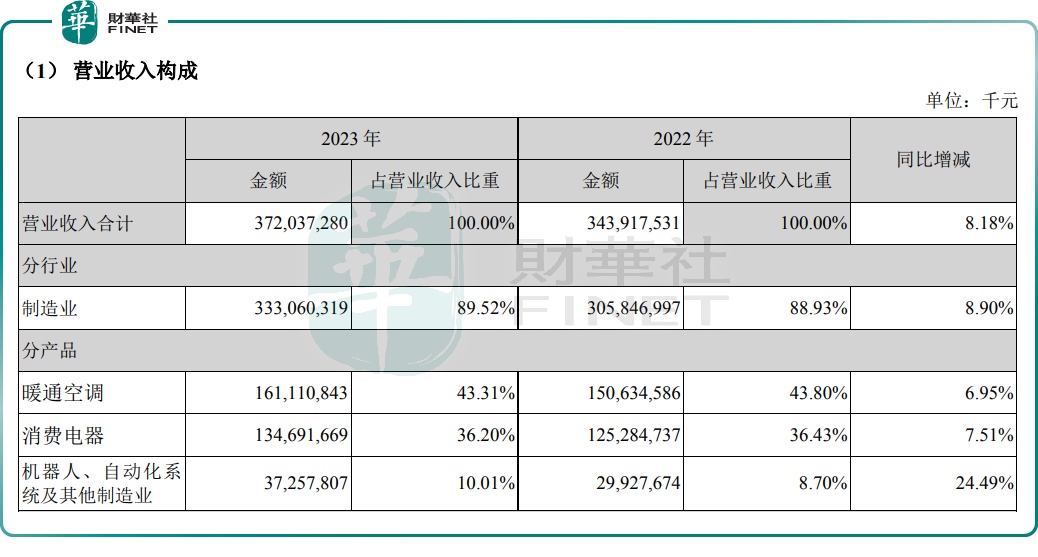
By business segment, HVAC and consumer appliances contributed the majority of revenue and profits, while robotics and automation systems, though accounting for a smaller share, were the fastest-growing businesses.
In 2023, HVAC revenue reached approximately 161.111 billion yuan, up 6.95% year-on-year, accounting for 43.31% of total revenue; consumer appliances revenue rose 7.51% to 134.692 billion yuan, making up 36.2% of total revenue; the remaining 10.01% came from robotics, automation systems, and other manufacturing, with revenue surging 24.49% to 37.258 billion yuan.
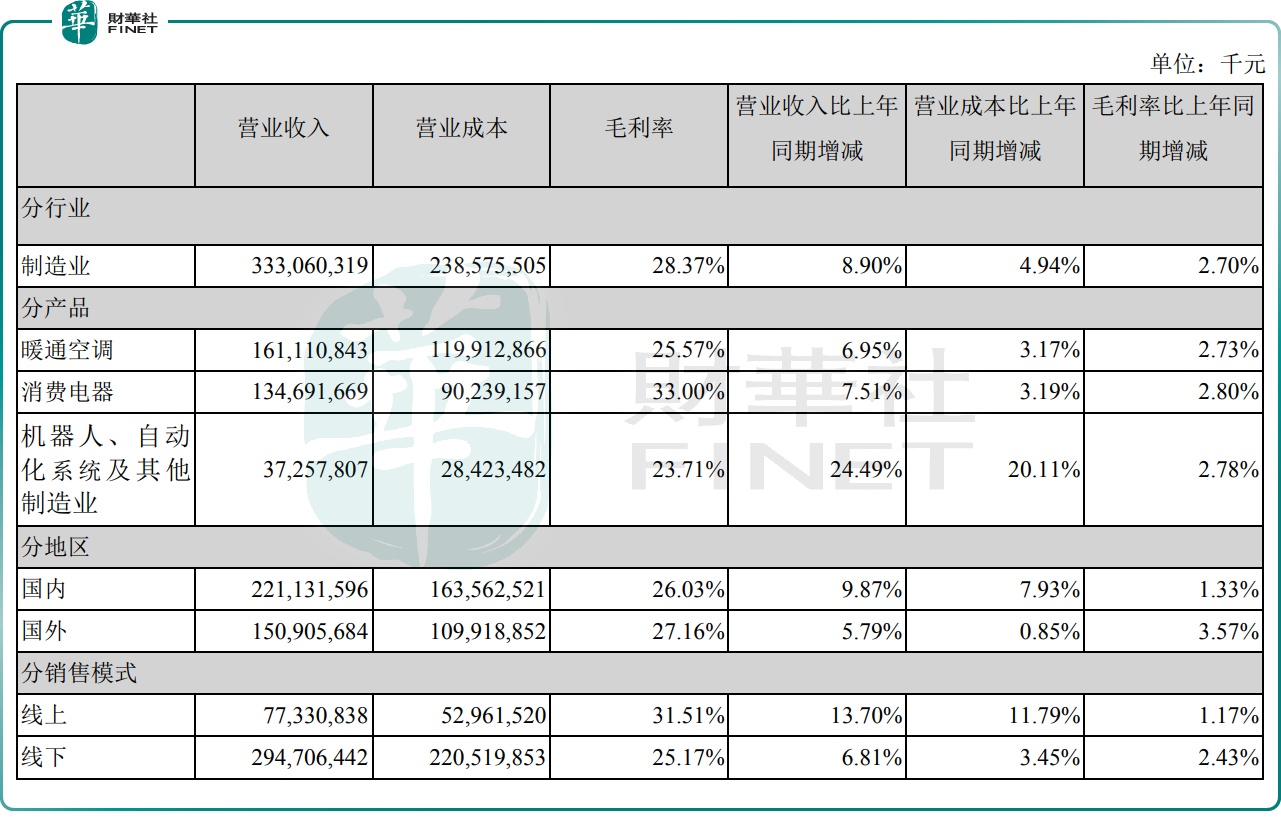
In terms of gross margin, consumer appliances led with 33%, followed by HVAC at 25.57%, and robotics, automation systems, and other manufacturing at 23.71%.
Undoubtedly, as one of the leading home appliance giants, Midea Group has demonstrated strong performance resilience. At the same time, its diversified development strategy showcases its robust capabilities and adaptability, with multiple businesses advancing in parallel, promising a bright future.
By: Hong Xiaodou
The copyright of this article belongs to the original author/organization.
The views expressed herein are solely those of the author and do not reflect the stance of the platform. The content is intended for investment reference purposes only and shall not be considered as investment advice. Please contact us if you have any questions or suggestions regarding the content services provided by the platform.
