


 Posts
PostsRunes hasn't launched yet, but the ecosystem has already become a red ocean.

Written by: Jaleel, BlockBeats
It's hard to imagine an ecosystem that hasn't even launched its mainnet yet already has nearly a billion dollars in market capitalization and over 20 infrastructure platforms.
Since the official version of the Runes protocol has not been released, there are currently no official Runes tokens in the market; many projects still exist in the form of Bitcoin NFTs. With the eventual launch of the Runes protocol, these projects are expected to be converted into official Runes through airdrops or 1:1 exchanges, thereby formally joining the Runes ecosystem.
Among them, the project with the highest market capitalization is Runestone, with a market cap of $640 million and a floor price that once surged to 0.074 BTC, surpassing BAYC to become the second-largest project in the NFT market. Additionally, early participants in Bitcoin Runes token pre-mining have already reaped substantial profits. The buyer price for RSIC on the OTC platform whales.market is mainly concentrated at 0.01u, corresponding to a total market cap of $210 million. Before the halving, early users could easily earn profits of up to $10,000.
Related reading: "Elephant Dancing": Why Runestone's Market Cap Surpassed BAYC? Unveiling Bitcoin Runes Token Pre-Mining: How Much Can Early Participants Earn?
It's no exaggeration to say that currently, no Bitcoin ecosystem protocol can match the hype of Runes. BlockBeats found that aside from pre-sale Runes mining projects like Runestone and RSIC, the biggest driver of the Runes ecosystem frenzy is undoubtedly its robust infrastructure support.
Over 20 Infrastructure Platforms Emerge
In the Bitcoin ecosystem, especially during the early "gold rush" phase, owning a Bitcoin full node often means significantly increasing profit potential—"eating meat." However, for the majority of ordinary users who only "drink soup," setting up a full node is too costly and complex, so many prefer using third-party minting platform services, which offer sufficient functionality.
During the peak of the Ordinals protocol hype, the market's minting platforms were mainly concentrated in a few like UniSat and OKX Web3 Wallet, with no more than five or six at most. According to BlockBeats' statistics and community-supplied information, nearly 20 infrastructure platforms offering minting, trading, and other services have already emerged in the Runes protocol, which hasn't even launched its mainnet yet. Among these numerous minting platforms, there are both new faces and seasoned players.
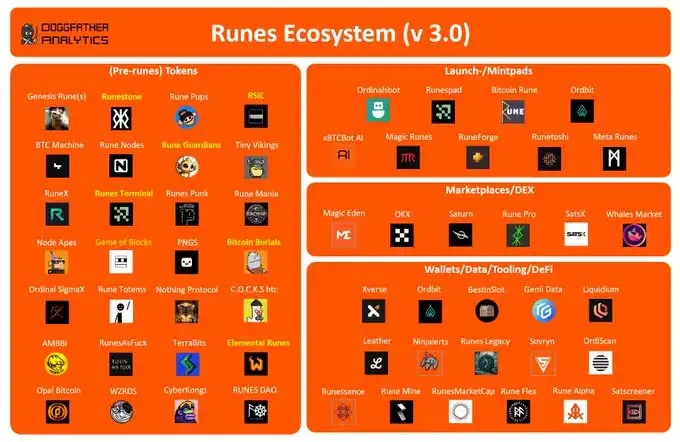
Image source: Doggfather
OKX Ready to Go, UniSat Late but Present
Since last March, the rapid development of the Bitcoin ecosystem has led to the emergence of billions of dollars in assets and the establishment of over 20 infrastructure platforms. Against this backdrop, OKX and UniSat have become key players, and their market dynamics and influence are worth discussing.
From quickly responding to market changes to implementing strategic deployments, OKX took only a week or two to decide to join the Bitcoin ecosystem. After months of preparation and accumulation, OKX has found a growth breakthrough in this new sector. As the Bitcoin ecosystem continues to heat up, OKX, with its smooth wallet product, has become the "biggest winner" in this wave of hype.
Related reading: Why Did OKX Become the Biggest Winner in BRC-20?
Currently, when people in the community mention CEX trading platforms and the Bitcoin ecosystem, the first name that comes to mind is OKX. From Ordinals to BRC20, ARC20, and now the Runes protocol, OKX's Web3 Wallet has consistently been one of the earliest platforms to offer support.
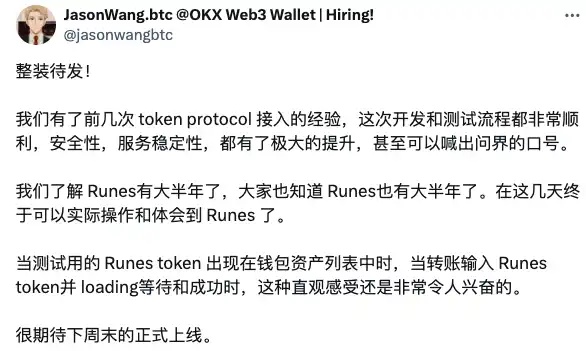
According to Jason Wang, head of OKX Web3 Wallet, as revealed on social media, the development and testing process for Runes this time has been very smooth, with significant improvements in security and service stability, leaving the entire team excited. They have been researching and preparing for Runes for over half a year, and now users can finally experience the charm of Runes firsthand.
Bitcoin ecosystem 科普博主比特里里 also told BlockBeats that during interactions with OKX Web3, she could sense their tension and excitement during the Runes development process.
On the other hand, UniSat, although one of the earliest infrastructures in the Bitcoin ecosystem, has been somewhat slow to respond to the Runes protocol. After the release of BRC-20, recalling when the Bitcoin ecosystem was just "emerging" last year, many traditional players dismissed it as a "crude imitation of ERC-20." UniSat was the first platform to integrate and adopt BRC-20 on a large scale, capturing most of the market before OKX entered.
Although the Runes protocol could have been UniSat's 主场, they arrived late, only announcing support for Runes on April 5 and planning to launch Runes inscription services and a trading market in mid-April.
It can be seen that since the beginning of this year, UniSat's focus has been on Ordinals or, more precisely, BRC20—from the Ordinals Jubilee upgrade to the development of cursed inscriptions, and most recently, the highly impactful support for 5-byte BRC20. It seems they are intentionally helping to mitigate the impact of the Runes protocol on BRC20.
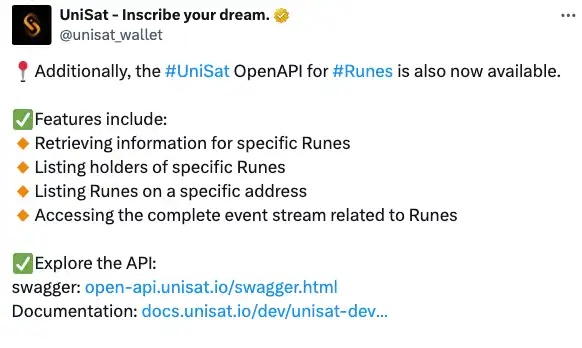
But UniSat, though late, has arrived. Currently, they have stated on social platforms that they support the Runes testnet. Additionally, the UniSat OpenAPI for Runes has been launched, offering features including: retrieving information on specific Runes; listing holders of specific Runes; listing Runes on specific addresses; and accessing the full event stream related to Runes.
Familiar Faces "Reemployed"
NFTGo was initially positioned as an NFT aggregation platform, providing market data analysis and trading functions. It is equipped with a series of powerful tools and features, including market analysis, real-time listings, rarity assessment, whale tracking, watchlists, auction calendars, and trading aggregators, helping users discover, trade, and manage NFT assets.
Founded in 2021, NFTGo is not just a one-stop NFT data analysis platform; it also offers users various NFT solutions, including data analysis, trading aggregation, and asset management, while launching data APIs and aggregator APIs. Last April, NFTGo completed a $4 million strategic financing round, receiving additional investments from Qiming Venture Partners and Hash Global, with new investors including 500 Global, Skyland Ventures, and personal investments from Liang Xinjun, co-founder of Fosun Group, and a former Binance executive.
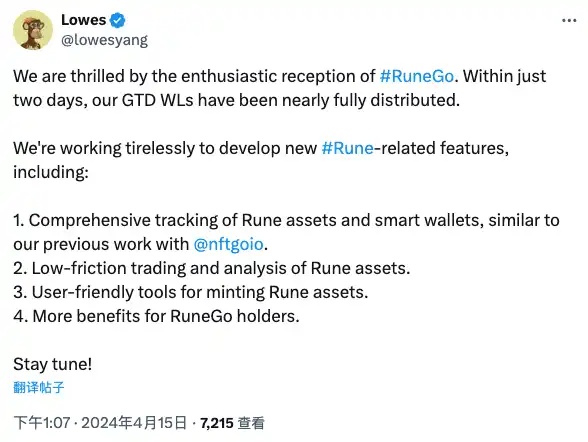
Recently, NFTGo founder Lowes announced on social media that they have not only launched the NFT project RuneGo but are also actively integrating into the Runes ecosystem, developing new features related to it. This includes comprehensive tracking of Rune assets and smart wallets, similar to the tools they previously developed for NFTGo, as well as providing low-friction trading and analysis for Rune assets, user-friendly minting tools, and more. It is reported that RuneGo holders will enjoy additional benefits.
Additionally, GeniiData is worth mentioning. This is a platform focused on cross-chain data analysis and API factories, known for its high performance, data reliability, and extensive coverage. It provides professional tools for individual data studios to discover, verify, and build Web3 solutions through blockchain analysis. For enterprises, GeniiData serves as an incubator for decentralized applications, offering access to comprehensive on-chain data APIs.
Since the rise of the Bitcoin ecosystem, few platforms have integrated Bitcoin on-chain data, and GeniiData has been relatively active in this area. BRC-20 token prices and market data can often be obtained through GeniiData, including capturing real-time minting situations for popular inscriptions and NFTs (such as Ordinals heatmaps and wallet statistics). It was also the first native inscription data platform to provide a dedicated viewing page for Merlin Chain.
As the team grew, GeniiData naturally launched minting features and more minting projects. Recently, GeniiData also completed the minting of its platform NFT project "Feeling Good." Similar to RuneGo, users holding the "Feeling Good" NFT will enjoy fee discounts in future minting processes.
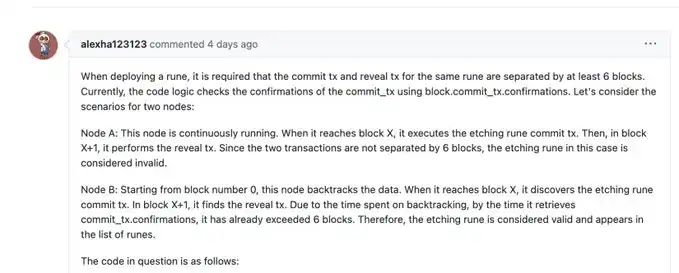
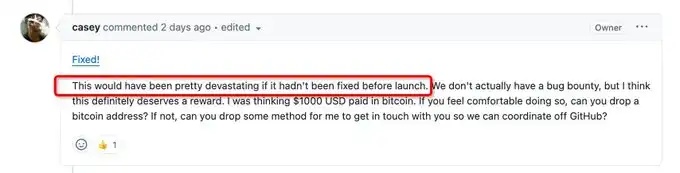
It's worth noting that, according to 比特里里's tweet, GeniiData recently reported a major bug to Casey. Regarding the severity of this bug, Casey's exact words were, "This would have been pretty devastating if it hadn't been fixed before launch."
In conversations with BlockBeats, 比特里里 also mentioned, "GeniiData has delved deeply into Runes research; they should be quite thorough in this technical field."
Bots "Not Adapting Well"
During the recent market 预热 for minting platforms, BlockBeats also noticed some new faces in the market, such as bot tools. This is the first time bots have appeared in the Bitcoin ecosystem, often used as a backup solution when minting platform websites crash.
While many are excited about bots, community acceptance is mixed, and not all members are convinced. Due to differences in transaction formats between the Bitcoin network and EVM, the possibility of code design vulnerabilities remains unverified. Some community members 直言, "Bots on Bitcoin are 伪需求," and "After the Runes mainnet launches, the likelihood of minting platform websites crashing is low."
After consulting with 比特里里, BlockBeats learned that recent NFT 抢售 incidents where websites crashed were mainly due to certain activities not requiring high gas fees. Users only needed to click to submit orders and pay minimal gas to successfully participate, a method known as "order locking." When activities are free or low-cost, many studios deploy scripts to 自动参与, leading to 瞬间的高访问量和点击流量, which can cause websites to crash.
However, in the Runes ecosystem, all orders are submitted to the mempool and sorted and confirmed based on the gas fees paid. Transactions with higher gas fees are prioritized, while those with lower fees may be delayed to subsequent blocks, similar to the 抢购 BRC-20 mechanism.
"After the mainnet launches, gas fees may be high, but even under such pressure, the primary impact will be on nodes processing and broadcasting transactions, such as memspace and quicknode. The likelihood of front-end websites crashing is very small." Based on her past experience, 比特里里 offered some 总结。
In this context, bot development in the Bitcoin ecosystem may face some obstacles, appearing "not adapting well." However, BlockBeats will continue to monitor and report on 后续发展。
The Gas War Game Is About to Begin
After 深入观察 the current market's Runes-related infrastructure, BlockBeats found that these platforms tend to offer 一站式服务。
Users in the entire Runes ecosystem can conveniently perform various operations, from minting to querying progress,统计交易金额, tracking wallets, and participating in trading markets. These features are designed to complement each other at the code level. This 一站式服务 trend not only provides users with 极大的便利 but also enhances the ecosystem's efficiency and user participation. As these infrastructures continue to improve and optimize, we expect the Runes ecosystem to attract more participants.
Additionally, observing current market dynamics, we can see that infrastructure platforms are 预热 the market by issuing NFTs to 吸引 and retain the first wave of users. These early users are not only the core target audience for future platform development, but these NFTs are also designed as special credentials symbolizing their early support and trust. This strategy not only helps build user loyalty but also provides a direct way for platforms to interact with their target audience.
Among the many minting platforms in the market, which one to choose? 比特里里 recommended some platforms she 看好 to BlockBeats: "For Layer 1, I recommend GeniiData, UniSat, iDclub, and OKX; for Layer 2, I recommend Unicross."
As for which minting platform will ultimately capture the largest market share, "The 真实铸造体验,交互, service fees, and other factors will only become clear on 减半 day when the 正式产品 is launched. Right now, we can only speculate based on past experience and 公开信息, and it's hard to say for sure," 比特里里 told BlockBeats.
After all, users' actions speak louder than words.
The copyright of this article belongs to the original author/organization.
The views expressed herein are solely those of the author and do not reflect the stance of the platform. The content is intended for investment reference purposes only and shall not be considered as investment advice. Please contact us if you have any questions or suggestions regarding the content services provided by the platform.
