


 Commemorative
 Likes Received
TSMC's 2024Q1 earnings report interpretation: Revenue returns to growth, profitability significantly improves

On Thursday, April 18, before the U.S. stock market opened, TSMC, the world's largest semiconductor foundry, released its Q1 2024 earnings report, reporting revenue of NT$592.64 billion, a 17% year-over-year increase, slightly better than the market expectation of NT$583.46 billion.$Taiwan Semiconductor(TSM.US) $NASDAQ Composite Index(.IXIC.US) $Dow Jones Industrial Average(.DJI.US) $S&P 500(.SPX.US) $Hang Seng Index(00HSI.HK) $NVIDIA(NVDA.US) $AMD(AMD.US) $Apple(AAPL.US)$Proshares UltraPro QQQ(TQQQ.US) $Invesco QQQ Trust(QQQ.US)
I. Summary of Personal Views
1. Based on Q1 performance, TSMC's recovery trend has further solidified, with a return to year-over-year revenue growth and significant improvement in profitability.
2. Although the proportion of advanced process nodes declined this quarter due to cyclical changes in the smartphone business, the continued recovery in consumer electronics and the growing demand for AI are likely to drive further gains in advanced process nodes in the future.
3. From a stock price perspective, TSMC's shares hit new highs as performance improved and demand increased. However, the stock opened lower after the earnings release, indicating market divergence over the future recovery of the sector, warranting cautious attention.
Overall, TSMC demonstrated a strong recovery trend in Q1, with year-over-year revenue growth and significant profit improvement. Despite a decline in the proportion of advanced process nodes due to cyclical smartphone business impacts, the continued recovery in consumer electronics and growing AI demand suggest future growth opportunities for advanced nodes. However, the stock's lower open post-earnings reflects market divergence over sector recovery, requiring investors to remain cautious and closely monitor market dynamics.
II. Financial Analysis: Revenue Growth Returns, Profitability Improves Significantly
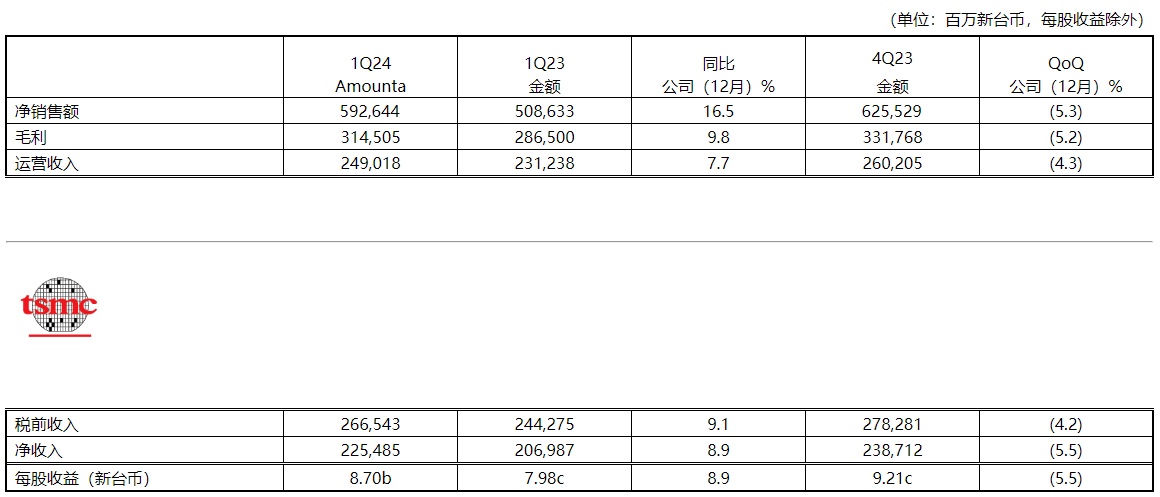
In terms of revenue, TSMC reported Q1 revenue of NT$592.64 billion, up 17% YoY, slightly exceeding the market expectation of NT$583.46 billion. TSMC's revenue growth has significantly rebounded in recent quarters, shifting from a decline last quarter to YoY growth this quarter. By segment, smartphone revenue declined, while high-performance computing (HPC) revenue continued to rise.
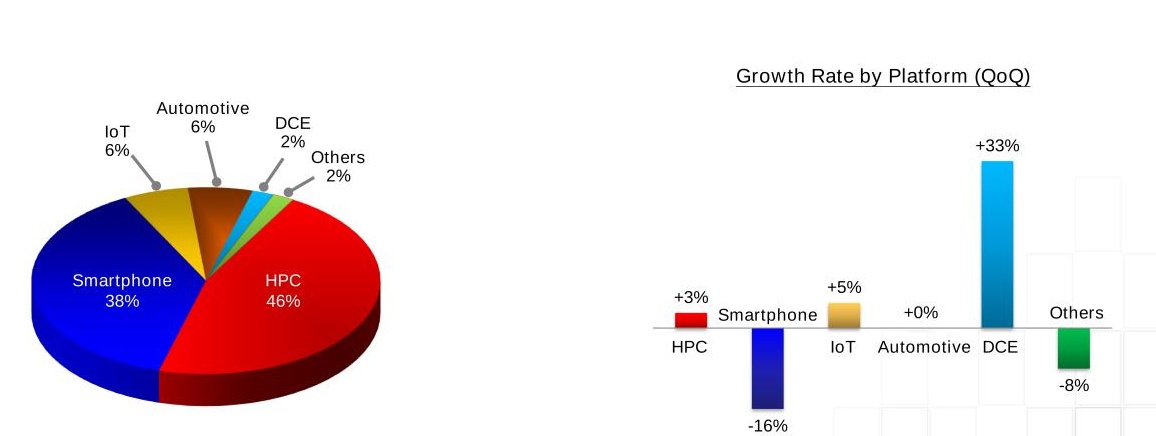
In terms of profitability, TSMC reported net income of NT$225.5 billion, up 8.9% YoY, also beating the expectation of NT$224.13 billion. Earnings per share were NT$8.7, up 8.9% YoY. Gross margin was 53.1%, down from 56.3% YoY and flat compared to last quarter's 53%, with the stagnation mainly due to high costs from 3nm capacity expansion. The proportion of 3nm revenue also declined compared to last quarter.
III. Operational Insights: 3nm Share Declines QoQ, Leading Semiconductor Sector Recovery, New Developments Under AI Demand
1. 3nm Share Declines QoQ
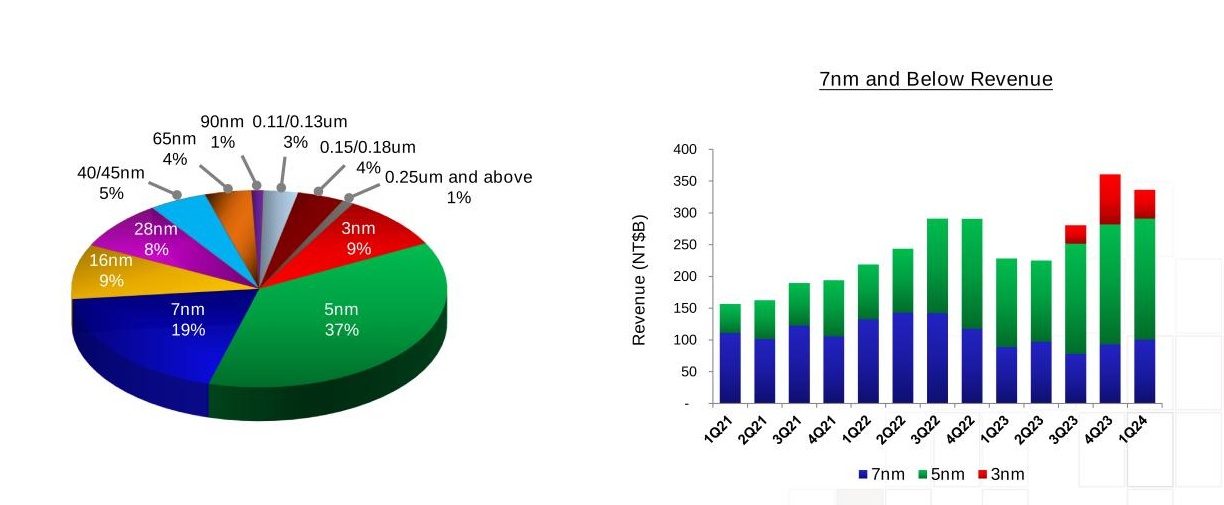
Last quarter, driven by Apple's new iPhone, TSMC's 3nm process commercialization accelerated significantly, with shipment share rising from 6% to 15%. The share of advanced nodes (7nm and below) reached 67% of total processes, a notable increase.
However, the latest earnings report shows a decline in the share of advanced nodes this quarter, primarily due to seasonal impacts on the smartphone business, which dragged down 3nm contributions. Nevertheless, TSMC remains well-positioned in the advanced chip demand market, especially as the transition to 3nm technology is expected to drive long-term growth.
However, TSMC faces risks and challenges. As the company noted, the complexity of 3nm technology and inflationary pressures mean it will take longer to achieve average margins, which warrants attention.
For TSMC, maintaining technological leadership while navigating market changes and challenges will be key to future growth. With intensifying global semiconductor competition, TSMC must stay agile in adjusting its strategy to retain its leading position.
2. Leading Semiconductor Sector Recovery
In the semiconductor industry, foundries like TSMC occupy a core upstream position. The performance of leading companies plays a significant role in driving sector recovery.
Objectively, downstream demand adjustments are a key factor affecting upstream performance. Recent earnings reports and global consumer electronics trends indicate gradual improvement in downstream conditions, with the recovery trend becoming increasingly clear and the inflection point highly certain.
Historically, the semiconductor industry is cyclical, and after a period of suppression, a recovery is now emerging. As a sector leader, TSMC's strength and position make it a focus for investors. Additionally, the smooth recovery is partly due to AI demand. The rapid development and application of AI technology have boosted demand for AI chips, further stimulating market recovery and creating more opportunities for the semiconductor industry.
3. New Developments Under AI Demand
Since early 2023, the AI boom has drawn widespread attention across industries, particularly in AI chips, where diversification is notable. Beyond NVIDIA and AMD, TSMC, as a major foundry, has also become a market focus. AI presents both unprecedented challenges and opportunities for the chip industry. As AI applications deepen, demand for high-performance chips has surged, requiring manufacturers to enhance technology, performance, and cost efficiency.
TSMC's leading 3nm technology has made it a standout in AI chip manufacturing. Meanwhile, AI is driving innovation in the chip industry, opening new markets like autonomous driving and smart home devices. These emerging applications provide broader opportunities for chipmakers, pushing them to innovate to meet diverse market needs.
This article is a personal interpretation of the earnings report, reflecting my thoughts within my capabilities. Feedback is welcome. Note that this does not constitute investment advice; readers should conduct their own analysis.
The copyright of this article belongs to the original author/organization.
The views expressed herein are solely those of the author and do not reflect the stance of the platform. The content is intended for investment reference purposes only and shall not be considered as investment advice. Please contact us if you have any questions or suggestions regarding the content services provided by the platform.
