


 Buffett Apprentice
Netflix's performance exceeded expectations, but the market saw a slight reversal.

On the evening of April 18, 2024, Beijing time, and during pre-market hours on April 18 local time, the American streaming giant Netflix released its first-quarter 2024 earnings report.
The announcement showed that Netflix achieved earnings per share (EPS) of $5.28 for the first fiscal quarter of 2024, significantly higher than analysts' expectations of $4.52. Revenue for the first quarter was $9.37 billion, exceeding market expectations of $9.26 billion. The number of paid streaming subscribers increased by 9.33 million, far surpassing analysts' expectations of 4.84 million. The total number of paid streaming members reached 269.6 million, compared to analysts' expectations of 264.52 million.
At the same time, Netflix provided its full-year outlook, forecasting free cash flow of approximately $6 billion, weaker than analysts' expectations of $6.49 billion. The company expects second-quarter EPS of $4.68, slightly higher than analysts' expectations of $4.54, and second-quarter revenue of $9.49 billion, slightly below the expected $9.51 billion.
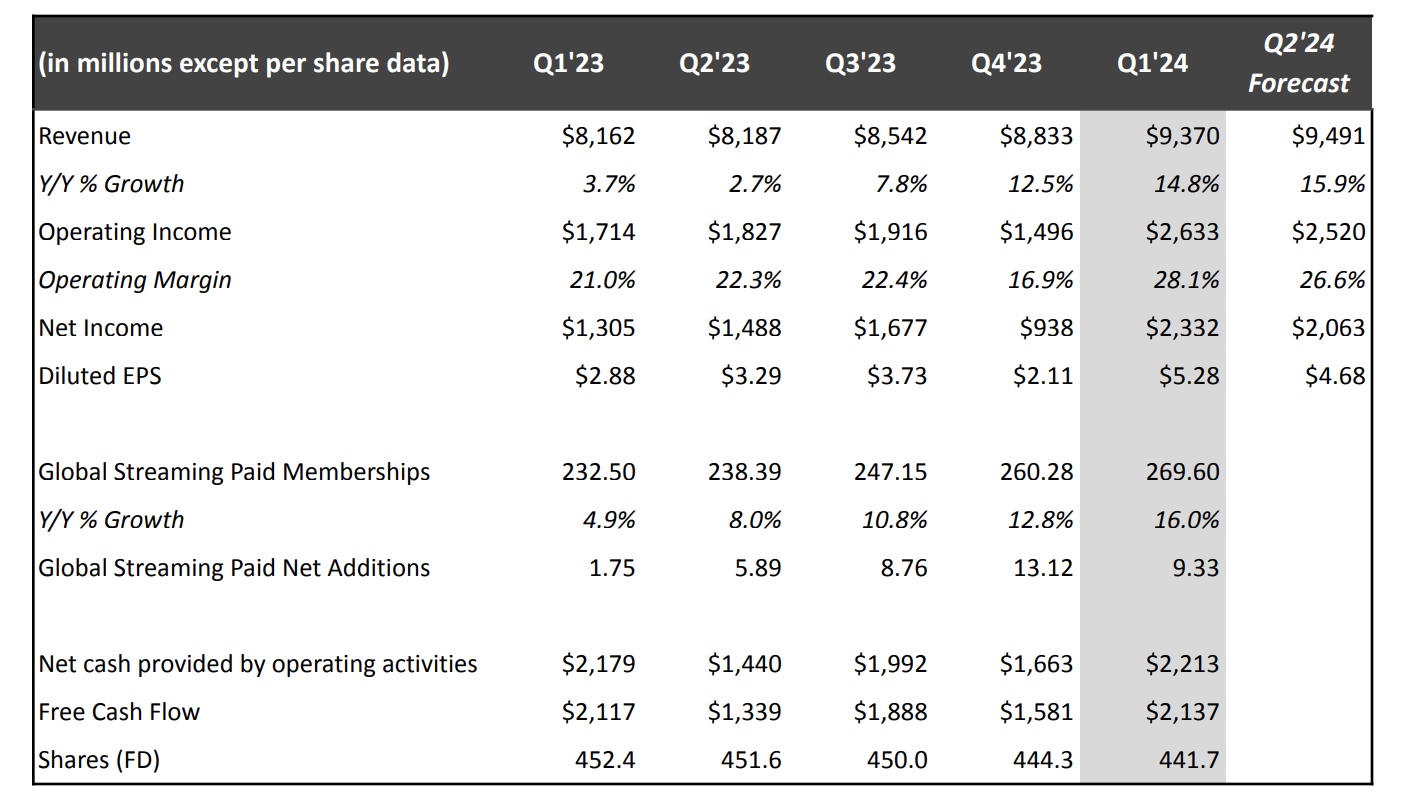
The company's performance in fiscal year 2024 has been better than previous market expectations and its own guidance.
However, it is worth noting that the company warned that "typical seasonal factors will result in lower user growth in the second quarter compared to the first quarter," implying a slowdown in the positive momentum of user growth.
During the earnings call, Netflix also clearly stated that starting from the first quarter of 2025, it will stop reporting paid membership numbers and revenue per user.
The reason for this decision is primarily Netflix's desire to shift the market's valuation model for the company. As Netflix begins to generate revenue from advertising and additional membership tiers, it hopes Wall Street will adjust its approach based on these changes in business and revenue structure.
Netflix's largest market, North America, saw paid subscriber growth of 2.53 million, far exceeding market expectations of 988,600. The Asia-Pacific region added 2.16 million users, compared to analysts' expectations of 1.48 million.
Netflix stated that nearly 270 million households in over 190 countries and regions currently subscribe to its service. With an average of more than two people per household, its audience exceeds 500 million, placing it among the top entertainment companies in the industry.
The number of members subscribing to the ad-supported plan in the first quarter increased by 65% compared to the fourth quarter of last year, maintaining the trend of nearly 70% sequential growth seen in the third and fourth quarters of last year.
The growth in membership has also benefited from the company's crackdown on shared accounts.
Two years ago, Netflix estimated that 100 million users were sharing passwords with 30 million UCAN (U.S. and Canada) users. However, starting in 2023, the company implemented measures to address this issue, including a paid sharing policy, as part of its standard mechanism to convert more entertainment value (such as movies, series, games, and live events) into revenue.
The company is iterating, testing, and improving these measures to better engage users, whether they are password borrowers, former members (rejoiners), or those who have never been members. Netflix is exploring the right calls to action, offers, and prompts to convert them at the right time. The company believes there is still room for improvement in this process and has identified opportunities to enhance value conversion mechanisms, which are expected to contribute to business growth in the coming quarters.
All these improvements are helping Netflix effectively attract more of the over 500 million smart TV households to register as members, with hundreds of millions of potential users still waiting to join.
As a platform where 70% of its content is self-produced, Netflix continues to improve the quality of its programming while controlling costs.
For content spending, Netflix remains committed to managing its cash content spending to amortization ratio at approximately 1.1x. The company will continue to focus on driving revenue growth, expanding its business, and improving profitability.
Netflix aims to increase free cash flow and believes it can manage cash content spending relative to expenses on the income statement at around 1.1x, which will lead to overall revenue growth, improved profit margins, and increased free cash flow.
Regarding the current AI boom, Netflix stated that it has been using advanced technologies like machine learning for nearly two decades. These technologies form the foundation of its recommendation system, helping the company reach the largest audience and maximize member satisfaction.
As new technologies emerge and evolve, Netflix will continue to refine these systems. The company believes it is well-positioned to be among the first to adopt and apply new methods, thanks to its developed capabilities and existing systems.
Additionally, Netflix sees opportunities to develop new tools for creators, enabling them to tell stories in more engaging ways—beneficial for creators, stories, and members alike. Presenting compelling stories through films, series, and games is highly challenging and complex, and storytellers play a unique and critical role in this process, which will not change.
However, it is worth noting that while Netflix's Q1 2024 performance and overall results were strong, the company lowered its guidance. The market is concerned that Netflix's user and revenue growth may not be sustainable, leading to significant volatility in after-hours trading despite a slight increase in the stock price at the close.
In the long term, Netflix's new business model and development strategy still require further validation.
The copyright of this article belongs to the original author/organization.
The views expressed herein are solely those of the author and do not reflect the stance of the platform. The content is intended for investment reference purposes only and shall not be considered as investment advice. Please contact us if you have any questions or suggestions regarding the content services provided by the platform.
