


 Buffett Apprentice
TSMC 24Q1: AI growth, but other clients are weak

On the evening of April 18, 2024, after ASML released a less-than-stellar earnings report, the market continued to focus on TSMC's Q1 2024 earnings report.
Pre-market, TSMC released its earnings and lowered its full-year guidance.
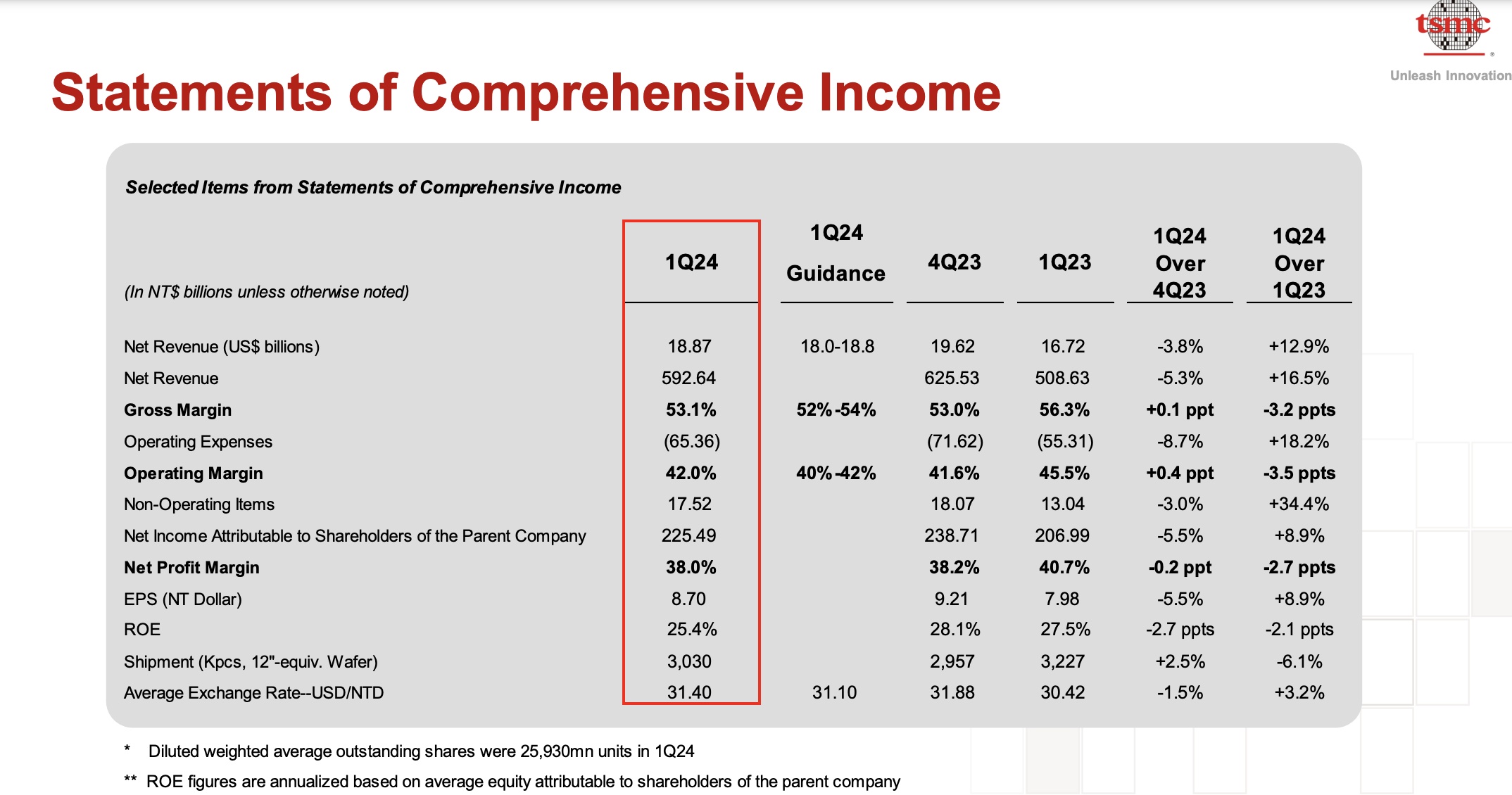
Specifically, TSMC reported Q1 2024 revenue of NT$592.64 billion, up 16.5% YoY, exceeding market expectations of NT$583.46 billion; operating profit of NT$249.02 billion, up 7.7%; net profit of NT$225.5 billion, up 8.9%, also beating expectations of NT$214.9 billion; gross margin of 53.1%, in line with the 53% consensus; capital expenditures reached $5.77 billion.
Overall, TSMC maintained solid growth in Q1 2024, surpassing market expectations across the board.
TSMC stated that by platform application: In Q1 2024, HPC (high-performance computing) revenue grew 3% QoQ, accounting for 46% of total revenue; smartphone revenue fell 16% QoQ, making up 38%. IoT grew 5% QoQ (6% of revenue), automotive was flat (6%), and DCE surged 33% (2%).
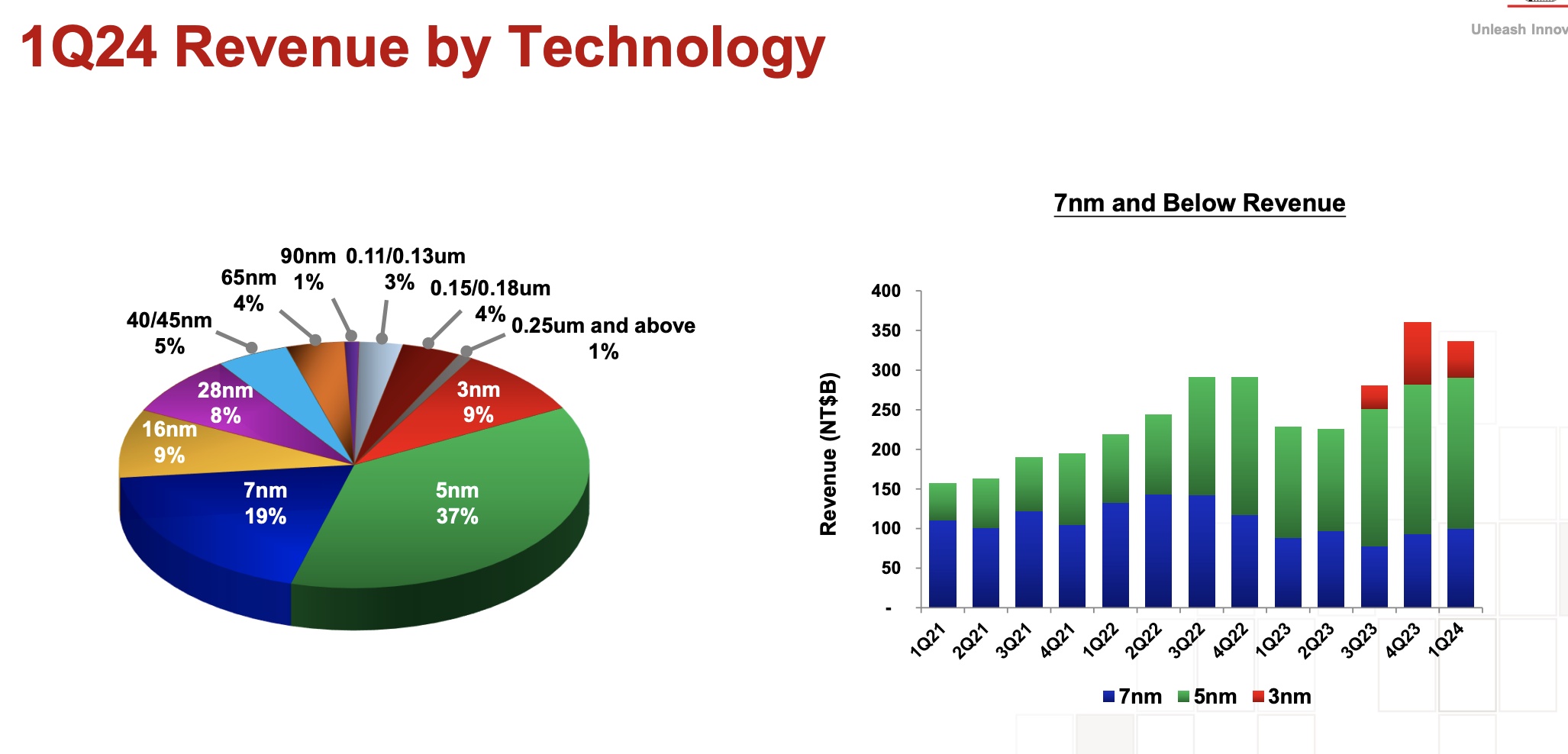
TSMC noted that 3nm process technology contributed 9% of total wafer revenue in Q1; 5nm accounted for 37%; 7nm made up 19%. Advanced technologies (defined as 7nm and below) represented 65% of total wafer revenue.
Management provided commentary on Q1 operations and gave guidance for Q2.
Q1 performance fluctuations were primarily driven by smartphone seasonality, though this was partially offset by sustained HPC demand.
TSMC's Q1 gross margin improved 0.1pp QoQ to 53.1%, mainly due to product mix changes from smartphone seasonality, partially offset by unfavorable forex. Operating expenses accounted for 11.1% of revenue, below the implied 12% guidance, thanks to stricter cost controls. Thus, Q1 operating margin rose 0.4pp QoQ to 42.0%, slightly exceeding expectations. ROE stood at 25.4%.
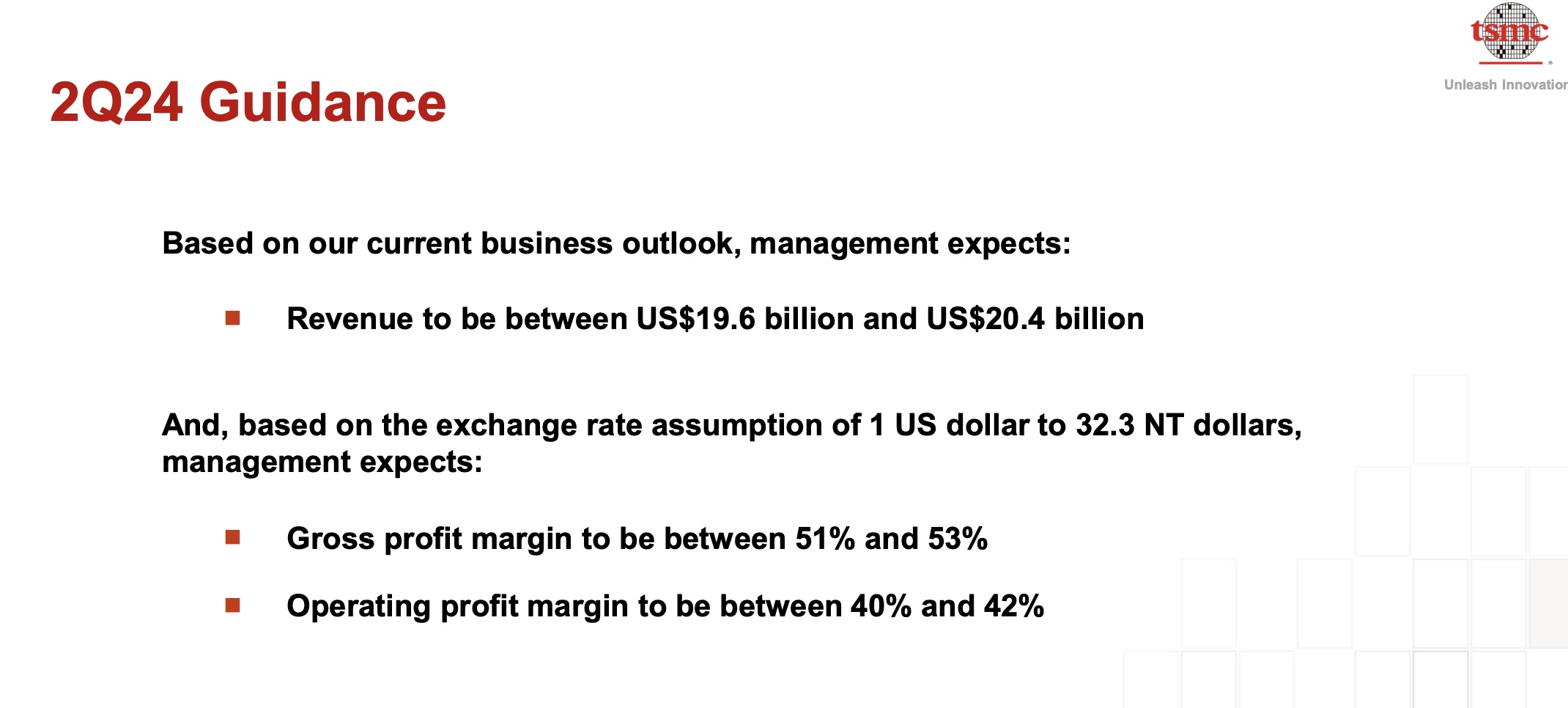
For Q2 2024, TSMC expects business to be supported by strong 3nm/5nm demand, though partially offset by smartphone seasonality. It forecasts Q2 revenue between $19.6B-$20.4B (midpoint $20B, up 6% QoQ, +27.6% YoY). Based on forex assumptions, gross margin is projected at 51%-53%, with operating margin at 40%-42%.
Additionally, Q2 will include tax on unallocated retained earnings, lifting the tax rate slightly above 19% before normalizing to 13%-14% in H2. The full-year 2024 tax rate is expected at 15%-16% (vs. 14.5% in 2023).
Regarding the April 3 Taiwan earthquake, TSMC said the impact was limited, with most lost production recoverable in Q2, resulting in minimal revenue impact.
The earthquake is estimated to reduce Q2 gross margin by ~50bps, mainly from wafer scrap and material losses.
Furthermore, Taiwan's 25% electricity price hike effective April 1, 2024 is expected to reduce Q2 gross margin by 70-80bps.
Looking ahead to H2, higher power costs will persist, reducing gross margin by 60-70bps. These costs will also indirectly increase variable expenses like materials and chemicals.
TSMC anticipates stronger H2 business, with growing 3nm revenue contribution diluting gross margin by 3-4pp (vs. 2-3pp in H1).
The company is converting some 5nm tools to support 3nm capacity, which may reduce H2 gross margin by 1-2pp.
Long-term, TSMC maintains its 53%+ gross margin target (excluding forex effects).
2024 capex is projected at $28B-$32B, with 70%-80% allocated to advanced process technologies, 10%-20% to specialty technologies, and ~10% to advanced packaging/testing/masks.
Management's outlook remains a key investor concern.
TSMC revised its 2024 semiconductor market (ex-memory) growth forecast from >10% to ~10%, and foundry industry growth from 20% to mid-to-high teens.
AI remains a bright spot: TSMC expects server AI processor revenue to more than double in 2024, reaching low-teens percentage of total revenue. Over the next 5 years, server AI processor revenue is projected to grow at a 50% CAGR, exceeding 20% by 2028.
Overall, TSMC maintains a conservative stance on 2024 electronics, with industry recovery likely slower than expected. This has heightened investor concerns about consumer electronics.
As a global foundry leader, TSMC's cautious outlook poured cold water on the "earnings rebound" narrative.
On April 18, TSMC's ADRs fell over 4%, dragging down other semiconductor stocks. On April 19, Samsung Electronics and peers also faced pressure from TSMC's report and geopolitical risks.
While blaming TSMC alone for the sector decline would be simplistic, its report undoubtedly sent chills through the market.$Taiwan Semiconductor(TSM.US)
The copyright of this article belongs to the original author/organization.
The views expressed herein are solely those of the author and do not reflect the stance of the platform. The content is intended for investment reference purposes only and shall not be considered as investment advice. Please contact us if you have any questions or suggestions regarding the content services provided by the platform.
