


 Rate Of Return
Can technical analysis identify the beginning of a downtrend in U.S. stocks? It really can. Logic Investment Market Review 240422


Key points of this article:
𝒪 Current holdings
𝒪 How to use the simplest yet most effective technical analysis to predict the major downturn in U.S. stocks
Full illustrated article: https://logicinvestmenthk.notion.site/240422-348b13313bae479799b46bcee21cc3b1?pvs=4
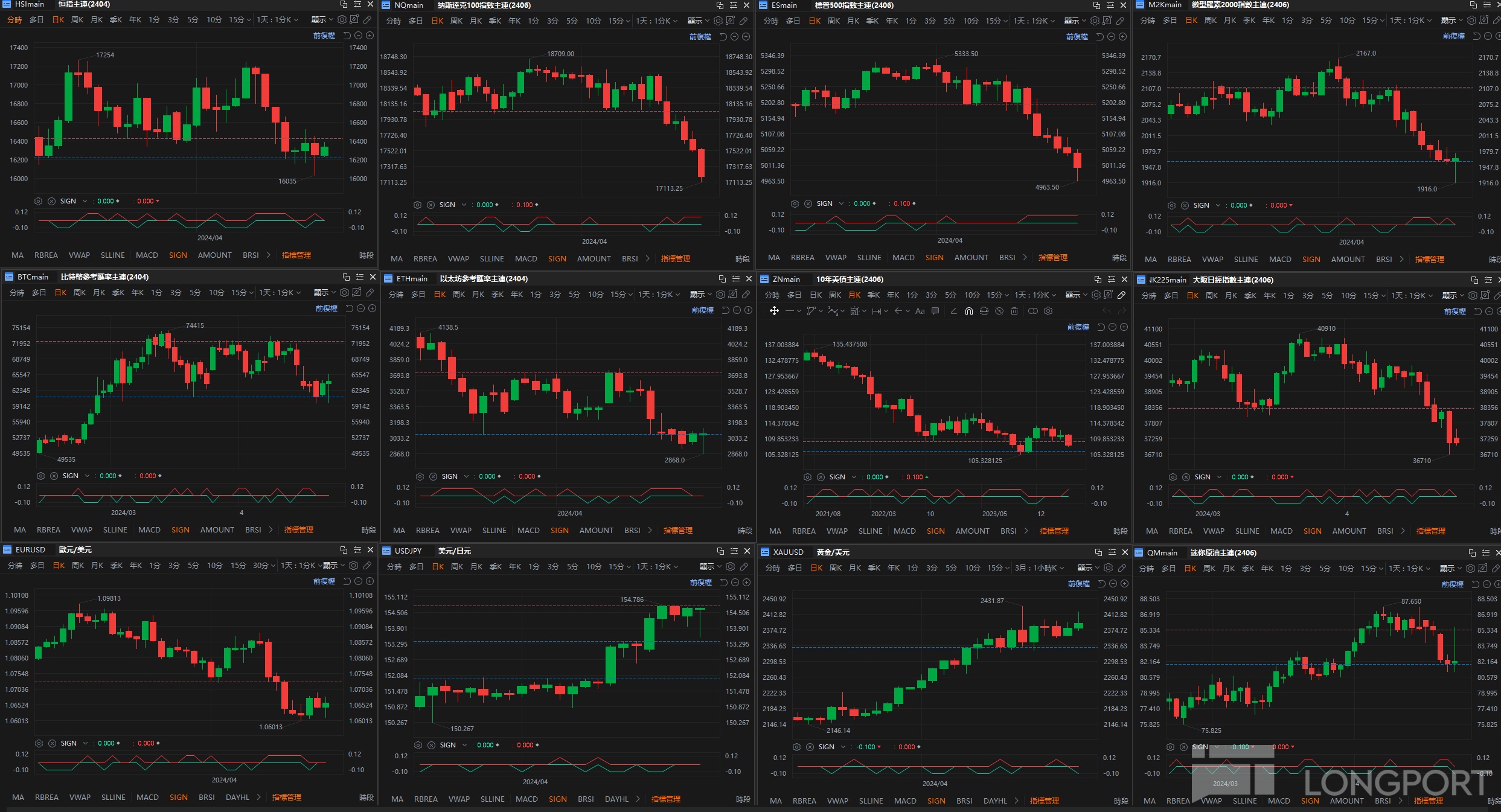
◉ Asian Markets—Hang Seng Index barely holds above 16,200, Nikkei breaks support level and explores lower
The Hang Seng Index fell first and then consolidated this week, not fully following the U.S. stock market trend.
The good news is that the support level from early March still holds, and a head-and-shoulders bottom pattern is faintly emerging.
The bad news is that the short-term trend remains weak, and the 16,400 level has turned from support to resistance after being breached.
This week, we will look for ultra-short-term long opportunities around 16,160, with 16,400 as the exit point.
The Nikkei Index has broken below its March major level, with daily and weekly charts turning bearish, but I believe this is just a pullback in a long-term uptrend.
However, compared to the sustained rise of U.S. stocks after breaking out of the consolidation range, Japanese stocks remain relatively weaker.
This week, we will continue to wait for the Nikkei's pullback, expecting it to take some time before entering the market, ideally around 33,770.
◉ U.S. Market—Continued sell-off, retail investors panic
After a long-term uptrend lasting months, U.S. stocks have begun their first significant correction.
From a fundamental perspective, the reasons are nothing more than the Fed's hawkish rhetoric and slightly disappointing corporate earnings.
After announcing on social media yesterday that we would share technical analysis knowledge for free, a friend asked if technical analysis could predict this U.S. stock downturn.
The answer is yes.
Two months ago, we mentioned the importance of the 18,040 level.
This key price level was tested as major support on March 6, March 14, April 4, and April 10.
Meanwhile, 18,470 acted as major resistance on March 12, April 4, and April 11.
These two prices formed a large daily consolidation range, and the failed breakout around March 21 clearly revealed a head-and-shoulders top pattern.
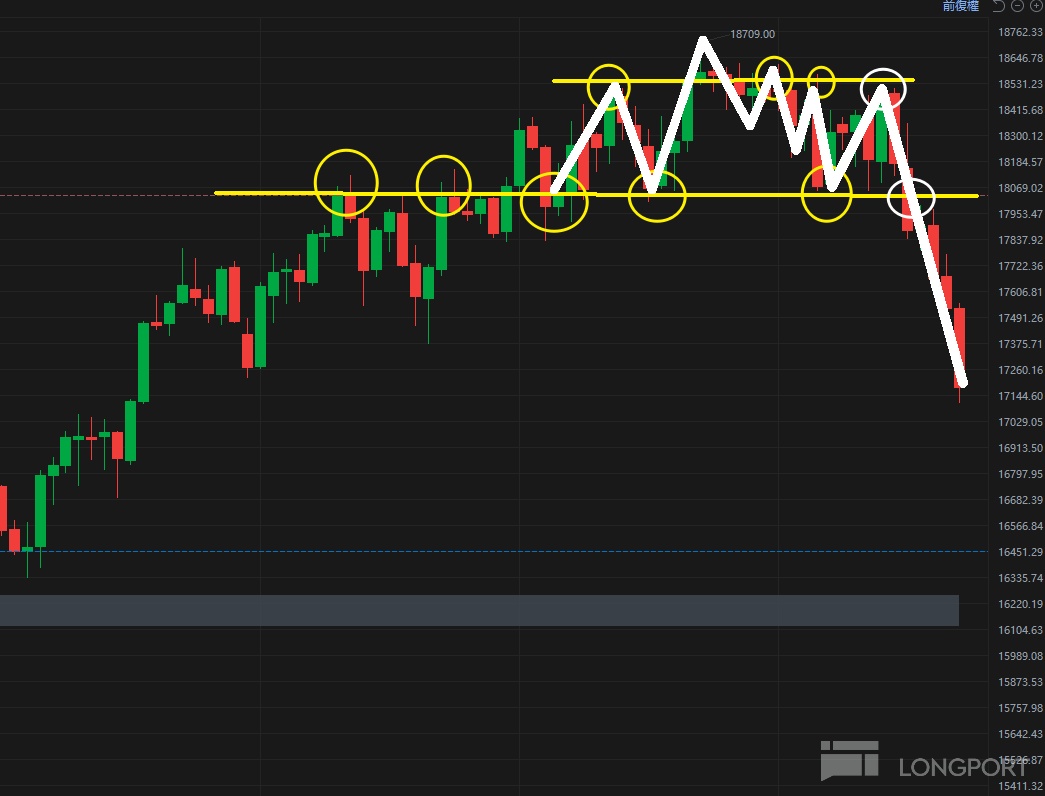
The yellow circles in the chart are all signals, while the white circles at highs and lows are where you should mentally prepare to trade.
If bearish, go short at the high white circle; if bullish, bet on the consolidation range at the low white circle—though this time it failed.
As for why we didn't short but remained cautiously neutral, it's because the long-term trend of U.S. stocks is far more bullish than bearish, making longs inherently more favorable than shorts.
As for U.S. Treasuries, since breaking below the monthly major level of $109, the trend has been very bearish.
I will wait for it to retest the $105.3 major level before considering going long.
◉ EUR/USD—Breaks below key support at 1.07
EUR/USD broke below 1.07 with a large weekly bearish candle, weakening the trend and turning 1.07 into the next focus for shorts.
For longs, watch the monthly major level around 1.0536.
◉ USD/JPY—Oscillating upward
USD/JPY's daily chart shows steady upward movement, though Friday saw a sharp lower shadow.
In other words, it briefly formed a large bearish candle intraday.
Since we entered during the April 10 breakout, such volatility won't shake us out.
Those who entered at higher levels might have been stopped out by leverage.
We maintain our view, with the first target at 160.
However, forex requires close attention to Fed and BOJ policies—weekly updates won't suffice, so follow our more frequent channels.
◉ Cryptocurrencies—Bouncing from lows
Bitcoin briefly fell below the 60,000 psychological level at the bottom of its daily consolidation range before recovering, now at the range's midpoint.
Daily charts suggest now isn't a good time to go long, as the April 2 support-turned-resistance remains effective.
Similarly, Ethereum faces heavy resistance at 3,200.
◉ Gold—Consolidating upward
Gold often experiences extreme intraday moves—sharp rallies followed by sharp drops.
After surging to 2,431 last week and pulling back sharply, most assets would enter a downtrend, but gold continues climbing slowly, with closing prices hitting new highs.
Fundamentally, Israel's recent airstrike on Iran keeps geopolitical risks alive.
However, after breaking out from 2,090 and rallying nearly two months without a pullback, much of the risk premium may already be priced in.
Daily charts show no long entry points here; if desperate to catch the last train, consider hourly charts—but beware of a reversal.
◉ Crude Oil—Falling back to previous consolidation range
Oil prices plunged to the March 18 range, then spiked on Friday but closed with a long upper shadow, indicating extreme short-term weakness.
We considered adding around 82, but current technicals are too unfavorable for bulls.
Our crude oil ETF SBO has a cost basis of $15.37. If it falls to this level, we'll exit flat.
This article does not constitute investment advice, nor is it an offer, solicitation, or recommendation for any investment product.
The copyright of this article belongs to the original author/organization.
The views expressed herein are solely those of the author and do not reflect the stance of the platform. The content is intended for investment reference purposes only and shall not be considered as investment advice. Please contact us if you have any questions or suggestions regarding the content services provided by the platform.
