



Is Meta testing investors' bottom line?


Competitor TikTok faces unfair treatment in the U.S., while the stock price of Facebook's parent company $Meta Platforms(META.US) fell instead of rising. After announcing its Q1 2024 results, Meta's stock price dropped over 15% in after-hours trading, as shown below.
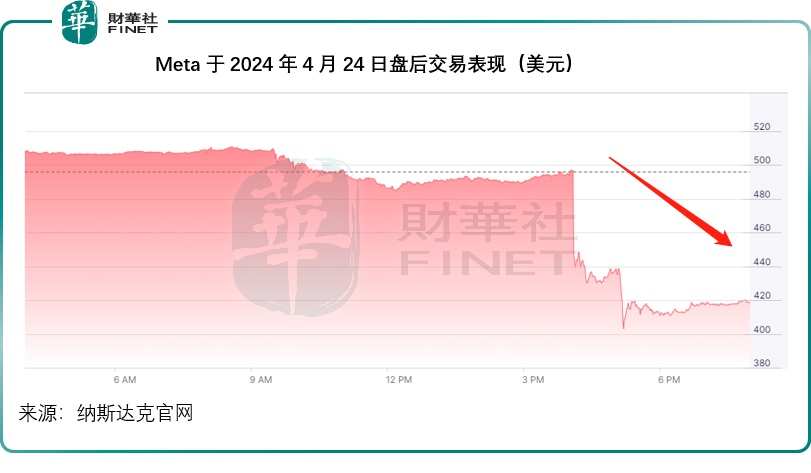
Recently, Meta's stock price hit a new high following Wall Street's AI frenzy, but the post-earnings decline may be due to profit-taking.
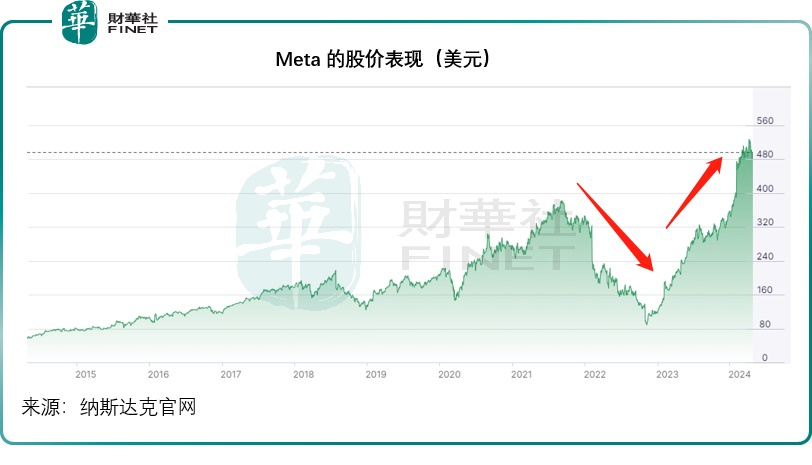
As shown below, Meta's previous peak occurred during the 2021 U.S. stock market high. However, starting in 2022 when the Federal Reserve began raising interest rates, the stock price began to decline. Of course, Meta's own issues also played a role: after reporting strong 2021 results, Meta's 2022 guidance showed a significant slowdown in the growth of its core social media advertising revenue, while losses in its ambitious metaverse business continued to expand. This led to subsequent restructuring and layoffs at Meta, with the profitability improvements from these measures gradually reflected in its 2023 and Q1 2024 results.
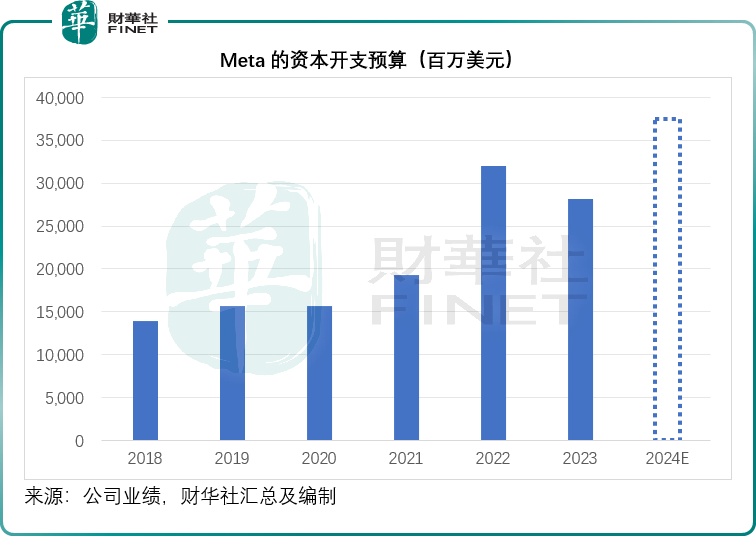
However, Caihua News believes that a key reason for Meta's stock price collapse after announcing Q1 2024 results was higher-than-expected capital expenditure budgets. Meta expects full-year 2024 capital expenditures to range between $35-40 billion, up from its previous forecast of $30-37 billion and significantly higher than its 2023 capital expenditures of $28.103 billion.
Q1 2024 Net Profit More Than Doubles
In fact, Meta's Q1 2024 results were not bad.
During the period, Meta's revenue grew 27.26% year-over-year to $36.455 billion; operating profit rose 91.20% to $13.818 billion; and net profit attributable to shareholders surged 116.66% to $12.369 billion.
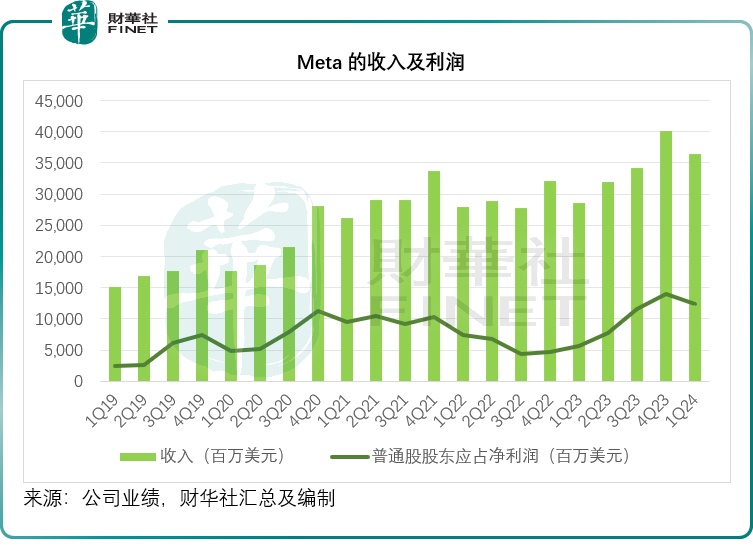
On the cost side, total quarterly expenses were $22.637 billion, up 5.69% year-over-year. Of this, cost of revenue increased 8.71%, partially offset by inventory-related valuation adjustments in the Reality Labs segment; R&D expenses rose 6.36%, mainly due to lower restructuring costs partially offsetting higher employee-related and infrastructure costs; and marketing and sales expenses fell 15.77%, primarily due to lower restructuring costs, professional services, and marketing spend.
Thanks to strong revenue growth and cost optimization, Meta's operating margin improved by 12.67 percentage points year-over-year to 37.90% in Q1 2024.
In Q1 2024, capital expenditures were $6.7 billion, including principal payments on lease obligations, mainly for investments in servers, data centers, and network infrastructure; free cash flow was $12.5 billion.
During the period, Meta repurchased $14.6 billion of Class A common stock and paid $1.3 billion in dividends to shareholders. As of March 2024, total cash and marketable securities stood at $58.1 billion, with debt at $18.4 billion.
Reality Labs Losses Widen Further
Meta's revenue growth continues to rely heavily on social media advertising. In Q1 2024, the daily active people (DAP) for Meta's family of apps reached 3.24 billion, up 7.28% year-over-year and 1.57% quarter-over-quarter; average revenue per user was $11.20, up 18.27% year-over-year but down 9.16% quarter-over-quarter.
In Q1, total revenue for Meta's apps grew 27.23% year-over-year to $36.015 billion, with advertising revenue up 26.81% to $35.635 billion. Management disclosed that within advertising revenue, the online commerce vertical contributed the most growth, followed by gaming and entertainment, and media.
By region, advertising revenue growth was strongest in Rest of World and Europe, at 40% and 33% respectively, with Asia Pacific up 25% and North America up 22%.
During the period, Meta continued to invest heavily in the development and operation of its apps. In Q1, app-related expenses totaled $18.4 billion, accounting for about 81% of total expenses, up 7% mainly due to higher legal and infrastructure costs, partially offset by lower restructuring expenses.
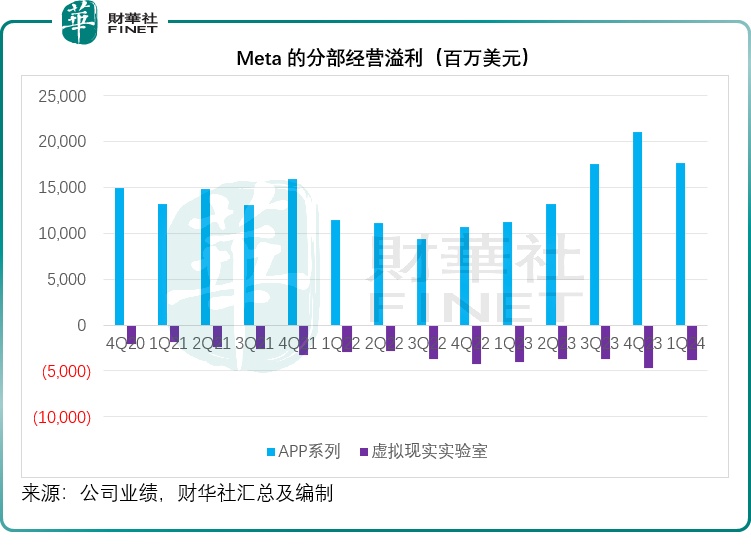
In Q1, operating profit for the apps segment was $17.664 billion, with an operating margin of 49.05%, up 9.41 percentage points year-over-year but down 4.82% quarter-over-quarter.
Revenue for the Reality Labs segment in Q1 was $440 million, up 29.79% year-over-year, driven by Quest headset sales. The segment's expenses were $4.3 billion, down 1% year-over-year—nearly ten times its revenue—mainly due to inventory-related valuation adjustments and restructuring costs offsetting higher employee-related expenses. Reality Labs reported an operating loss of $3.846 billion.
As shown below, the apps segment (primarily advertising revenue) is solely responsible for absorbing the losses from Reality Labs (i.e., the metaverse business).
Future Focus on AI
During the earnings call, Zuckerberg focused heavily on AI.
He stated that Meta is building multiple AI services, from Meta AI (an AI assistant users can query across Meta's apps and glasses), to creator AI (helping creators manage communities and engage with fans), to business AI (tools for businesses on its platforms to assist with shopping and customer support), to internal programming and development AI, to hardware products like glasses that let users interact with AI.
Last week, Meta released a new version of Meta AI powered by its latest model, Llama 3, with the goal of making Meta AI one of the world's leading AI services in quality and usage. Currently, Meta AI is progressing well, with tens of millions of users having tried it and providing positive feedback. Meta has begun rolling out Meta AI in some English-speaking countries and plans to add more languages in the coming months.
Zuckerberg said Meta will invest heavily over the next few years to build more advanced models and the world's largest-scale AI services. As AI capital and energy expenditures scale, efficiencies in Meta's other businesses will continue to improve. He noted that while significant resources will focus on AI, Meta will also invest broadly to drive revenue from these new products.
Meta has been adding new products that are not yet monetized, contributing to significant stock price volatility. He expects Meta to undergo a multi-year investment cycle before achieving full scale with Meta AI, business AI, and others. Although progress is smooth, building leading AI will be much more challenging than other products and may take several years.
On the bright side, once new AI services scale, Meta will be able to monetize them effectively.
He sees several ways to commercialize at scale: expanding business messaging, introducing ads or paid content in AI interactions, and having people pay to use larger AI models and computing power. Most importantly, he believes AI can increase engagement with its apps, thereby boosting ad revenue.
He revealed that about 30% of posts on Facebook's News Feed are now recommended by its AI system, up from less than half that a few years ago. On Instagram, over half of content is AI-recommended. AI has significantly contributed to Meta's ability to show users more relevant ads and create value for advertisers, with related revenue streams more than doubling from last year.
Additionally, Meta's training and inference accelerator chips will power its recommendation-related workloads. As this project matures over the next few years, Meta plans to apply it to other workloads.
He emphasized that while increasing these investments, Meta will continue to carefully manage headcount growth and other operating expenses.
Beyond AI, he noted that Meta's long-term focus also includes the metaverse. He believes glasses are the ideal device for AI assistants because they allow the AI to see and hear what you do, providing ample context. Meta's recently launched glasses with Meta AI are a prime example—you can ask questions about what you're seeing.
On the apps front, Zuckerberg highlighted short-form video as a continued bright spot. This month, Meta launched an upgraded full-screen video player on Facebook, integrating Reels, long-form videos, and live content into a unified recommendation system. On Instagram, Reels and video continue to boost engagement, with Reels now accounting for 50% of time spent on the app. If TikTok exits the U.S., Meta could be the biggest beneficiary. Threads is also growing well, now with 150 million monthly active users.
Capital Expenditure Budget Exceeds Expectations
Meta CFO Susan Li identified two key drivers of Meta's overall revenue growth: the ability to increase community engagement and the effectiveness of monetizing that engagement.
Currently, the company is pleased with engagement trends, with strong momentum across products, and will continue increasing investments in advanced recommendation systems to further boost platform usage time and stickiness.
Additionally, Meta's short-form video business continues to grow, now accounting for over 60% of user time spent on Facebook and Instagram. Reels remains a primary growth driver, and Meta remains committed to integrating Reels, long-form video, and live content into Facebook.
She noted that in April, the company launched this integrated video experience in the U.S. and Canada first. Meta is also further integrating generative AI into its apps in the U.S. and over a dozen other countries. Beyond using Meta AI in chat interfaces, users will soon be able to access it in app searches, Facebook News Feed, and Groups. Threads is also progressing well, with Meta continuing to roll out valuable features and expand the community.
As for the second revenue growth driver—improving monetization efficiency—there are two aspects: optimizing the ad experience for users (e.g., understanding preferences to better time, place, and target ads) and enhancing marketing performance (improving ad models and giving advertisers more autonomy).
Based on these factors, Meta expects 2024 total revenue between $36.5-39 billion (including a 1% forex headwind). Total 2024 expenses will be $96-99 billion, up from prior guidance of $94-99 billion, mainly due to higher infrastructure and legal costs. The CFO expects Reality Labs' operating losses to increase significantly year-over-year as Meta continues product development and ecosystem expansion.
Meta anticipates full-year 2024 capital expenditures of $35-40 billion, above prior guidance of $30-37 billion, as it accelerates infrastructure investments to support AI development. Capital expenditures are expected to continue rising beyond 2024 to support AI research and product development.
As shown below, 2024's capital expenditure budget is significantly higher than in previous years. Given management's expectation that Reality Labs will continue posting heavy losses, market concerns about Meta's increased spending without turning around the loss-making business are the main drag on its post-earnings stock decline.
In response to analyst questions, the CFO noted that the 2024 budget increase was mainly due to higher Q1 legal expenses, with uncertainty about future costs, and higher depreciation from increased capital expenditures. She expects capital expenditures to rise further in the remainder of 2024, primarily for servers and data centers.
Conclusion
Overall, Meta's Q1 2024 results exceeded expectations, but the company's higher-than-expected capital expenditure budget and early signaling of continued Reality Labs losses disappointed the market.
As seen in Meta's stock chart, the company already suffered a sharp drop in 2022 due to weak ad revenue. After recovering and reaching new highs thanks to ad business revival and restructuring benefits, Meta's latest unwelcome news may test investor confidence or reflect market concerns about sustainable growth prospects.
Meta's family app daily active user numbers suggest limited room for further growth in social platform users. To increase revenue per user, Meta must optimize experience and costs to sustain growth in its social platform business. Traditional methods like adding services to boost engagement offer limited potential. This explains Meta's heavy emphasis on AI: optimizing cost structures and revenue efficiency while unlocking infinite service possibilities and greater potential value through AI. Thus, Meta won't abandon AI and will invest heavily in it. Understanding this makes Meta's development plans clear.
Author: Mao Ting
The copyright of this article belongs to the original author/organization.
The views expressed herein are solely those of the author and do not reflect the stance of the platform. The content is intended for investment reference purposes only and shall not be considered as investment advice. Please contact us if you have any questions or suggestions regarding the content services provided by the platform.
